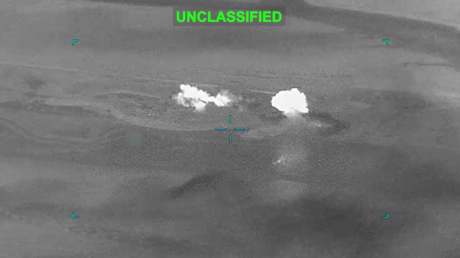
The United States military has resumed direct kinetic strikes against Iranian-backed assets following a series of sophisticated drone and fast-attack craft engagements targeting commercial shipping vessels in the Strait of Hormuz. This shift in posture reflects an acknowledgment that passive maritime policing has failed to secure the global energy bottleneck. The immediate objective is clear: re-establish a credible deterrent to prevent a total shutdown of a maritime corridor that carries roughly 20 percent of the world’s petroleum supply. However, the underlying strategic architecture suggests these strikes are treating the symptoms of a much deeper, structural vulnerability in global trade networks rather than addressing the core drivers of regional instability.
For months, the policy in Washington relied on defensive interception. Naval destroyers expended millions of dollars per engagement to shoot down cheap, mass-produced loitering munitions. That calculus has broken down completely. The economic asymmetry of utilizing multi-million-dollar air defense missiles to counter five-figure drones created an unsustainable burn rate for Western forces. By transitioning back to offensive strikes against launch sites, command hubs, and drone storage facilities inside the region, the administration is attempting to shift the financial and material burden back onto Tehran.
Yet, the intelligence communities in both Washington and Brussels know this is a game of diminishing returns. The infrastructure supporting these maritime disruptions is not comprised of sprawling, easily targeted conventional military bases. Instead, it is highly decentralized, mobile, and deeply integrated into civilian or sovereign coastlines.
The Failed Math of Asymmetric Deterrence
The assumption that tactical airstrikes can enforce permanent quiet in the shipping lanes misjudges the nature of modern asymmetric warfare. For decades, traditional deterrence relied on the threat of overwhelming conventional force. If a state actor disrupted global trade, they faced the destruction of their formal naval fleet. Today, the threat has been thoroughly atomized.
The groups executing these disruptions operate with a degree of deniability that complicates traditional military messaging. When a commercial tanker is struck by an uncrewed aerial vehicle, the fingerprints point toward Iranian manufacturing, but the actual launch sequence is often carried out by proxy networks or covert units operating from unmarked skiffs. This deliberate ambiguity blunts the impact of a standard retaliatory strike. A bomb dropped on an empty warehouse in a desert facility does little to deter a decentralized cell equipped with mobile, truck-mounted launch rails that can be repositioned within minutes.
Furthermore, the economic equation remains heavily tilted in favor of the disruptors. A standard Arleigh Burke-class destroyer relies on Standard Missile-2 or ESSM interceptors to protect commercial traffic. Each engagement drains a finite inventory of vertical launch system cells that cannot be easily replenished while at sea. The manufacturing pipeline for these advanced Western defense systems is measured in years, while the assembly line for composite-wing attack drones is measured in days. The Pentagon is fundamentally burning through high-end inventory to counter low-end tech. This reality is not lost on regional adversaries, who view every intercepted drone not as a failure, but as a successful drain on Western military readiness and capital.
The Shadow Shipping Fleet Capitalizing on Chaos
While major international shipping conglomerates redirect their vessels around the Cape of Good Hope, a massive ecosystem of unregulated maritime commerce is thriving in the gaps left behind. This shadow fleet, often utilizing flags of convenience and opaque corporate structures, has adapted to the elevated risk environment with remarkable speed.
Standard maritime insurance providers have drastically increased war-risk premiums for transit through the Persian Gulf and the Gulf of Oman. For a standard Suezmax tanker, these premiums can add hundreds of thousands of dollars to a single voyage. Blue-chip maritime corporations cannot justify these costs to their shareholders, nor can they risk the safety of their crews. They opt for the longer, costlier route around Africa, which adds up to two weeks to transit times and drives up global freight rates.
Shipping Route Comparison (Persian Gulf to Rotterdam)
+-------------------------+-----------------+-----------------+
| Route                   | Transit Time    | Relative Cost   |
+-------------------------+-----------------+-----------------+
| Via Suez Canal / Hormuz | 14–20 Days      | Baseline        |
| Via Cape of Good Hope   | 30–35 Days      | +35% to +50%    |
+-------------------------+-----------------+-----------------+
Conversely, operators willing to fly under the radar are filling the vacuum. These vessels frequently disable their Automatic Identification System transponders, engage in ship-to-ship transfers in international waters, and utilize state-backed insurance pools from countries unaffected by Western sanctions regimes. By operating outside the standard regulatory framework, this parallel maritime economy ensures that certain energy flows remain entirely uninterrupted. The strikes conducted by US forces do little to deter these shadow operators. If anything, the heightened state of conflict cements their market share by driving out legitimate, law-abiding competitors who refuse to navigate a live combat zone.
Washington Corporate Dilemma Over Insurance and Energy
The economic ripples of the renewed kinetic campaign extend far beyond the immediate waters of the Middle East. Inside corporate boardrooms in New York, London, and Tokyo, the resumption of US strikes signals that the crisis is entering a prolonged, chronic phase rather than moving toward a diplomatic resolution.
This presents a severe challenge for global energy markets. While global oil prices have historically spiked during previous flare-ups in the region, the current market response has been more volatile and harder to predict. The insulation provided by domestic US shale production has partially shielded Western consumers from immediate price shocks at the pump, but it has not insulated the global financial system from the compounding costs of disrupted logistics. Supply chains are finely tuned mechanisms that operate on just-in-time delivery models. When the reliability of those models is compromised, companies are forced to hold larger inventories, which ties up capital and drives up the final cost of goods across the board.
"The true measure of risk in the maritime sector is no longer the physical loss of a vessel, but the systemic uninsurability of entire trade lanes."
Major underwriting syndicates are quietly re-evaluating their long-term exposure to the region. If the US military operations fail to suppress the attacks quickly, underwriters may designate the entire region as an excluded zone. Such a move would effectively halt all legal commercial shipping through the strait, forcing governments to consider drastic measures, including the implementation of military convoys to physically escort commercial tankers. Convoys, however, are an immense drain on naval resources and force a rigid, slow-moving pace on global commerce that the modern economy is ill-equipped to handle.
The Governance Collapse in Maritime Chokepoints
The crisis in the Strait of Hormuz cannot be viewed in isolation from other vital maritime chokepoints around the globe. From the Bab el-Mandeb to the South China Sea, the international legal framework governing freedom of navigation is undergoing a profound erosion. For three generations, the global economy functioned on the assumption that international waters were a shared commons, protected by implicit consensus and enforced primarily by the United States Navy. That consensus has evaporated.
Regional powers and non-state factions have realized that international shipping is the ultimate leverage point against the globalized West. By threatening the flow of goods and energy, small actors can force superpower engagement, dictate terms, and exact heavy economic tolls without ever having to win a conventional battle. The resumption of strikes by the US is an attempt to enforce the old rules of the road by sheer kinetic output. But a rules-based order cannot be sustained by Tomahawk missiles alone when the underlying political willpower to enforce long-term stability is fractured.
The strategic reality is that the tools currently being deployed are designed for a twentieth-century model of state-on-state conflict. They are poorly suited for a fragmented security environment where the adversary does not wear a uniform, does not fly a traditional national flag, and views kinetic retaliation as a form of validation. As long as the production pipelines for autonomous weapons remain active and the financial rewards for sanctions evasion remain high, the strikes will serve merely as a holding action, delaying a fundamental reckoning over who truly controls the arteries of global trade.