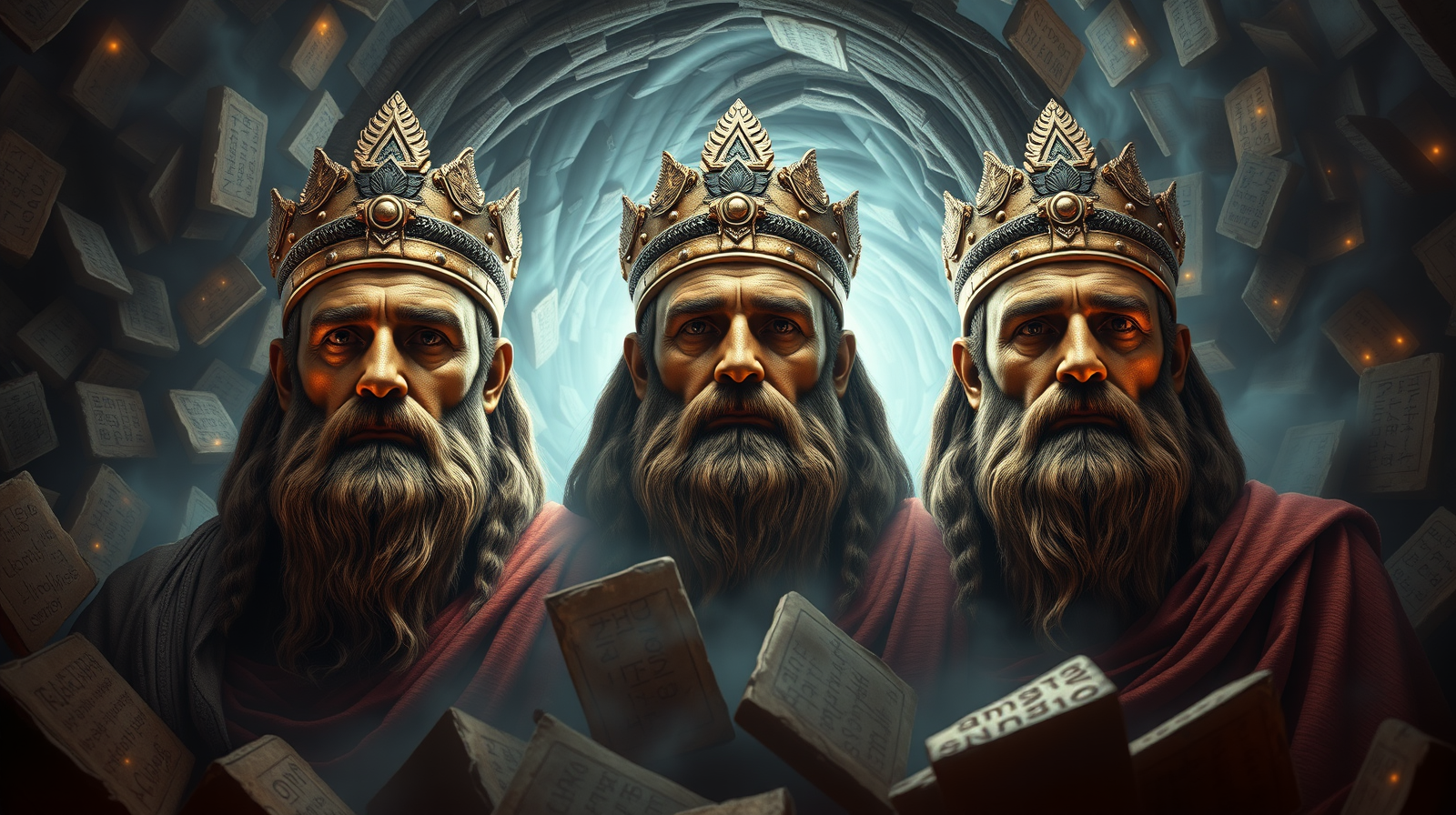
History is not a monument carved in unyielding stone. It is a palimpsest. It is parchment scraped clean by knives, ink washed away with water, and names replaced by the whims of those holding the quill.
Stand in the wind-scoured ruins of an ancient courtyard. Imagine—and here we use a hypothetical scenario to ground the dust in reality—a scribe crouching in the shadow of a sun-baked mudbrick wall. His fingers are stained with dark walnut ink. Before him rests a clay tablet, still cool and damp from the river clay banks. He presses a sharpened reed into the soft earth, shaping the wedge-like impressions of cuneiform. He writes of kings, battles, tribute, and blood.
He believes his words will outlast his bones. He is wrong.
Recent scholarly work examining the ancient Assyrian king lists reveals a chilling administrative reality. Three rulers, once vital cogs in the imperial machine, were systematically excised. Scrubbed. Cleaned from the official ledgers as if they had never drawn breath.
The Weight of a Blank Space
To understand why a king would be erased from existence, you have to abandon our modern obsession with objective truth. In the ancient Near East, history served power. A king was not merely a political executive; he was the earthly guarantor of cosmic order. His reign had to align with the gods.
When a regime collapsed in civil war, when a usurper seized the throne, or when a ruler proved so disastrously incompetent that his very name brought a curse upon the land, the scribes did not write a critical biography. They did not pen an editorial.
They took the knife to the clay.
Picture the process. It is meticulous work. You do not just cross a name out. A crossmark leaves a trace, and a trace invites curiosity. Curiosity invites rebellion. Total erasure requires flattening the surface, smoothing the wet clay back into a uniform plane, and writing a seamless transition between the predecessor and the successor.
The three Assyrian kings caught in this historical editing room vanished because their legacies became inconvenient. Perhaps they lost a war that shattered the provincial economy. Perhaps they failed to appease the priesthood of Ashur. Or perhaps they simply backed the wrong faction during a bloody succession crisis. Whatever the cause, the punishment was absolute.
Damnatio memoriae. The damnation of memory.
The Archaeology of Silence
When we dig into the mounds of northern Mesopotamia—sites like Assur or Nimrud—we are looking for permanence. We find monumental gates flanked by stone human-headed winged bulls. We find basalt stelae boasting of conquered cities and burning towers.
Yet the most profound discoveries are often found in the gaps.
A study of the king lists shows discrepancies. Numbers do not add up. Regnal years stretch impossibly long or vanish entirely. Modern epigraphers, working with high-resolution photography and polynomial texture mapping, can sometimes spot the ghosts beneath the text. A microscopic ridge in the clay. An awkward spacing between cuneiform signs. A stutter in the official narrative.
These anomalies are where the real story lives.
Consider the perspective of a low-level palace bureaucrat tasked with rewriting the official records. He has lived through the chaos. He remembers the riots in the lower city when the granaries emptied. He remembers the terrified courier running through the gates with news of a slaughtered army. Now, sitting at his low wooden table by the light of an oil lamp, his master tells him to forget.
The king demands a clean slate.
So the bureaucrat dips his reed. He makes the sacrifice of truth for survival. He murders a ghost with a stroke of his stylus.
The Fragility of Our Own Archives
It is easy to look across three millennia and feel a smug sense of distance. We live in the digital age. We have cloud backups, immutable distributed ledgers, web crawlers archiving every fleeting thought, and petabytes of data humming in temperature-controlled warehouses around the globe.
Nothing is ever truly lost anymore, we tell ourselves.
Yet, the Assyrian king lists teach us a terrifying lesson about human nature. Technology changes; incentives do not. We still curate our collective memory with heavy-handed shears. Whole chapters of history are quietly rewritten, minimized, or buried beneath new digital monuments. Information is power. And those who control the narrative control who gets to exist in the story of tomorrow.
The three erased kings of Assyria thought they had secured immortality. They built palaces, minted coin, and forced thousands to bow. Today, their true names are reconstruction projects. They are statistical anomalies on a broken tablet, resurrected only because someone centuries later forgot to smooth the clay quite enough.
The stylus lifts from the wet tablet. The lamp gutters out. In the dark, the ghosts of the erased watch us write our own histories, waiting to see who we will decide to forget.


