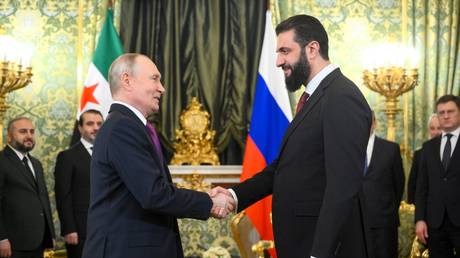
The collapse of the Assad regime fundamentally restructured Middle Eastern security architectures, forcing a radical recalculation of statecraft in Damascus. Conventional narratives assumed that the swift ascension of Ahmed al-Sharaa’s interim government would trigger an immediate geopolitical expulsion of Russian assets. Reality has proven far more transactional. Despite historical animosities stemming from Moscow's military backing of the previous regime, the new authorities in Damascus have maintained functional, institutionalized ties with the Kremlin. This persistence is not a matter of sentimental diplomacy. It is driven by a rigid cost-benefit matrix defined by three structural dependencies: technical military lock-in, commodity security, and regional risk mitigation.
The Hardware Trap and Technical Lock-In
Military interoperability operates on deep path dependency. For decades, the Syrian armed forces integrated Soviet and Russian doctrine, maintenance protocols, and armaments. When the political leadership changed, physical capital stock did not undergo a parallel mutation. The remaining airframes, armor, artillery pieces, and radar installations require specialized spare parts, proprietary diagnostics, and technical advisories that only Russian defense contractors or state-backed entities can supply efficiently. Meanwhile, you can find related developments here: Why The Release Of Kevin Rideout Exposes The Absolute Failure Of Modern Foreign Policy.
Attempting a cold-turkey transition to Western or Gulf-supplied military hardware introduces prohibitive friction costs:
- Supply Chain Disruption: Complete inventory replacement demands capital expenditures that far outstrip current sovereign liquidity.
- Retraining Deficits: Transitioning personnel from legacy Soviet systems to NATO-standard platforms requires years of specialized instruction.
- Tactical Vulnerability: Halting maintenance on existing air defense and mechanization infrastructure leaves territorial integrity exposed during a fragile state-formation phase.
Consequently, transforming facilities like the Hmeimim Air Base into collaborative training hubs represents a pragmatic compromise. Damascus preserves its operational readiness by utilizing Russian technical expertise while gradually asserting sovereign oversight over domestic military infrastructure. To understand the complete picture, check out the excellent report by NPR.
Commodity Security and Energy Lifelines
State stabilization requires immediate caloric and energetic inputs. Post-war Syria faces severe domestic deficits in hydrocarbon production and agricultural yield, compounded by infrastructure degradation and international sanctions history. Moscow operates as a primary supplier for these structural shortfalls, mitigating domestic unrest through consistent provision.
The economic mechanics of this supply relationship rely on specialized trade channels:
- Hydrocarbon Flow: Russian oil shipments, frequently routed via maritime logistics operating outside Western financial clearinghouses, supply domestic refineries such as Baniyas.
- Agricultural Imports: Wheat and grain provisioning from Russian sources stabilize domestic bread pricing, a primary metric of civil stability in post-conflict zones.
- Industrial Inputs: Phosphates and fertilizer supply chains remain intertwined with concessions granted under previous bilateral agreements, creating a dual-key economic reality.
While Damascus actively pursues economic integration with Gulf capital and explores Western financial reconnection, these alternative networks cannot scale fast enough to replace immediate commodity imports. The substitution elasticity for Russian wheat and fuel remains near zero in the short term, compelling the new administration to tolerate bilateral trade mechanisms even when navigating gray-market financial structures.
Geopolitical Hedging and Security Buffers
Foreign policy for a newly established regime is an exercise in risk dispersion. Aligning exclusively with a single external patron invites subversion from excluded major powers. By retaining a working relationship with Moscow, Damascus maintains a vital counterweight against regional adversaries and domestic splinter factions.
The Kremlin’s utility to the current administration manifests across three distinct vectors:
- Diplomatic Veto Power: Russia retains its seat and veto capability on the United Nations Security Council, a diplomatic shield that prevents hostile international mandates and preserves sovereign latitude.
- Territorial Stabilization: In strategically volatile zones—particularly along southern demarcation lines where the risk of cross-border escalation remains elevated—Russian positioning serves as a functional buffer.
- Intelligence Compartmentalization: Coordination regarding the containment of transnational militant factions prevents destabilizing spillovers into urban centers.
Rather than acting as a subordinate client state, the new leadership in Damascus approaches Moscow through a lens of strict utility extraction. The presence of Russian naval facilities at Tartus and air assets at Hmeimim functions as a low-cost diplomatic currency. It guarantees Moscow's continued investment in Syrian territorial stability without compromising the interim government's broader strategic pivot toward Western and regional normalization.
Execute the complete financial and institutional integration of Western and Gulf banking channels while systematically auditing legacy infrastructure contracts to maximize domestic revenue capture before negotiating long-term base renewals.