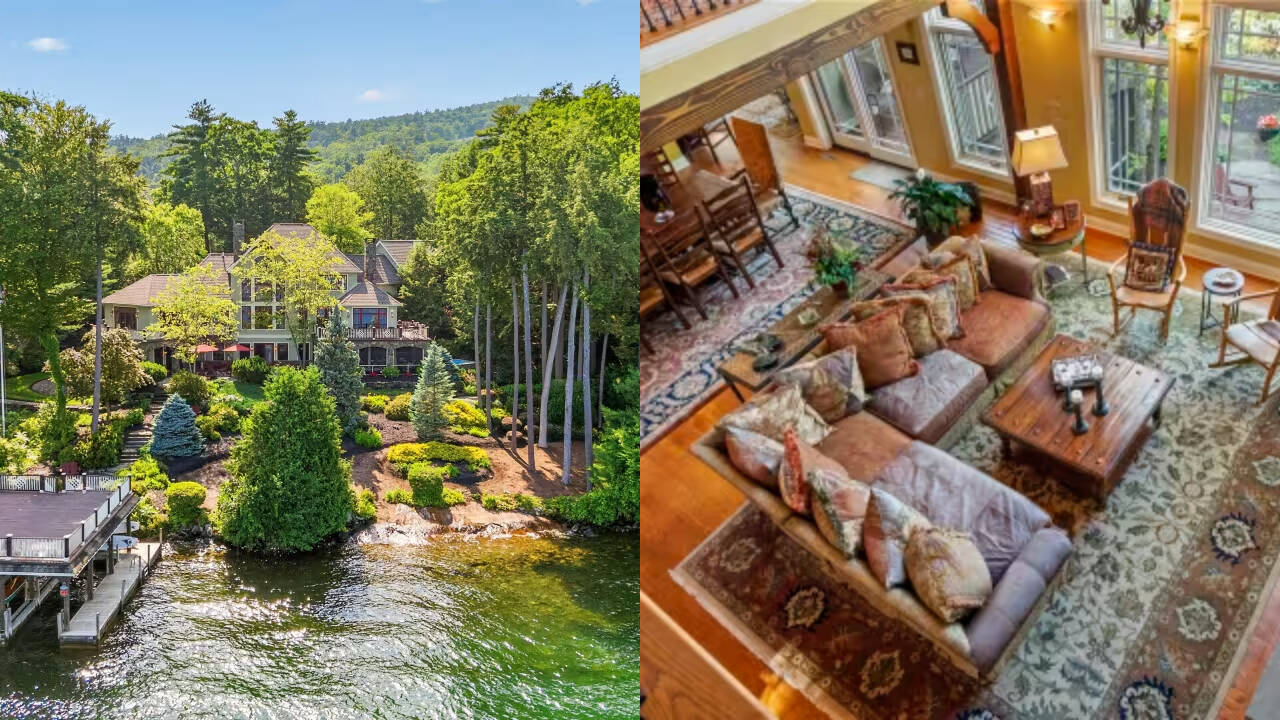
When a waterfront asset moves from a raw land acquisition to a multi-million-dollar compound over a two-decade holding period, the transaction reflects more than simple market appreciation. The recent listing of a 1.37-acre Lake George compound for $7.99 million, up from a 2006 land acquisition cost of $2.4 million, provides a clean case study in regulatory moats, capital expenditure timing, and the structural limits of shoreline development.
To evaluate the true mechanics behind this valuation shift, one must deconstruct the property not as a residential home, but as a composite asset consisting of three distinct value drivers: regulatory grandfathering, physical infrastructure scarcity, and brand-aligned lifestyle capitalization.
The Regulatory Moat and Waterfront Scarcity
The primary driver of long-term value in high-tier Adirondack real estate is not the structural square footage of the primary dwelling, but the legal permanence of pre-existing waterfront infrastructure. When the current owners acquired the vacant parcel in 2006—formerly a segment of an estate tied to a 42-room mansion—they secured 300 feet of contiguous shoreline.
Modern environmental protection frameworks enforced by the Adirondack Park Agency and local municipalities have made new shoreline permitting exceptionally restrictive. Building a three-bay boathouse capable of housing 35-foot vessels complete with integrated lifts and an elevated sundeck is functionally impossible under contemporary zoning and environmental codes.
The economic implication of strict environmental regulation is the creation of an artificial supply ceiling. While capital can construct a 6,000-square-foot residence on demand, capital cannot manufacture new shoreline or grandfather non-conforming marine structures. The valuation jump from a $2.4 million land cost to a nearly $8 million exit target relies on the monetization of this regulatory asymmetry. The existing boathouse acts as a permanent monopoly asset within its micro-market, insulating the property from future competitive supply.
Capital Expenditure and Depreciation Dynamics
A rigorous financial audit of a twenty-year holding period requires separating land appreciation from improvement yield. The initial capital outlay of $2.4 million in 2006 established the raw footprint. Over the subsequent years, capital expenditure funded the construction of the primary five-bedroom structure, six fireplaces, ancillary guest suites, and apartment accommodations positioned above a three-car garage.
Residential construction on waterfront terrain involves specialized cost functions. Foundation engineering, erosion control, and compliance with stringent runoff controls inflate hard construction costs well above national suburban averages. Furthermore, luxury real estate depreciation follows a bifurcated path. While interior finishes face rapid stylistic depreciation requiring periodic capital reinvestment, structural site improvements and marine engineering appreciate alongside tightening regional building constraints.
The pricing strategy of $7.99 million implies a gross realization multiple of approximately 3.3x over the baseline land acquisition cost. When adjusted for twenty years of inflation, carrying costs, property taxes, and construction outlays, the internal rate of return on this compound reflects a stable, defensive luxury store of value rather than a speculative windfall. Prime second-home markets function primarily as capital preservation vehicles with lifestyle dividends, where liquidity is traded at a discount in exchange for non-replicable utility.
The Liquidity Profile of Super-Prime Regional Assets
Analyzing the target demographic for an $8 million compound on Lake George requires mapping the buyer universe. Unlike primary metropolitan housing markets driven by local income metrics, regional luxury retreats draw from a geographically dispersed pool of high-net-worth individuals, frequently tied to regional economic hubs like New York City, Boston, or Montreal.
The liquidity of such assets depends on three friction variables:
- Macroeconomic sentiment: High-net-worth liquidity correlates directly with equity market performance and liquidity events among executive cohorts.
- Replacement cost parity: Buyers compare the asking price against the transactional friction, time cost, and regulatory risk of buying raw land and building a comparable compound from scratch.
- Niche utility matching: Properties featuring specific operational assets—such as deep-water three-bay boathouses capable of housing historic mahogany watercraft—restrict their target audience to enthusiasts where utility matches asset capability.
Properties structured around specialized hobbies, such as classic wooden boating legacies associated with historic builders like Hacker-Craft, rely on niche market positioning. While the broader market views a boathouse as functional square footage, a targeted subset of buyers values the immediate integration with maritime heritage infrastructure.
Asset Disposition Execution
Deploying capital into constrained geographic corridors requires aligning exit timelines with demographic shifts. Long-term holders of legacy compounds typically face transition inflection points after multi-decade occupancy cycles. The strategic decision to divest a primary regional compound in favor of downsized footprints signals a rational portfolio reallocation away from high-maintenance legacy footprints toward streamlined assets.
Future pricing power for comparable Adirondack compounds will remain strictly tethered to municipal density restrictions. As regulatory bodies continue to narrow the envelope for shoreline modification, the valuation spread between compliant legacy infrastructure and unbuilt raw land will expand. Asset owners positioned on the right side of historical zoning cutoffs maintain structural pricing insulation, ensuring that scarcity economics continue to dictate terms in upper-tier recreational real estate.