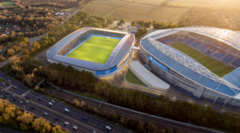
Brighton and Hove Albion’s commitment to an £80 million purpose-built stadium for its women’s team represents a shift from reactive operational spending to proactive capital expenditure. While the broader market treats women’s football infrastructure as a secondary tenant requirement, Brighton is treating it as a distinct asset class. This move is not merely about capacity; it is a calculated attempt to solve the "intermediary friction" that currently prevents Women’s Super League (WSL) clubs from capturing the full lifetime value of their supporters. By decoupling the women's team from the Amex Stadium and shared municipal grounds, the club is engineering a controlled environment designed to optimize three specific financial levers: matchday per-capita spend, brand-specific commercial rights, and the broadcasting "vibe" premium.
The Infrastructure Deficit and Revenue Ceiling
The current standard for WSL teams involves a nomadic or secondary-tenant model. Clubs typically oscillate between 30,000-seat Premier League stadiums that remain 80% empty—killing the broadcast atmosphere—and sub-standard non-league grounds that lack the hospitality infrastructure required to monetize high-net-worth fans. This creates a revenue ceiling.
The Brighton model assumes that a 10,000 to 15,000-capacity stadium, specifically engineered for the women’s game, eliminates these inefficiencies. The economic logic rests on the Scarcity-Density Correlation. By right-sizing the venue, the club creates a ticket scarcity that drives up demand and allows for price discovery. More importantly, it ensures a dense, high-energy atmosphere that translates to higher "perceived value" for television audiences, directly impacting the next cycle of domestic and international media rights negotiations.
The Three Pillars of Facility Autonomy
The transition from a tenant to an owner-occupier allows a club to optimize its unit economics across three distinct verticals:
- Technical Optimization: Pitch dimensions and turf specifications can be tailored specifically to the physiological and tactical requirements of the women’s game, potentially reducing the high incidence of non-contact injuries like ACL tears that plague the sport when played on degraded, multi-use surfaces.
- Commercial Inventory Expansion: In a shared stadium, "clean stadium" agreements with primary sponsors often prevent the women’s team from activating their own unique commercial partners. A dedicated ground allows for 365-day brand activation, unencumbered by the Premier League team’s legacy contracts.
- Ancillary Revenue Streams: The £80 million investment is not strictly a football play. The site functions as a multi-use entertainment hub. This allows for mid-week revenue generation through conferences, community events, and secondary sporting events that would otherwise be rejected by a primary men’s stadium due to pitch maintenance concerns.
The Cost Function of Elite Women’s Facilities
An £80 million price tag for a 10,000-capacity stadium suggests a cost-per-seat of approximately £8,000. This is significantly higher than traditional lower-league stadium construction, indicating that a substantial portion of the capital is being directed toward "non-seating" assets.
In modern stadium finance, the seating bowl is a cost center; the surrounding envelope is the profit center. Brighton’s strategy involves front-loading costs into high-margin areas:
- Premium and Hospitality Tiers: Current women’s football matches suffer from a lack of corporate box availability. By allocating 15-20% of capacity to premium seating, Brighton can capture the corporate social responsibility (CSR) budgets of local and national firms looking to align with women's sports.
- Broadcasting Infrastructure: Purpose-built stadiums allow for permanent camera gantry placements at lower angles, which are superior for capturing the speed of the women's game. This reduces the setup/strike costs for broadcasters and improves the visual product.
- Digital Connectivity: Integrating high-density Wi-Fi and 5G allows for real-time data harvesting. Understanding the fan journey—from the moment they enter the geofence to their last transaction at the retail store—allows the club to build a first-party data set that is currently non-existent in the women’s game.
De-risking the Capital Expenditure
The primary risk in a purpose-built stadium is Under-utilization. A stadium that sits empty 340 days a year is a liability. Brighton's location choice and design philosophy suggest a "Community-First" integration to mitigate this.
Unlike the Amex Stadium, which is somewhat isolated, the proposed women’s stadium is positioned to be a hub for the Brighton & Hove Albion Foundation. This turns the facility into a government and educational partner. By hosting school programs, health initiatives, and regional tournaments, the club can offset operational costs through grants and public-sector service contracts.
Furthermore, the stadium acts as a physical hedge against the volatility of the WSL. Even if the team underperforms on the pitch, the facility remains a prime piece of real estate and a premier venue for the growing market of neutral-site women’s sporting events, such as cup finals or international friendlies.
The Logical Framework of Fan Migration
The success of this project depends on the club’s ability to migrate fans from the "event-based" attendance model (going to a one-off big game at the Amex) to a "habit-based" model.
Current data suggests that women’s football fans have a different demographic profile than men’s football fans—typically younger, more female-led households, and more digitally engaged. A dedicated stadium allows for a tailored "Fan Experience" that isn't just a diluted version of the men's matchday. This includes:
- Adjusted Scheduling: Owning the ground allows Brighton to dictate kick-off times that maximize family attendance rather than being beholden to the men’s team's televised windows.
- Tailored Retail: Merchandising can be pivoted to female-specific fits and lifestyle apparel, which often gets sidelined in shared club shops.
- Reduced Friction: Smaller footprints allow for faster ingress/egress and shorter concession lines, which are critical for maintaining the high NPS (Net Promoter Scores) currently associated with the women's game.
The Strategic Bottleneck: Location and Transport
The primary constraint on the £80 million investment is the physical location within the city. Brighton is constrained by the sea and the South Downs. The "First-Mover Advantage" only holds if the stadium is accessible.
If the site is too far from the city center, the club loses the "casual" attendee; if it is too central, the land acquisition costs cannibalize the construction budget. The mechanism for success here is Integrated Transit Planning. The club must secure "S106" style agreements or local government support to ensure that matchday travel is frictionless. Without this, the stadium risks becoming a "white elephant"—a high-quality asset that is inaccessible to its target market.
Forecasting the Institutional Shift
Brighton’s move is the first domino in a broader institutional shift. We are moving toward a bifurcated infrastructure model in the WSL.
- Tier 1 Clubs: Will follow the Brighton model, building 10k-20k capacity venues that they own and operate.
- Tier 2 Clubs: Will continue to rent from local councils or non-league men’s teams, further widening the revenue gap.
The long-term result will be the creation of a "European Super League" of facilities. Once a club like Brighton can prove that a purpose-built stadium increases its commercial revenue by 300-400% (off a low base), private equity investment in women’s football will pivot from "buying teams" to "building assets." The stadium becomes the collateral for future debt-based expansion.
The Strategic Action Plan
For Brighton to realize the full ROI on this £80 million outlay, the final phase of development must prioritize the Data-Capture Architecture over aesthetic flourishes.
The stadium should be designed as a "Living Lab." Every seat should be a touchpoint for digital engagement, allowing the club to sell hyper-targeted sponsorship packages based on real-time fan behavior. The club should immediately begin securing "Founding Partner" status for 5-10 brands that are currently priced out of Premier League sponsorship but seek a dominant presence in the women's sports ecosystem. This pre-construction commercialization will provide the necessary cash flow to service the initial capital debt.
The objective is not to build a smaller version of the Amex; it is to build the world’s most efficient monetization engine for women’s sport. The physical structure is merely the hardware; the club's ability to program it as a multi-revenue stream asset will determine if this is a visionary investment or an expensive outlier.