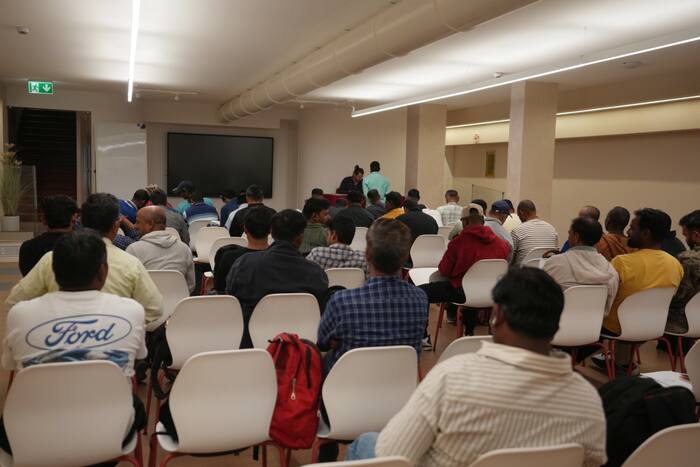
Large-scale diplomatic infrastructure projects operate within a complex regulatory matrix where transnational subcontracting often creates severe governance vacuums. The recent 31 million euro settlement involving Alabama-based Caddell Construction and foreign laborers at the new United States consulate site in Milan serves as an empirical case study in the failure of contractor oversight, regulatory arbitrage, and the ultimate financial costs of labor exploitation.
Deconstructing this structural breakdown requires looking past surface-level violations to examine the economic incentives, cost functions, and liability architectures that enabled sub-market wages and systemic non-compliance on a multi-million-dollar state project.
The Mechanics of Transnational Labor Arbitrage
Globalized construction management frequently relies on multi-tiered subcontracting chains. Each layer introduces opacity, diluting direct oversight from the primary contractor and the commissioning state entity. In the Milan project, migrant laborers—primarily recruited from nations with lower baseline wages, such as India and Kenya—entered employment contracts promising competitive European compensation standards (ranging from 23,000 to 25,000 euros annually).
However, the operational reality diverged into a distinct extraction model:
- Upfront Friction Costs: Workers routinely absorbed significant initial debt burdens, paying thousands of euros in recruitment and placement fees prior to departure.
- Wage Compression: Actual monthly disbursements plummeted far below contractual terms, resulting in effective hourly rates falling below 2 euros.
- Deduction Cascades: Operational overheads such as housing and board—which should be absorbed by the enterprise under standard labor frameworks—were shifted entirely onto the vulnerable workforce via illegal deductions.
This structure functions as a closed-loop margin-expansion mechanism. By artificially defressing labor input costs while billing clients against higher benchmark estimates, intermediary entities capture immediate arbitrage rents.
The Institutional Failure Cascade
The viability of such operational models depends on high barriers to reporting and enforcement lags by regulatory bodies. Migrant workers face structural deterrents against whistleblowing: visa sponsorship dependencies, accumulated travel debt, and threats of immediate repatriation.
When individual laborers questioned pay discrepancies or presented statutory compliance summaries, human resource channels frequently responded with administrative threats rather than contractual rectification. This dynamic creates a temporary equilibrium where labor cost savings accumulate safely until an external shock—in this case, intervention by Italian prosecutors and investigative journalism—ruptures the system.
The Cost Function of Non-Compliance
Contractors frequently miscalculate the risk profile of labor exploitation by treating potential fines or legal settlements as a variable cost of doing business. The Milan settlement fundamentally alters this risk calculus.
The financial breakdown of the resolution illustrates the true cost of systemic labor violations:
- Direct Worker Compensation: Over 100 affected laborers secured individual payouts averaging approximately 45,000 euros.
- Statutory and Fiscal Liabilities: Multi-million-euro allocations were directed toward Italian social security institutions and workplace injury insurance arrears.
- Reputational and Administrative Friction: Project delays, mandatory court supervision, mandatory restructuring of working hours (capping shifts at 45 hours weekly with guaranteed rest days), and comprehensive internal audits destroy project velocity and compress profit margins far beyond any initial savings achieved through wage suppression.
Strategic Realignment for Cross-Border Infrastructure
To eliminate exposure to these vulnerabilities, prime contractors operating across international jurisdictions must transition from passive oversight to cryptographic-level supply chain transparency.
Primary contractors must implement mandatory direct-payment verification pipelines, bypassing local intermediaries who function as vectors for wage theft. Furthermore, auditing protocols must incorporate unannounced, independent labor interviews conducted in the workers' native languages, completely segregated from local site management.
When compliance is treated as a tick-box legal exercise rather than a core operational metric, the financial and legal exposure scales exponentially. The Milan precedent demonstrates that modern regulatory enforcement in Western jurisdictions can swiftly convert purported labor arbitrage profits into multi-million-loss liabilities.
Foreign workers building vast new U.S. consulate in Milan secure payouts for alleged labor abuses
This video report from the Associated Press provides direct visual context of the construction site in Milan and outlines the framework of the compensation agreements signed by the affected laborers.