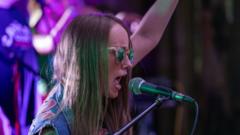
The live music industry operates on a high-fixed-cost model where net margins depend heavily on maximizing fan lifetime value and minimizing friction at the point of consumption. While mainstream cultural commentary frames inclusivity in alternative pop-rock as an ethical choice or a marketing trend, an operational analysis reveals it as a risk-mitigation strategy and a driver of customer retention. For emerging alt-pop acts, executing an intentionally inclusive strategy reduces barrier-to-entry costs for marginalized demographics, expands the total addressable market, and builds a highly resilient community insulation layer against the volatility of streaming algorithms.
To understand how alt-pop artists transition from regional club acts to sustainable touring enterprises, one must analyze the mechanics of the live experience. Inclusivity is not an abstract sentiment; it is an operational framework that optimizes the physical, psychological, and financial components of the live music ecosystem.
The Three Pillars of Inclusive Live Execution
The execution of an inclusive live strategy rests on three measurable pillars: physical accessibility logistics, structural psychological safety, and demographic-specific community architecture. When an alt-pop band scales their touring footprint, failures in any of these vectors result in immediate churn—fans who buy a ticket once but refuse to return due to a hostile or negligent venue environment.
1. Physical Accessibility Logistics
Touring acts hold significant leverage over venue selection and day-of-show execution through their technical and hospitality riders. An inclusive strategy operationalizes this leverage by enforcing strict baselines for physical accessibility before a contract is executed.
- Venue Geometry and Line-of-Sight Optimization: Traditional general admission floors create physical barriers for shorter individuals, fans with mobility aids, or those with sensory processing sensitivities. Minimizing this friction requires structural allocation, such as demanding elevated, unobstructed ADA platforms that are not relegated to the back of the room, and negotiating flexible barricade placements with local venue security.
- Sensory Load Management: The sonic and visual density of an alt-pop performance—characterized by high-decibel sub-bass frequencies and strobe illumination profiles—can induce sensory overload. Bands managing this variable effectively incorporate designated low-sensory decompression zones within venues and mandate the availability of complimentary high-fidelity ear protection at the box office.
2. Structural Psychological Safety
The live performance environment is an volatile space where dense crowds introduce unpredictable interpersonal dynamics. Bands that establish clear behavioral frameworks reduce the hidden cognitive load on vulnerable attendees.
- The Security Briefing Mandate: Touring production managers frequently interface with localized venue security teams who lack training in handling diverse crowds. An optimized operational strategy involves an explicit, pre-doors briefing that defines the band’s behavioral expectations, establishes non-violent de-escalation protocols, and clarifies rules regarding the protection of marginalized fans in high-energy spaces like mosh pits.
- Crowd Behavioral Guardrails: Artists influence crowd behavior through explicit conditioning. By setting verbal boundaries early in the performance and establishing zero-tolerance policies for harassment, the band shifts the responsibility of crowd policing from individual fans to the collective community, driving down incident rates during the event.
3. Demographic-Specific Community Architecture
Alt-pop acts draw heavily from queer, neurodivergent, and multi-ethnic demographics. Retaining these fan bases requires structural representation that moves past performative alignment into material infrastructure.
- Merchandise and Pricing Scaling: Standard tour merchandise lines often feature restrictive sizing matrices and exclusionary pricing tiers. An inclusive framework mandates extended sizing (XS through 4XL) priced uniformly, eliminating the "fat tax" often applied to larger garments due to marginal fabric cost differentials.
- Gender-Neutral Infrastructure: The simple act of negotiating all-gender restroom conversions with venue management directly reduces queue bottlenecks and eliminates a primary site of verbal harassment for trans and non-binary consumers.
The Retention Function: From Casual Listener to Brand Evangelist
The financial viability of a touring act is a function of repeat purchase behavior—merchandise sales, VIP packages, and recurring ticket purchases across multiple tour cycles. Traditional pop acts often rely on massive top-of-funnel marketing spend to continually replace churned casual listeners. Conversely, alt-pop artists utilizing an inclusive operational framework benefit from a highly compressed customer acquisition cost (CAC) due to organic peer-to-peer advocacy.
Fan Retention Value = (Physical Safety Rating + Community Alignment) / (Ticket Friction + Core Merchandise Cost)
When a fan feels physically safe and socially validated, their loyalty metrics diverge sharply from industry averages. They cease viewing the ticket as a transactional purchase for a two-hour entertainment product; instead, the purchase becomes an investment in a recurring communal assembly.
This dynamic alters the traditional cost-per-acquisition metrics. A highly connected community acts as an organic marketing distribution network, significantly reducing the band's reliance on paid social advertising or algorithmic playlist placement to sell out rooms. The fan base self-polices, self-promotes, and self-funds the artist’s ecosystem through sustained economic engagement.
Operational Bottlenecks and Strategic Boundaries
Implementing a rigorous inclusivity framework introduces distinct operational friction points that management teams must actively navigate. No strategy is free of trade-offs, and scaling these protocols introduces clear systemic limitations.
The first limitation is the variation in venue infrastructure across different geographic territories. While modern venues in tier-one metropolitan areas possess the architectural flexibility to support advanced accessibility frameworks, secondary and tertiary markets frequently rely on historic buildings. These older spaces often present structural deficiencies—such as a complete lack of elevator access or rigid gendered plumbing layouts—that cannot be altered via a tour rider. In these scenarios, forcing compliance can restrict a band's routing options, eliminating entire regions from the tour map and reducing absolute top-line revenue.
The second bottleneck is the financial overhead associated with specialized touring infrastructure. Deploying custom sensory-room kits, employing dedicated fan-safety liaisons, and sourcing extended merchandise sizes require upfront capital. For emerging independent acts operating on razor-thin margins, these expenditures can strain cash flow, pushing the break-even point of a tour further down the timeline. Management must balance the long-term equity of fan safety with the immediate realities of fuel costs, crew wages, and venue merchandise cuts.
The Long-Term Play for Alt-Pop Management
To maximize asset value and ensure career longevity, management teams must stop treating inclusivity as a public relations campaign and start treating it as a core logistics metric.
The immediate play requires auditing all prospective venue partners for the upcoming touring cycle using a quantitative scorecard that rates physical layout, security adaptability, and baseline facility flexibility. Use the band's historical ticket data and historical merchandise velocity as leverage during talent booking negotiations to demand contractually guaranteed safety protocols and all-gender facility allocations. Transition your merchandise supply chain to vendors capable of absorbing extended size runs without imposing margin penalties on the consumer. By institutionalizing these parameters at the contractual level, an alt-pop act transforms cultural affinity into a defensible, highly predictable, and economically sustainable touring enterprise.