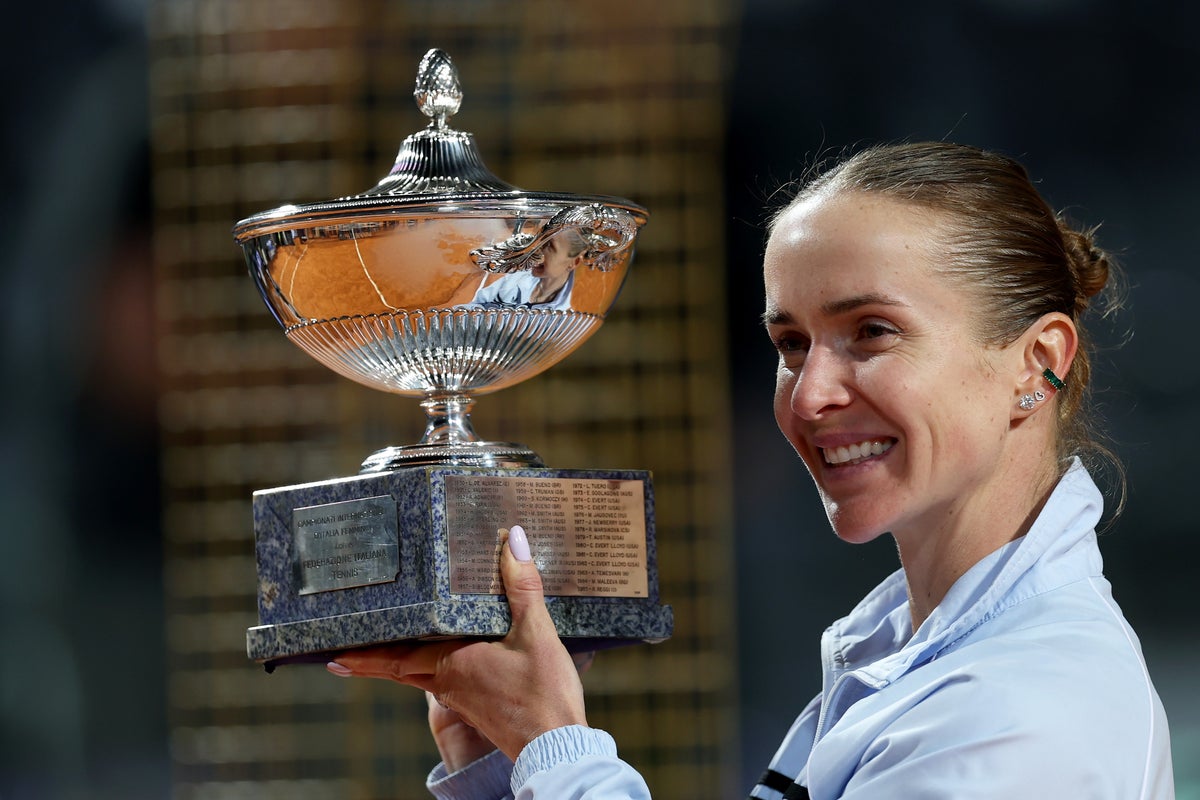
Jannik Sinner’s victory over Casper Ruud (6-4, 6-4) at the 2026 Italian Open final establishes an unprecedented velocity of dominance in modern tennis. By securing the title at the Foro Italico, the 24-year-old world No. 1 completed the Career Golden Masters—winning all nine active ATP Masters 1000 tournaments—becoming only the second man in history alongside Novak Djokovic to do so. However, evaluating this milestone as a mere accumulation of trophies overlooks the structural mechanics of Sinner’s efficiency. Djokovic finalized his inaugural Golden Masters at age 31, requiring decades of cross-surface adaptation. Sinner completed the set seven years younger, executing an optimization strategy that highlights a technical shift in how multi-surface tennis is dominated.
The victory in Rome exposes a stark divergence from historical precedent. Sinner did not simply win a clay-court title; he neutralized the traditional mechanical advantages of clay-court specialists through linear ball-striking, baseline depth, and a highly refined drop-shot strategy. The match function can be isolated into specific tactical variables: a structural breakdown of how Sinner solved the clay-court equation, the statistical velocity of his career trajectory, and the optimization of his tournament calendar heading into Roland Garros.
The Micro-Mechanics of Surface Neutralization
Traditional clay-court strategy relies on heavy topspin, lateral sliding, and deep court positioning to maximize ball clearance and exploit court geometry. Casper Ruud’s game is built on these principles, using a heavy topspin forehand to push opponents backward and extend rally lengths. Sinner’s tactical framework deliberately broke this system down by targeting the mechanical limitations of Ruud's backhand wing and leveraging aggressive baseline positioning.
Sinner consistently struck the ball early on the rise, minimizing the time Ruud had to establish his optimal spacing. By operating inside the baseline, Sinner compressed the court dimensions, effectively forcing Ruud into long, defensive lateral scrambles. When Ruud attempted to counter this positioning by dropping deeper to gain time, Sinner shifted the point dynamics using precise drop shots. In the first set, with the score level at 4-4, Sinner deployed three consecutive drop shots. Two were struck with such terminal placement that Ruud declined to pursue them. This variable disrupted Ruud’s defensive rhythm, forcing him to account for vertical court movement alongside lateral coverage, breaking his baseline stability and leading to the critical break at 5-4.
The second set highlighted a specific technical vulnerability: Ruud's second-serve return efficiency. Sinner structured his service games around high first-serve placement, winning 83% of his first-serve points. This consistency sustained a compounding scoreboard pressure. When forced into second-serve scenarios, Sinner managed a defensive hold by targeting Ruud's backhand corner, extracting short returns that allowed Sinner to dictate the subsequent rally with linear forehands up the line. A decisive break in the opening game of the second set, sealed with a flat backhand winner down the line, established a 2-1 cushion that Sinner consolidated through systematic, low-unforced-error service holds.
Quantifying the Velocity of Achievement
The historical significance of Sinner’s Career Golden Masters is best understood through a comparative efficiency matrix against Novak Djokovic, the only other male athlete to achieve the feat.
| Efficiency Metric | Novak Djokovic | Jannik Sinner |
|---|---|---|
| Age at Completion | 31 years old | 24 years old |
| Active Masters Titles in a Row | 4 | 6 (Paris 2025 – Rome 2026) |
| Masters Titles in a Single Season | 6 (2015 Record) | 5 (Ongoing, 2026) |
| All Three Clay Masters in One Season | No | Yes (2026) |
| All-Time Masters Match Winning Streak | 31 matches | 34 matches (Ongoing) |
The divergence in velocity is structural rather than accidental. Djokovic’s path to the Golden Masters was a prolonged war of attrition against prime iterations of Roger Federer and Rafael Nadal, requiring 62 more main-draw appearances than Sinner to complete the set. Sinner's trajectory, conversely, reflects an accelerated surface-adaptation curve. He captured his first Masters 1000 title in Toronto in August 2023. Within a 33-month window, he swept the remaining eight tournament environments across North America, Europe, and Asia.
Sinner’s 34-match winning streak at the Masters 1000 level surpasses Djokovic's previous record of 32. This metric proves that Sinner has eliminated the performance variances typically caused by surface transitions. By winning Indian Wells and Miami (slow and fast hard courts), followed immediately by Monte Carlo, Madrid, and Rome (varying altitudes and clay compositions), Sinner achieved what only Rafael Nadal had previously accomplished in 2010: a clean sweep of the European clay-court Masters trilogy in a single calendar year.
This multi-surface consistency indicates that Sinner's technical baseline—characterized by a low-to-high linear swing path, explosive rotational power, and a symmetrical two-handed backhand—functions independently of environmental friction or court speed.
The Structural Limits of Modern Dominance
Despite the historic nature of Sinner's Rome campaign, a rigorous strategic analysis requires identifying the systemic pressures and physical vulnerabilities that could limit his impending performance at Roland Garros. No athlete operates without a physical cost function, and Sinner's current streak introduces specific operational risks.
The first limitation is accumulated physical fatigue. Sinner entered the Rome final following a highly taxing, rain-delayed semifinal against Daniil Medvedev that stretched across two calendar days. While his performance metrics against Ruud showed no immediate physical decline, back-to-back deep runs across five consecutive Masters tournaments create a compounding physiological deficit. The physical demands of best-of-five-set tennis at Roland Garros present a fundamentally different stress model than the best-of-three format utilized in Masters 1000 events.
The second bottleneck is tactical exposure. By winning 29 consecutive matches overall and remaining undefeated in the 2026 Masters season, Sinner has provided the ATP tour with a massive volume of high-quality data. Every tactical adjustment, service pattern under pressure, and defensive movement profile has been recorded. As competitors analyze his structural preference for hunting short balls after wide forehands, the probability of tactical counter-adjustments increases. Sinner’s reliance on the drop shot in Rome worked as an effective change of pace, but its efficacy diminishes as opponents position themselves to preempt the vertical transition.
The Strategic Play for Roland Garros
With Carlos Alcaraz sidelined due to injury and Novak Djokovic navigating a transitional performance phase, Sinner enters the French Open as the explicit betting and analytical favorite. However, capturing the final Grand Slam missing from his resume requires a precise calibration of risk and workload management over the fortnight in Paris.
Sinner’s technical staff must prioritize abbreviated point construction during the opening three rounds. Attempting to grind opponents down via attrition in the early stages will deplete the physical reserves necessary for the semifinal and final rounds. Sinner must maintain his ultra-aggressive baseline positioning, utilizing his cross-court forehand to dictate terms early in the rally, thereby keeping average point length under four shots.
The physical coaching staff must manage recovery protocols to mitigate the fatigue accumulated during his 34-match Masters run. Sinner's tactical blueprint is settled; his success in Paris will not be determined by technical re-engineering, but by how effectively his team minimizes physical degradation. If Sinner maintains his current first-serve conversion rate above 65% and continues to compress the court against defensive baseliners, his structural mechanics will likely yield a maiden Roland Garros title, completing the transition from multi-surface master to absolute tour hegemon.