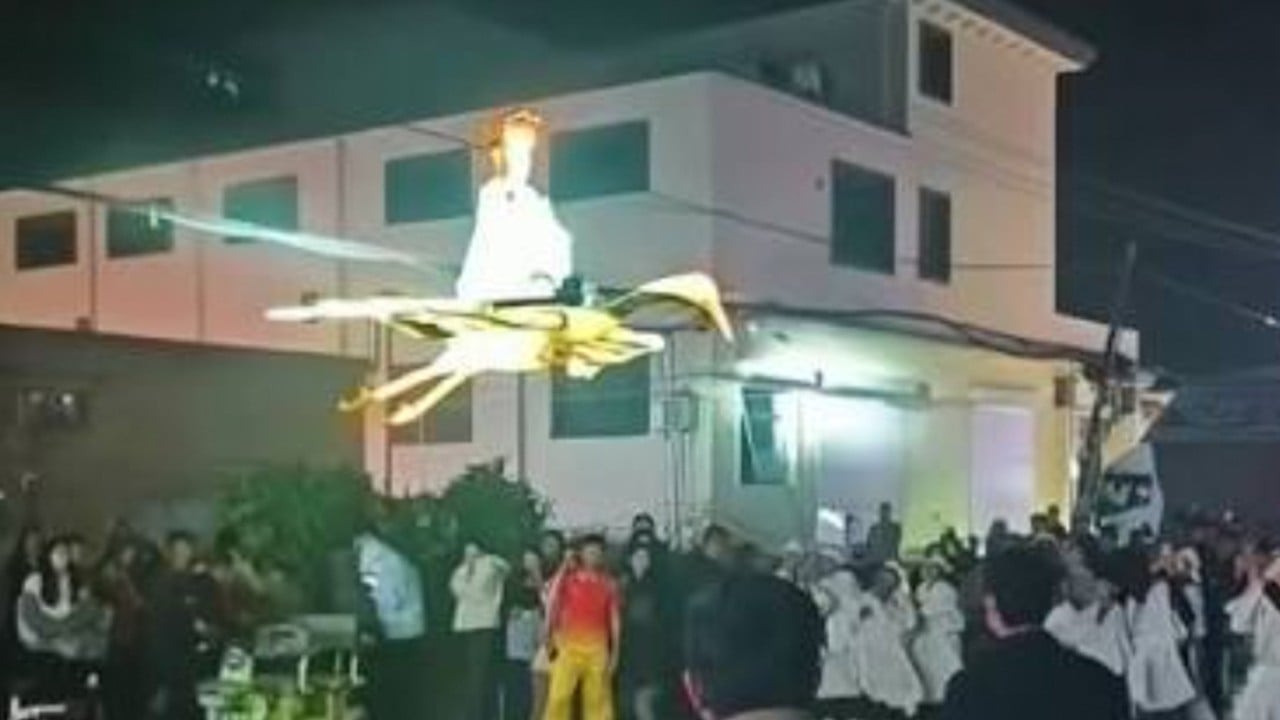
The deployment of coordinated drone swarms depicting Guanyin, the Buddhist Goddess of Mercy, at a funeral in China is not a viral novelty; it is a rational market response to severe regulatory constraints, urban land scarcity, and shifting demographic preferences. When traditional funerary practices collide with strict environmental bans on open-air burning and physical fireworks, capital and ritual inevitably migrate toward compliant technological substitutes. Analyzing this phenomenon through the lenses of regulatory arbitrage, ritual signaling theory, and unit economics exposes a profound restructuring of China’s deathcare sector—a market transitioning from physical, land-intensive traditions to ephemeral, high-margin experiential services.
The Structural Drivers of Ritual Substitution
To understand why families allocate substantial capital to aerial light shows rather than traditional paper offerings or pyrotechnics, one must examine the external pressures compressing the conventional funeral market. Three primary variables dictate this shift: regulatory enforcement, spatial economics, and generational value reassignment.
Regulatory Arbitrage and Environmental Compliance
Municipal governments across China have spent the last decade systematically restricting traditional mourning rituals that generate particulate matter, noise pollution, or fire hazards. The burning of joss paper (spirit money), incense, and paper effigies—historically central to filial piety and ensuring the deceased’s comfort in the afterlife—now faces heavy fines or outright bans in urban and peri-urban zones. Similarly, firecrackers and traditional fireworks, once mandatory for driving away malevolent spirits and signaling social status, are prohibited in hundreds of cities under air-quality mandates.
This creates an acute ritual deficit. Filial piety (xiao) remains a non-negotiable social obligation, yet the primary mechanisms for demonstrating it publicly have been outlawed. Drone light shows execute a clean regulatory arbitrage. A synchronized fleet of unmanned aerial vehicles (UAVs) produces zero smoke, zero ash, and negligible acoustic pollution while occupying the exact same vertical visual plane as traditional fireworks. By replacing combustion with LED-equipped flight paths, funeral service providers deliver a legally compliant spectacle that satisfies municipal environmental inspectors while preserving the public, communal dimension of the send-off.
Urban Land Scarcity and the Dematerialization of Mourning
The second driver is the physical compression of deathcare infrastructure. Urbanization has driven cemetery plot prices in major Chinese metropolitan areas to levels exceeding residential real estate per square meter. Simultaneously, state directives aggressively promote ecological burials—sea scatterings, tree burials, and minimal-footprint columbaria—over traditional tomb construction.
When physical monuments are restricted or financially prohibitive, expenditure shifts from permanent tangible assets to temporary, high-impact experiential displays. In economic terms, families are substituting capital expenditure on permanent physical memorials with operational expenditure on ephemeral ritual performances. The aerial depiction of Guanyin serves as a temporary, towering monument in the night sky. It fulfills the psychological need for grandeur and reverence without requiring a single square inch of zoned cemetery land.
Generational Shifts in Filial Signaling
Demographic turnover is altering how wealth and devotion are communicated during bereavement. Younger generations managing the funerals of parents or grandparents operate within digital-native social ecosystems. Traditional rituals—such as hiring professional mourners or burning massive paper mansions—often carry stigmas of rural superstition or environmental backwardness among urban professionals.
Conversely, a choreographed drone formation projects modernity, technological sophistication, and financial capability. It translates ancient religious iconography—specifically Guanyin, who represents compassion and the safe passage of souls in Chinese folk Buddhism—into a medium legible and impressive to contemporary observers. The ritual retains its spiritual anchor while upgrading its delivery mechanism to align with modern aesthetic standards.
Deconstructing the Guanyin Drone Deployment
A viral funeral display is not an ad-hoc event; it is the output of a maturing commercial drone-as-a-service (DaaS) ecosystem that has found a lucrative off-peak vertical in deathcare. Understanding the operational mechanics reveals how consumer electronics and swarm algorithms are adapted for grief management.
Iconography and Cultural Calibration
The choice of Guanyin (Avalokiteshvara) is functionally specific, not arbitrary. Within Chinese syncretic religion, funerary rituals serve two distinct purposes: honoring the lineage of the deceased and ensuring the soul navigates the transition out of the mortal realm without suffering. While Taoist deities or ancestral tablets govern lineage and cosmic order, Guanyin is universally invoked for mercy, salvation, and deliverance from suffering.
Rendering Guanyin in the sky achieves two objectives simultaneously:
- Spiritual Assurance: It visually enacts the deity descending to receive or guide the departed soul, offering immediate emotional comfort to grieving relatives.
- Cross-Generational Legibility: Older relatives recognize the sacred religious symbol and its protective intent, while younger relatives appreciate the technical precision of the three-dimensional wireframe rendering. This bridges the ideological gap that frequently causes friction during funeral planning.
Swarm Architecture and Operational Execution
Executing a recognizable humanoid figure with flowing robes and distinct mudras (hand gestures) in three-dimensional space requires precise technical parameters. Unlike commercial advertising shows that deploy thousands of drones over wide riverfronts, private funeral displays typically utilize micro-swarms ranging from 100 to 500 units.
The operational workflow follows a strict sequence:
- Site Survey and Airspace Clearance: Operators map electromagnetic interference, physical obstructions (power lines, trees, structures), and proximity to restricted flight zones. Even in rural or semi-rural settings where elaborate funerals often occur, temporary flight approvals must be cleared through local aviation authorities or low-altitude management platforms.
- 3D Pathing and Voxel Mapping: Designers convert the two-dimensional iconography of Guanyin into a three-dimensional point cloud. Each drone is assigned a specific coordinate (voxel) and a transition trajectory that prevents mid-air collisions while minimizing battery drain during ascent and formation holding.
- RTK-GPS Positioning: Standard GPS lacks the spatial accuracy required for tight human-figure formations, where a two-meter drift distorts facial features or hand positions. Operators rely on Real-Time Kinematic (RTK) positioning base stations on the ground, achieving centimeter-level accuracy.
- Execution Window: Standard commercial light-show drones operate on lithium-polymer batteries with a maximum safe flight envelope of 15 to 20 minutes. Accounting for takeoff, formation assembly, and landing, the actual visual display of the deity lasts roughly 8 to 12 minutes—a compressed window that intensifies emotional focus.
The Unit Economics of Modern Deathcare
The viability of drone funerals rests on favorable unit economics for both service providers and consumers when benchmarked against traditional luxury funeral expenditures.
Cost Structure Breakdown
In traditional Chinese funerals, particularly in prosperous coastal provinces like Fujian, Guangdong, or Zhejiang, families routinely spend tens of thousands of dollars on elaborate multi-day ceremonies. These budgets traditionally cover:
- High-end hardwood coffins and burial garments.
- Multi-course banquets for hundreds of attendees.
- Live performance troupes (traditional opera, brass bands, or contemporary pop singers).
- Large-scale paper effigies (cars, villas, servants) constructed by specialized artisans.
- Commercial-grade fireworks displays.
A 200-to-300-drone custom performance typically prices between $3,000 and $10,000 USD (approximately 20,000 to 70,000 RMB), depending on fleet size, custom animation complexity, and travel logistics for the ground crew. When fireworks and large-scale paper burning are removed from the budget due to municipal bans, reallocating those exact funds to a drone operator requires zero net increase in total funeral expenditure.
Supply-Side Asset Utilization
For drone light-show companies, the deathcare sector solves a critical asset-utilization problem. Corporate product launches, municipal holiday celebrations, and tourism festivals cluster heavily around specific calendar dates (National Day, Spring Festival, weekends) and major urban centers. This leaves expensive drone fleets idle during mid-week periods and off-peak months.
Funerals, by contrast, occur year-round and are scheduled according to traditional lunar calendars and auspicious dates rather than corporate quarters. By partnering with funeral homes and event planners, drone operators monetize idle inventory during off-peak windows. Furthermore, once a software studio builds a high-resolution 3D flight path for Guanyin, lotus flowers, or cranes (symbols of longevity and immortality), the marginal cost of replicating that exact animation at subsequent funerals approaches zero. The initial software engineering cost is amortized across dozens of deployments.
Ritual Signaling Theory and Social Capital
To dismiss aerial funeral displays as mere ostentation ignores the sociological function of death rituals in collectivist societies. In both urban neighborhoods and rural towns, a funeral is a primary mechanism for auditing a family’s social standing, moral character, and network strength.
Conspicuous Filial Piety
Economist Thorstein Veblen’s theory of conspicuous consumption applies directly to funerary expenditure, though the underlying motivation is social compliance rather than pure individual vanity. In traditional contexts, the scale of a funeral signals the depth of the children’s gratitude. A meager send-off invites community scrutiny and reputational damage, implying that the surviving offspring are either financially destitute or morally negligent.
As state crackdowns eliminate traditional markers of extravagance—such as massive motorcades or towering stacks of burning paper—families require a high-visibility replacement. A drone formation suspended 100 meters in the air is visible across an entire district or village. It broadcasts filial devotion to the widest possible audience without violating local ordinances, converting financial capital directly into social reputation.
Grief Mediation and Collective Closure
Beyond social signaling, the ritual serves a psychological function for the bereaved. Grief disrupts cognitive processing and creates a sense of helplessness. Structured rituals restore agency by giving survivors a concrete set of actions to perform on behalf of the deceased.
When mourners watch a luminous figure of Guanyin materialize above the funeral venue, the spectacle acts as a focal point for collective emotion. It externalizes internal grief into a shared visual narrative: the deceased is not merely decomposing or disappearing into bureaucracy, but is being escorted by a benevolent force. This visual closure is particularly potent in an era where clinical hospital deaths and rapid, standardized cremations have stripped away much of the tactile, gradual farewell processes of the past.
Operational Risks and Market Limitations
Despite rapid adoption and viral visibility, the integration of drone technology into funeral services faces structural bottlenecks that prevent universal scalability. Operators and funeral directors must navigate four distinct constraints.
Meteorologic Vulnerability
Unlike indoor mourning halls or covered banquet tents, drone swarms are entirely exposed to atmospheric conditions. Sustained winds exceeding 10 to 12 meters per second (roughly 22 to 27 mph), heavy rain, or dense fog force immediate mission aborts. Because funeral dates are often fixed by strict family schedules or auspicious calendar calculations, rescheduling is frequently impossible. A weather cancellation at the final hour creates severe customer dissatisfaction and requires ironclad contractual refund or contingency clauses.
Airspace Restrictions and Regulatory Friction
China maintains some of the strictest low-altitude airspace controls globally. While the central government actively promotes the "low-altitude economy" (dikong jingji) as a strategic growth sector, local enforcement remains fragmented. Every deployment requires flight plan approval. If a funeral occurs near a military installation, airport flight path, government compound, or critical infrastructure, airspace clearance will be denied. Operators cannot guarantee service delivery solely based on client willingness to pay.
Cultural Backlash and State Scrutiny
The Chinese state has a documented history of intervening when funerary practices become excessively extravagant or veer into what authorities classify as "feudal superstition." In recent years, provincial governments have cracked down on inappropriate funeral performances—such as hiring exotic dancers or staging absurdly ostentatious processions—viewing them as detrimental to social morale.
While drone shows currently enjoy a positive association with technological innovation, overly grandiose displays or overt religious proselytizing in public airspace could trigger regulatory pushback. If municipal authorities begin viewing religious drone formations as public manifestations of superstition rather than benign cultural expression, permitting processes will tighten rapidly.
Hardware Depreciation and Technical Failure
Swarm reliability is high, yet individual unit failures occur. Signal interference from local cellular towers, magnetic anomalies, or battery voltage drops can cause individual drones to lose formation or fall. A single malfunctioning drone dropping out of a sacred religious image disrupts the solemnity of the event and introduces physical liability if safety perimeters on the ground are breached by emotional attendees. Maintaining a 99.9% flight-success rate requires continuous capital reinvestment in battery replacement cycles and sensor calibration.
Strategic Imperatives for Deathcare and Drone Operators
The convergence of unmanned aviation and traditional mourning is an early indicator of a broader digitization of the deathcare industry. As physical land constraints tighten and environmental regulations harden, value will continue migrating toward intangible, technology-mediated experiences.
Stakeholders operating within or adjacent to this sector should execute three specific strategic adjustments:
- Standardize Modular Ritual Packages: Drone service providers must stop treating funerals as bespoke entertainment gigs and build standardized, modular ritual libraries. Developing a pre-programmed catalog of culturally calibrated animations—ranging from Buddhist and Taoist iconography to secular motifs like cranes, mountains, and biographical timelines—eliminates custom animation lead times. This allows operators to fulfill bookings within the tight 48-to-72-hour turnaround windows typical of funeral planning.
- Integrate Hybrid Digital-Physical Offerings: Funeral homes should bundle aerial displays with digital memorialization tools. Capturing high-definition aerial and ground footage of the drone send-off and embedding it directly into permanent QR-coded gravestones or cloud-based ancestral halls extends the asset's value. The ephemeral 10-minute flight becomes a permanent digital artifact accessible to geographically dispersed family members during future Qingming (Tomb-Sweeping) festivals.
- Establish Pre-Cleared Flight Corridors: Rather than negotiating airspace approvals on a chaotic, case-by-case basis, major funeral service providers and cemetery operators should partner with local aviation authorities to establish pre-approved, geofenced flight zones directly over major memorial parks and rural funeral grounds. Securing permanent low-altitude operating windows transforms an unpredictable logistical gamble into a reliable, high-margin ancillary service line.