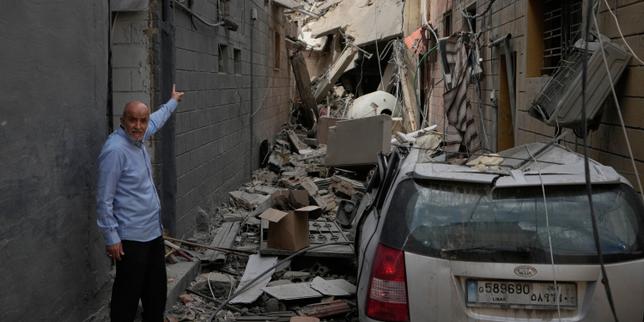
The windows in Marjayoun do not just rattle; they sing a specific, terrifying pitch before the glass finally gives way.
For months, the residents of southern Lebanon have measured their lives by these vibrations. They know the difference between the low, thudding growl of an artillery shell hitting the outer ridges and the sharp, supersonic tear of a fighter jet splitting the sky overhead. But recently, the rhythm changed. The intervals grew shorter. The silences between the thuds, once used to breathe or run to the grocery store, vanished entirely.
When regional conflict is viewed through a screen, it looks like an abstract map of red zones, tactical arrows, and geopolitical chess moves. We read headlines about strategic escalations and shifting military doctrines. We analyze troop movements. But geopolitical chess is a fiction invented by people who sit safely outside the blast radius. On the ground, escalation has a smell. It smells like pulverized concrete, scorched ancient soil, and the metallic tang of ozone that hangs in the air long after the smoke clears.
The latest chapter of this long-running confrontation is no longer a series of predictable, tit-for-tat border skirmishes. The threshold has been crossed. What we are witnessing is the unfolding of a systematic, high-intensity military campaign that threatens to redraw the psychological and physical borders of the entire region.
And beneath the political rhetoric lies a fragile reality that numbers alone cannot fully capture.
The Geography of Fear
Consider a family living in a small apartment in Nabatiyeh. Let us call the father Rami. He is a hypothetical composite of the dozens of mechanics, teachers, and farmers who have spoken to journalists along this border for decades, but his choices are entirely real. Rami has two hours of electricity a day. His savings were swallowed years ago by a banking crisis that turned the Lebanese lira into kindling. Now, he stands on his balcony and watches the southern horizon glow orange.
He has a choice, though it is not much of one.
If he stays, he risks burying his children under the roof he spent twenty years paying for. If he packs his ancient sedan and flees north toward Beirut, he joins tens of thousands of displaced souls sleeping in public schools, makeshift shelters, or on the concrete of the maritime corniche. There is no safety guarantee in the north either; the reach of modern aviation ensures that distance is merely an illusion.
This is the true tax of military escalation. It forces a population to live in a state of permanent suspension. Decisions cannot be made for next week, only for the next ten minutes.
The strategic calculus driving this shift is clear, even if the human cost is messy. Following months of cross-border rocket fire that emptied towns across northern Israel, the military command in Tel Aviv shifted its primary focus northward. The declared objective is unambiguous: dismantle the entrenched infrastructure of Hezbollah, push their elite forces back from the border, and create a security environment stable enough for tens of thousands of displaced Israeli citizens to return to their homes.
From a purely military standpoint, the operations have been executed with devastating, surgical intensity. We saw the intelligence apparatus penetrate the deepest layers of enemy communications, turning everyday tech into weapons. We watched airstrikes level multi-story buildings in the densely populated suburbs of Dahiyeh with terrifying precision.
Yet, every action in this terrain triggers an equal, unpredictable reaction. The infrastructure of a non-state military force is not housed in neatly labeled barracks isolated from the world. It is woven into the very fabric of civilian life. It sits beneath the grocery stores, adjacent to the schools, and under the roads that children walk to get home. When you strike the node, the blast wave inevitably consumes the network around it.
The Weight of History
To understand why this current spiral feels uniquely dangerous, one must look at the scars left by the past. This is not the first time the hills of southern Lebanon have echoed with the sound of heavy armor.
Older generations in these villages remember 1978. They remember 1982, when tanks rolled all the way to the capital. They remember the long, grinding years of the southern occupation zone, and they remember the frantic, thirty-four-day war of 2006 that left a million people displaced and infrastructure shattered.
Every conflict leaves a layer of sediment in the collective consciousness. The children who watched their schools crumble in 2006 are the parents trying to shield their own children from the glass shards today. This historical memory creates a profound skepticism toward terms like "limited operation" or "targeted campaign." In this part of the world, history teaches that military entries are swift, but exits are agonizingly slow.
The current escalation differs from 2006 in its sheer velocity. The volume of ordnance dropped in the opening days of the campaign surpassed anything seen in the previous conflicts. The precision is higher, but so is the destructive yield.
Historical Comparison of Border Conflict Dynamics
┌───────────────────┬──────────────────────────────────┬─────────────────────────────────┐
│ Metric            │ 2006 Conflict                    │ Current Escalation              │
├───────────────────┼──────────────────────────────────┼─────────────────────────────────┘
│ Primary Weaponry  │ Unguided rockets, standard air   │ Precision-guided munitions,     │
│                   │ strikes, conventional artillery  │ drone swarms, cyber penetration │
├───────────────────┼──────────────────────────────────┼─────────────────────────────────┐
│ Displacement      │ Rapid, concentrated in south     │ Massive, nationwide, coupled    │
│                   │ and southern Beirut              │ with severe economic collapse   │
├───────────────────┼──────────────────────────────────┼─────────────────────────────────┐
│ Warning Time      │ Hours to days via leaflets       │ Minutes, often via hyper-       │
│                   │                                  │ targeted digital messages       │
└───────────────────┴──────────────────────────────────┴─────────────────────────────────┘
The numbers tell a story of displacement that outpaces the country’s ability to cope. Lebanon was already buckled under the weight of an unprecedented economic meltdown, a paralyzed government without a president, and the lingering trauma of the 2020 Beirut port explosion. It was an ecosystem running on fumes. To introduce a massive military conflict into this fragile environment is to drop a heavy stone onto a spiderweb.
The state apparatus cannot provide. The hospitals, already suffering from chronic shortages of medicine and fuel, are overwhelmed by the sudden influx of casualties. Doctors who have spent years treating chronic illnesses are suddenly thrust back into the grim, familiar routine of battlefield triage.
The Illusion of Control
There is a dangerous fallacy inherent in modern warfare: the belief that technology guarantees predictability.
Commanders sit in subterranean bunkers surrounded by high-definition screens, watching thermal feeds of targets thousands of feet below. They calculate blast radiuses down to the meter. They use algorithms to minimize collateral damage while maximizing tactical impact. It looks clean. It feels controlled.
But the moment the bomb leaves the wing, control begins to slip. A sudden gust of wind, a family returning home unexpected seconds before impact, an intelligence report that missed a hidden cache of secondary explosives—and the clean math of the bunker dissolves into the messy, bloody reality of a civilian tragedy.
On the other side of the blue line, the calculation is equally fraught. Rockets fired into northern Israel are described by their operators as acts of resistance, a necessary pressure lever to force a ceasefire on other fronts. But those rockets do not choose their targets. They fall on cooperative farms, on Arab-Israeli villages, on public parks, and on residential neighborhoods in Haifa and Safed. They keep millions of people sprinting to bomb shelters at all hours of the night, their own lives disrupted, their own children traumatized by the wail of sirens.
This is the symbiotic nature of escalation. Fear on one side of a border does not dilute the fear on the other; it amplifies it. It justifies the next strike, legitimizes the next deployment, and silences the voices calling for restraint.
The Empty Spaces
The true tragedy of this military escalation is not found only in the smoke plumes or the cratered highways. It is found in the quiet, abandoned spaces left in its wake.
Drive through the villages of the south during a lull in the bombardment, and the silence is deafening. These are agrarian communities built around the seasonal rhythms of tobacco farming and olive harvesting. The trees in these valleys have stood for centuries, their twisted trunks surviving empires, mandates, and civil wars.
This season, the olives will rot on the branches.
The farmers are gone. The soil is contaminated with white phosphorus and the toxic remnants of modern munitions. The local economy, which relied on the fragile continuity of generations working the same plots of land, has been severed. Even if a permanent ceasefire were declared tomorrow, the ground itself will remain hostile for years to come.
Meanwhile, the international community watches with a familiar, weary helplessness. Diplomatic statements are issued from New York and Paris, filled with well-worn phrases urging de-escalation and respect for international law. But these words ring hollow in the valleys of southern Lebanon. They carry no weight against the kinetic reality of a two-thousand-pound bomb.
The machinery of war has its own momentum. Once the gears are fully engaged, stopping them requires a level of political courage and mutual compromise that currently seems entirely absent from the landscape. The conflict has become self-sustaining, fed by the strategic imperatives of leaders who are insulated from the immediate consequences of their decisions.
Rami's old sedan sits by the side of the road on the highway to Beirut, its radiator boiling over under the midday sun. His children sit in the back seat, staring out the window at the columns of black smoke rising behind them. They do not know who holds the territory they are leaving, or what tactical advantage was gained by the strike that shattered their neighborhood.
They only know that the home they left this morning is now a memory, joining the long, tragic history of a borderlands identity defined not by where you live, but by what you are forced to leave behind.