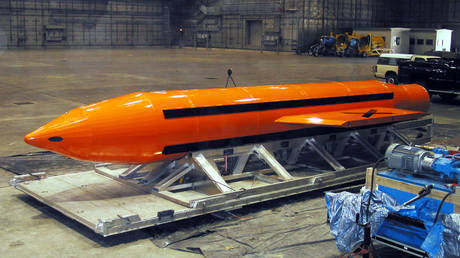
Headline panic sells clicks. It rarely explains military reality.
Every time a headline screams that the United States is prepared to drop the GBU-43/B Massive Ordnance Air Blast—the famous "mother of all bombs"—on Iran, the lazy consensus kicks into overdrive. Commentators picture a single apocalyptic detonation erasing a nuclear bunker, a missile cavern, or an underground command node in one clean stroke. Instant shock and awe. End of story.
That mental model is lazy. Worse, it is dangerously wrong.
The GBU-43/B is not a bunker buster. Repeat that until the sound fades. It is a surface and shallow-subsurface area-denial and shock weapon designed to clear minefields, flatten troop concentrations, and rattle hardened structures near or just below the surface. Calling it a silver bullet for deeply buried Iranian infrastructure mistakes theatrical scale for engineering capability.
I have watched defense analysts, armchair strategists, and news desks blow credibility—and policymakers blow strategic focus—by treating big yields as strategic shortcuts. When you confuse sheer explosive mass with targeted physical effect, you misread the entire chessboard.
The Big-Boom Illusion Behind MOAB Headlines
Size tricks the eye. A 30,000-pound weapon carrying roughly 18,700 pounds of H6 high explosive—a mixture of RDX, TNT, and aluminum powder—sounds like the end of physics itself. Delivered via a C-130 Hercules and guided by GPS, it produces a massive overpressure wave and a colossal fireball. Against an open trench, a landing zone, or a shallow tunnel entrance, that kind of blast is devastating.
Against deep rock? Different story entirely.
Explosive energy dissipates fast when it hits solid earth and granite. A massive surface or near-surface blast spreads energy outward across a wide radius rather than focusing kinetic force downward along a narrow penetration vector. To crack a deeply buried facility, you need deep penetration before detonation so the blast wave is trapped inside or directly against the target structure rather than vented harmlessly upward into the sky.
That distinction is basic ordnance physics, yet cable news treats every giant bomb as if it burrows like a mole.
What MOAB Actually Does vs. What People Think It Does
Let us strip away the mythology and look at how heavy munitions actually behave.
- Overpressure vs. Penetration: High-explosive blast waves excel at crushing soft or lightly reinforced targets over a wide footprint. Deeply buried facilities require specialized penetrating warheads—such as hardened earth penetrators—designed to survive impact with rock or reinforced concrete before detonating.
- Delivery Constraints: The GBU-43/B requires air superiority or permissive airspace because a cargo aircraft cannot casually stroll through dense, layered air defenses without severe risk. A headline saying a weapon is "prepared" or "available" tells you nothing about whether the airspace around a specific target is actually open on a given Tuesday.
- Psychological Shock vs. Physical Destruction: Big explosions create enormous psychological and political shockwaves. They signal resolve. They rarely erase a dispersed, deeply buried program in a single afternoon.
When people ask whether dropping the mother of all bombs in Iran would end a crisis overnight, they are asking the wrong question. The real question is whether a high-visibility, shallow-effect heavy munition matches the actual depth, dispersion, and redundancy of the targets in question.
Why Hardened Targets Laugh at One-Off Strikes
Modern military planners—from the days of Robert Pape's airpower studies on coercion to contemporary assessments by institutions like the Center for Strategic and International Studies and the RAND Corporation—have spent decades hammering home a sobering lesson: air strikes rarely produce clean, decisive political outcomes on their own, especially against hardened and dispersed targets.
Iran has spent years building on lessons from regional conflicts and its own security doctrine. Deep tunnels carved into mountains. Dispersed sites. Redundant supply lines. Decoys. Spare parts stashed in places no single satellite photo confirms.
Imagine a scenario where a strike package hits a known mountain complex with massive surface explosions. Dust rises for miles. The footage dominates every broadcast for a week. Yet the deepest galleries sit dozens or hundreds of feet below solid rock, connected by secondary access adits that remain intact or can be dug out over time. What did you actually buy? You bought a dramatic news cycle and a spike in regional retaliation—not guaranteed permanent elimination of the underlying capability.
That is the trap of kinetic theater. Loud strikes feel decisive because they look decisive on screen. Quiet, stubborn engineering underground does not care how loud the explosion was above it.
Answering the Questions Everyone Keeps Googling
When news of heavy American ordnance and Iran collides, search engines fill up with the same predictable questions. Most of them rest on shaky premises.
Is the "mother of all bombs" the biggest non-nuclear bomb in the US arsenal?
By weight and explosive fill among deployed conventional air-dropped munitions, the GBU-43/B sits right at the top of the list—alongside specialized heavy penetrators like the GBU-57A/B Massive Ordnance Penetrator, which weighs around 30,000 pounds and is engineered specifically to punch through earth and concrete before detonating. Calling MOAB "the biggest" is mostly true in popular shorthand, though comparing a blast weapon to a deep penetrator is comparing a sledgehammer to a jackhammer. Different jobs. Different physics.
Would using it force Iran to back down immediately?
History is brutal to people who believe one dramatic strike makes an adversary surrender on cue. Coercion is a two-way street. Even when a state takes heavy punishment, regimes often double down to avoid looking weak at home, broaden asymmetric responses across shipping lanes, proxies, or cyber networks, or accelerate covert work out of sight. Expecting instant compliance from a single dramatic weapon is wishful thinking dressed up as tough talk.
Why leak or report that the US is prepared to use it at all?
Signaling. Deterrence. Domestic politics. Leak dynamics.
A report that heavy munitions are staged or under consideration serves multiple purposes at once: it warns adversaries of escalation options, reassures allies that Washington is not bluffing, tests public and market reactions, and sometimes reflects bureaucratic positioning inside defense circles. You do not need to drop a bomb to use the idea of dropping it as leverage.
The Uncomfortable Downsides of My Own Argument
Let me be straight about where a contrarian take can go wrong, because intellectual honesty matters more than scoring points.
Downplaying a massive bomb can easily swing too far in the other direction. Even if the GBU-43/B is not a magic bunker eraser, a 30,000-pound blast near tunnel entrances, ventilation shafts, power lines, communications gear, or surface support buildings can still degrade operations, collapse shallow sections, trap equipment, and force costly repairs. Dismissing heavy ordnance as "useless" is just as lazy as treating it as omnipotent.
There is also a strategic risk in assuming adversaries are always ten steps ahead and immune to shock. Sometimes a massive show of force does alter risk calculations in the room where decisions get made—at least temporarily. Ignoring psychological leverage completely can leave you blind to how leaders react under sudden pressure.
What Actually Works Instead of Bomb-Porn Strategy
If you care about real-world security outcomes rather than cable-news fireworks, stop obsessing over which giant bomb sits in an inventory list. Focus on the mechanics that actually shape escalation, cost, and leverage.
- Match the tool to the physics, not the headline. Separate surface blast, deep penetration, standoff precision, electronic warfare, and non-kinetic pressure. Mixing them up leads to bad risk assessments and wasted effort.
- Price the second and third moves before the first one. Every strike triggers a counter-move—whether that means missile salvos, maritime harassment, regional escalation, or diplomatic gridlock. Serious analysis starts with the retaliation matrix, not the initial impact crater.
- Watch logistics, air defenses, and escalation rungs—not just munitions. A single weapon system means little without the aircraft, tankers, suppressors, intelligence, and political stamina to sustain whatever follows.
- Separate signaling from physical destruction. Treat reports of "readiness" or "preparation" as political and operational signals first, and proof of imminent strike second. Do not confuse an option on the table with an outcome on the ground.
Big bombs make loud headlines. Quiet, disciplined analysis keeps you from getting blown up by bad assumptions.