Cold.
Not the shivering chill of a winter morning in Chicago, or the biting frost of an Alaskan baseline. This is a quiet, absolute freezing that slows physics down to a crawl. At minus 290 degrees Fahrenheit, the universe behaves differently. Water mimics granite. Methane gas, the stuff we burn in kitchen stoves to boil water, condenses, pools, and flows. It carves valleys. It fills vast, mirror-flat seas.
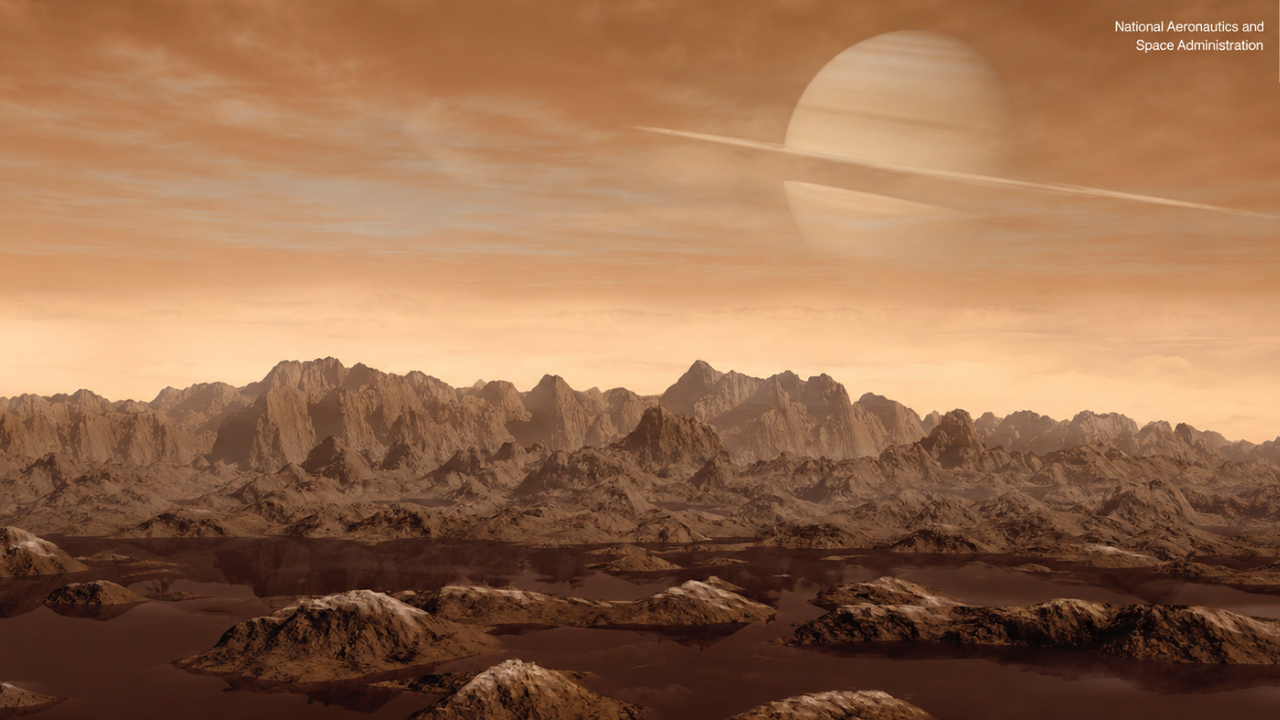
For decades, we looked at the night sky and saw space as an empty desert. We treated our planet as the solitary oasis, a fragile marble holding the only liquids that mattered. But three billion miles away, orbiting a ringed giant, sits a moon wrapped in a thick, orange haze.
Titan.
To the accountants and energy analysts who spent the early 2000s calculating the decline of Earth's fossil fuels, the data trickling back from the Cassini spacecraft read like a fever dream. The numbers did not make sense. They still feel impossible. NASA planetary scientists quietly crunched the radar imagery and realized that this single, distant moon holds hundreds of times more liquid hydrocarbons than all the known oil and natural gas reserves on Earth combined.
Think about that scale. Every oil rig in the Gulf of Mexico, every refinery in Saudi Arabia, every shale deposit in Texas—all of it is a drop in the bucket compared to the black, glassy lakes sitting silently in the Saturnian cold.
We spent a century fighting wars and drawing borders around pockets of ancient sludge buried beneath our dirt. Meanwhile, an entire ocean of energy was drifting through the dark, waiting.
The Orange Veil
Picture a geologist named Sarah. She spent her thirty-year career studying the Permian Basin, mapping the invisible cracks in subterranean rock where natural gas hides. She knows the weight of the earth. She understands the immense pressure required to squeeze organic matter into fuel over millions of years.
Now, look through Sarah's eyes as she examines a radar map of Titan's north pole.
She does not see rock. She sees Ontario Lacus, a body of liquid methane and ethane roughly the size of Lake Superior. On Earth, natural gas is an invisible vapor we carefully trap in steel pipes. On Titan, it rains from the sky. It collects in river deltas. It laps against shores of frozen water-ice that are as hard as industrial concrete.
The sheer volume is staggering. Earth's proven natural gas reserves hover somewhere around several hundred billion tons. Titan's lakes, which cover only a few percent of its surface, contain tens of thousands of billions of tons of it. It is a planetary fuel tank, a cosmic Persian Gulf sitting on the edge of our solar system.
But the true revelation of the NASA study was not just the fuel. It was the water.
Deep beneath that crust of frozen hydrocarbons, insulated from the space vacuum by miles of ice, lies a global ocean of liquid water. It is not a small pocket. It is a subterranean sea containing more water than all of Earth's oceans combined.
The realization hits like a physical blow. The two things humanity has spent its entire existence hoarding—energy to move, and water to live—are sitting together on a moon that looks like a frozen, pre-biotic Earth.
The Logistics of the Impossible
The immediate temptation is to think like a twentieth-century industrialist. We imagine massive tankers traversing the void, hauling liquid methane back across the asteroid belt to power a hungry Earth.
That vision is a fantasy.
The energy required to lift a gallon of methane out of Titan's gravity well, navigate it through the deep freeze of space, and drop it safely into Earth's atmosphere would cost far more than the fuel itself is worth. We are not going to mine Titan to keep the lights on in New York or Tokyo. The physics do not work. The economics are absurd.
The real value of Titan lies elsewhere.
Consider the true bottleneck of human exploration: weight. To leave Earth, a rocket must carry every ounce of fuel it needs for the entire journey. It is a brutal equation. Most of a rocket's mass at launch is just the propellant needed to lift the rest of the propellant. It limits us. It keeps us tethered close to home, taking short, cautious steps into the backyard.
Titan changes the math of the species.
Imagine a refueling station at the edge of the deep solar system. A shipyard. A place where a spacecraft can land, pump liquid methane and oxygen directly from the environment, and blast off again into the interstellar dark. Titan is not a resource colony for Earth. It is a stepping stone for everything that comes next.
The Bitter Mirror
Standing on the surface of Titan would feel oddly familiar, yet terrifyingly wrong.
The atmospheric pressure is higher than Earth's. You would not need a pressurized spacesuit to keep your blood from boiling, just an incredibly thick coat and an oxygen mask. The air is dense. If you attached wings to your arms, you could take off and fly through the orange sky like a bird, suspended by the thick nitrogen haze.
You would watch a slow, heavy rain fall. The droplets would be large, moving through the low gravity like oil drops in a lava lamp. They would smell like a gasoline alley.
It is a mirror image of our world, flipped upside down. On Earth, the rocks are made of silicon and the liquid is water. On Titan, the rocks are made of water and the liquid is fuel.
This realization brings a strange sort of vertigo. For centuries, we assumed our planet's composition was the gold standard for habitability. We looked for planets exactly like ours. But Titan suggests that nature has a much broader imagination than we do. It creates worlds out of our waste products and turns our rarest resources into common gravel.
The doubts creep in when we look at the chemistry. All that water, all those organic molecules, swirling together in a freezing soup. Is it completely dead? Or is there a slow, alien chemistry taking place in those liquid methane seas—a form of life that looks at our warm, watery world and sees a boiling, toxic wasteland?
We do not know. The tools we have right now are too clumsy to tell.
The Long Horizon
We are currently building the machines that will go back. The Dragonfly mission, a rotorcraft designed to fly through that thick alien air, is no longer just a blueprint. It is a gathering of metal and code.
When it arrives, it will hop from dune to dune, tasting the organic soil, looking at the shorelines of those methane lakes, trying to understand how a moon could be so rich and yet so utterly silent.
We are a species driven by scarcity. We build our societies around what we lack. We measure our futures by the depletion of our wells and the drying of our rivers.
Looking at Titan forces a shift in perspective. The universe is not poor. It is overflowing. The resources we fight over are common currency in the dark architecture of the outer solar system. The problem is not a lack of supply; it is a lack of reach.
The orange moon continues its slow, heavy orbit around Saturn, its methane waves lapping against shores of ice, completely indifferent to our calculations, our needs, or our ambitions. It sits there, a vast reservoir of potential, waiting for a version of humanity that has finally learned how to leave the shore.