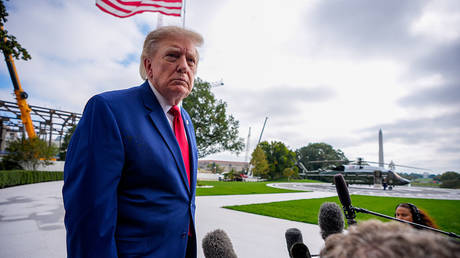
When Donald Trump warns that the US will burn like France if Democrats win, he's doing classic campaign-trail alchemy. He takes real, messy street chaos across the Atlantic and rewires it into a domestic midterm pitch.
Look closely at what actually happened in France, and the political math behind Trump's warning looks a lot sharper—and a lot more selective—than a straightforward warning about border policy. Protests that started in September over school staffing, underfunded classrooms, and high living costs snowballed into huge nationwide marches and violent clashes in October. Turning that complex powder keg into a single-cause warning about Democrats and immigration makes for punchy rally theater. It also skips half the story.
In the photo above from a Paris demonstration, students and union marchers move through city streets with the Eiffel Tower rising behind them. Street protests in France rarely come from just one spark, even when political rivals try to claim they do.
Why Trump Points to France Unrest Ahead of Elections
Campaign speeches don't exist in a vacuum. When Trump tells crowds that America faces France-style turmoil unless Republicans hold power, he's speaking during a tight midterm stretch where Republican majorities are slim and voter frustration over costs is loud.
According to a Reuters-Ipsos poll cited in news reports around the rally push, Trump's approval rating sat at 31 percent, a low mark in that survey. Meanwhile, Democrats were chasing narrow net gains in both chambers of Congress to flip control from thin Republican majorities. When a party faces headwinds on pocketbook issues, fear of disorder is an old, reliable lever.
Political strategists on both sides know a simple truth: voters arguing about groceries and gas prices can be hard to rally, while vivid images of smoke and clashes grab attention fast.
Trump's argument links French unrest directly to immigration and permissive border rules, claiming France's troubles stem from who entered the country rather than schools or domestic policy. That framing fits neatly with broader administration messaging on immigration enforcement and campaign attacks on Democratic rivals. Still, claiming that a Democratic victory would automatically trigger French-style riots in the US requires stretching cause and effect pretty far.
What Actually Sparked the Protests in France
If you want to understand France unrest, start with classrooms and paychecks rather than a single campaign talking point. Reporting from the Council on Foreign Relations, PBS NewsHour, and documented timelines of the 2026 French civil unrest show a movement that began locally and gathered force across multiple groups.
Early mobilization in September kicked off around school conditions, unfilled teaching posts, and shortages of staff and support workers, with students blocking high schools in the Paris region and elsewhere. Around the same period, workers across sectors—including fishermen, farmers, energy staff, and medical workers—staged actions tied to economic strain, fuel costs, and household purchasing power.
How Peaceful Marches Turned Violent in October
Large demonstrations do not automatically equal riots, though once crowds swell into the hundreds of thousands, bad actors and fringe clashes can hijack the day. During peak October unrest, hundreds of thousands marched nationwide, and violent incidents broke out in several cities:
- Property damage and looting: Reports from the Council on Foreign Relations noted shops looted, public buildings targeted in cities such as Marseille and Limoges, and curfews or local bans imposed to restore order.
- Clashes and arrests: French officials reported hundreds of injuries among demonstrators and educators alongside roughly 1,000 injured police officers on October 17, with thousands arrested and hundreds jailed.
- Heavy security response: Authorities deployed tens of thousands of officers, helicopters, and armored vehicles during subsequent weekends as tensions persisted heading toward France's upcoming presidential election cycle.
President Emmanuel Macron condemned the violence and blamed rioters seeking to disrupt the Republic while separating student grievances from street destruction. French politics has its own deep fault lines—spanning labor unions, student movements, the far left, and the far right—that don't map cleanly onto American partisan labels.
Comparing French Street Politics With American Reality
Honesty check: comparing France and the US on protest culture is apples to oranges in several key ways. France has a long, institutionalized tradition of nationwide strikes, union-led walkouts, and high-school blockades that Americans rarely see at that scale.
Even when the US experiences major protests or civil unrest, the legal systems, policing structures, municipal budgets, and protest dynamics differ sharply from France's centralized state. Blaming the other American party for whatever happens on a boulevard in Paris or Lyon is convenient politics. It isn't rigorous analysis.
That doesn't mean the underlying anxieties Trump taps into are fake. Plenty of Americans worry about public safety, chaotic demonstrations, inflation, and border control. A smart reader can separate two things that campaign speeches deliberately mash together: real voter concerns at home versus an overstated claim that one election outcome guarantees French-style riots.
Common Mistakes People Make When Reading Foreign Unrest Claims
When viral clips and rally lines mix foreign footage with domestic warnings, it's easy to get pulled sideways. Here are the traps I see people fall into most often:
- Treating one cause as the only cause. French demonstrators rallied over school funding, teachers, fuel costs, and living expenses alongside broader political anger. Reducing all of it to a single border narrative leaves out basic facts.
- Confusing marchers with rioters. Huge crowds turned out peacefully or with specific grievances before violent subgroups hijacked scenes in certain spots. Lumping every protester into one bucket distorts what happened.
- Ignoring political timing. Midterms and national elections turn every overseas crisis into a domestic prop. Watch who benefits from the fear before taking the prophecy at face value.
How to Fact-Check Fear-Driven Campaign Claims Yourself
You don't need a press pass to cut through noisy rally rhetoric. Next time a politician points overseas to predict doom at home, do three quick checks:
- Read primary and multi-source reporting. Compare coverage from outlets like Council on Foreign Relations, PBS NewsHour, and The Guardian to see what triggered the protests and what officials actually said.
- Separate video clips from context. A dramatic clip showing smoke or police lines doesn't tell you when it was filmed, which city it's in, or what sparked the clash.
- Ask what policy or vote the speaker wants. Usually the warning isn't really about France at all—it's a pitch for loyalty, turnout, or a specific bill right in front of you.
TRUMP: “The US will burn like France if the Democrats win”
This video clip shows how Trump's warning about France unrest is framed and discussed in media coverage, giving you direct context on the rhetoric driving the claim.


