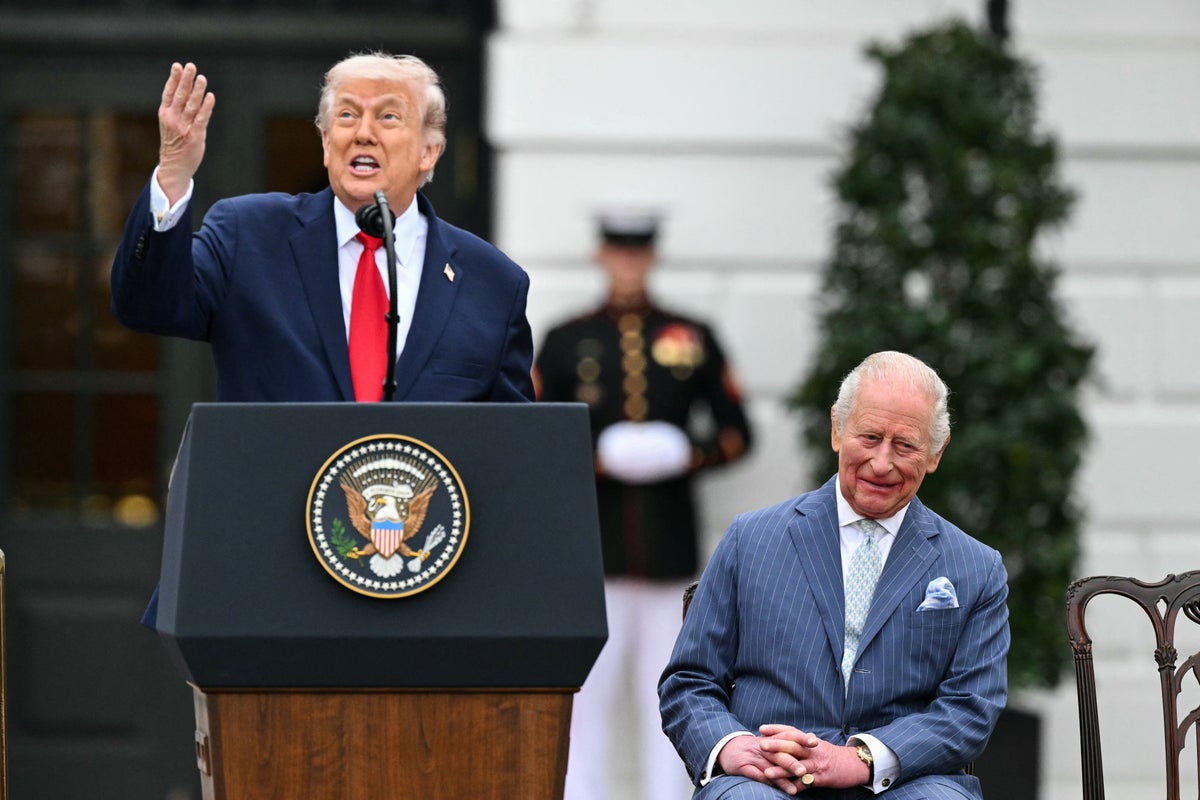
Donald Trump recently shared a story regarding his mother’s supposed "crush" on King Charles III during a high-profile gathering. The anecdote, delivered with Trump’s signature blend of hyperbole and personal branding, reportedly left the British monarch in a state of visible discomfort. This exchange represents more than a simple social stumble; it highlights a recurring friction point in international relations where the American populist style of personal intimacy meets the rigid, silent protocols of the British Crown. While the remarks were framed as lighthearted, the resulting awkwardness serves as a case study in how modern political communication can inadvertently strain the delicate machinery of the special relationship between the United States and the United Kingdom.
The Mechanics of Discomfort
The incident occurred during a moment that required the traditional dignity associated with heads of state. Instead of sticking to the vetted script of bilateral cooperation, Trump pivoted to a narrative about Mary Anne MacLeod Trump. By suggesting his mother harbored a romantic fascination with a young Prince of Wales, he crossed a line of decorum that the Royal Family has spent centuries maintaining.
To understand why this landed with a thud, one must look at the nature of the British monarchy itself. The Crown operates on a foundation of "never complain, never explain." It is an institution built on a specific type of distance. When an American politician attempts to humanize the sovereign through the lens of a middle-class infatuation, it strips away the very mystique that justifies the monarchy’s existence. King Charles, a man who has spent seven decades mastering the art of the neutral facial expression, was forced into a public display of awkwardness because the comment left him with no dignified exit path.
A Clash of Branding Styles
Donald Trump views the world through the prism of personal celebrity. To him, mentioning a mother’s admiration is a way to establish a blood tie to the elite circles he inhabits. It is a tool for proximity. He isn’t just a former president; in his own narrative, he is the son of a woman who looked at the throne with longing, thereby framing his own rise as a completion of a family arc.
On the other hand, the King represents continuity and a rejection of the individual in favor of the office. The contrast is stark.
- The Trump Approach: Personal, anecdotal, transactional, and designed to provoke an immediate emotional reaction.
- The Windsor Approach: Impersonal, symbolic, historical, and designed to avoid any reaction at all.
When these two forces collide, the result is rarely a productive dialogue. Instead, it creates a vacuum where the "awkward laughter" mentioned by witnesses becomes the only available currency. This isn't just about a joke that didn't land. It is about a fundamental misunderstanding of the audience. A veteran journalist looks at this and sees a pattern of diplomatic disruption that has characterized the last decade of Atlanticism.
The Role of Mary Anne MacLeod Trump
The mention of Trump’s mother is not incidental. Mary Anne MacLeod was a Scottish immigrant who retained a deep, lifelong reverence for the British monarchy. For Trump, invoking her name is a way to ground his often-combative rhetoric in a sense of heritage.
However, using a deceased parent’s private feelings as a conversational gambit in a formal setting is a high-risk maneuver. It assumes a level of familiarity that the King, by virtue of his position, cannot reciprocate. Sources close to the palace often speak of the "invisible wall." Trump didn't just knock on that wall; he tried to spray-paint a family mural on it.
The King’s reaction—or lack thereof—is the standard defense mechanism of the institution. By offering nothing more than a strained smile, the monarch ensures that the comment remains the property of the speaker. The King does not become a participant in the narrative; he remains a statue while the tourist takes a selfie.
Beyond the Social Gaffe
Diplomacy is often governed by the "small talk" that happens in the margins of the big meetings. In these moments, the goal is to find common ground that is safe, boring, and predictable. Weather, architecture, and vague historical ties are the staples of this diet.
When a leader introduces a sexual or romantic subtext, even as a joke about a previous generation, they introduce volatility. It forces the other party to consider the implications. Was this an attempt at a genuine compliment? Or was it a subtle assertion of dominance? In the world of high-stakes statecraft, ambiguity is the enemy of stability.
The fallout from such comments rarely appears in a formal communique. You won't find a line in a State Department briefing about "maternal crushes." Yet, the damage is real. It creates a sense of wariness among the staff and the diplomats who have to clean up the metaphorical broken glass. They are left wondering what will be said in the next closed-door session, and that uncertainty slows down the actual work of governing.
The Persistence of the Populist Playbook
This event is a microcosm of the broader populist movement’s relationship with traditional institutions. Populism thrives on the breaking of taboos. It gains its energy from the "can you believe he said that?" factor. For Trump’s base, this story is likely seen as a sign of authenticity—a man who is so powerful and comfortable that he can joke with a King as if they were sitting in a country club locker room.
But the international community does not operate on the rules of a country club. It operates on the rules of a courtroom.
Every word is weighed. Every gesture is cataloged. When the American leader treats a royal encounter as a segment of a reality television show, it signals to other world leaders that the United States is moving away from the predictable norms that have underpinned global order since 1945. This isn't about being "politically correct." It is about being professional in a way that allows for the smooth transfer of information and intent.
The King’s Burden
King Charles is currently navigating a difficult period for the monarchy. With health concerns and family internal strife dominating the headlines, the last thing the palace needs is to be a punchline in a story about 1950s celebrity worship.
The monarch’s role is to be a steadying hand. When he is pulled into the orbit of a figure as polarizing as Trump, his neutrality is threatened. If he laughs too hard, he is seen as partisan. If he reacts with anger, he is seen as weak. The "awkwardness" was his only viable survival strategy. It was a tactical retreat into the silence that has protected his family for a millennium.
Why This Matters Now
We are entering a cycle where the intersection of celebrity and politics is becoming the primary driver of public discourse. The substance of trade deals or security pacts is frequently overshadowed by the optics of a handshake or a poorly timed joke.
This specific interaction highlights the reality that as much as we talk about "policy," the personalities of the individuals at the top remain the most significant variable in the equation. A single comment about a mother’s crush can do more to set the tone of a month-long diplomatic mission than a thousand pages of white papers.
The challenge for the next generation of diplomats is learning how to navigate a world where the leaders they serve may no longer respect the boundaries that once made their jobs possible. They are being forced to operate in a reality where the "unfiltered" is the new standard, and the "awkward" is the new normal.
The Strategy of the Uncomfortable
Some analysts argue that Trump’s use of discomfort is intentional. It is a way to keep the other party off-balance. If you are worried about what the man across the table is going to say about your family, you are less focused on the specifics of the negotiation at hand. It is a psychological tactic used in real estate and high-finance for decades.
Whether this was a calculated move or a genuine slip of the tongue matters less than the outcome. The outcome was a public display of the widening gap between the old guard of the European establishment and the new, loud, and unpredictable force of American populism.
The Special Relationship has survived wars, economic depressions, and ideological shifts. It is now being tested by the simplest of things: a story about a fan girl from the Isle of Lewis and the man who eventually became King.
Watch the hands of the advisors next time. They aren't reaching for their notes; they are reaching for their foreheads.