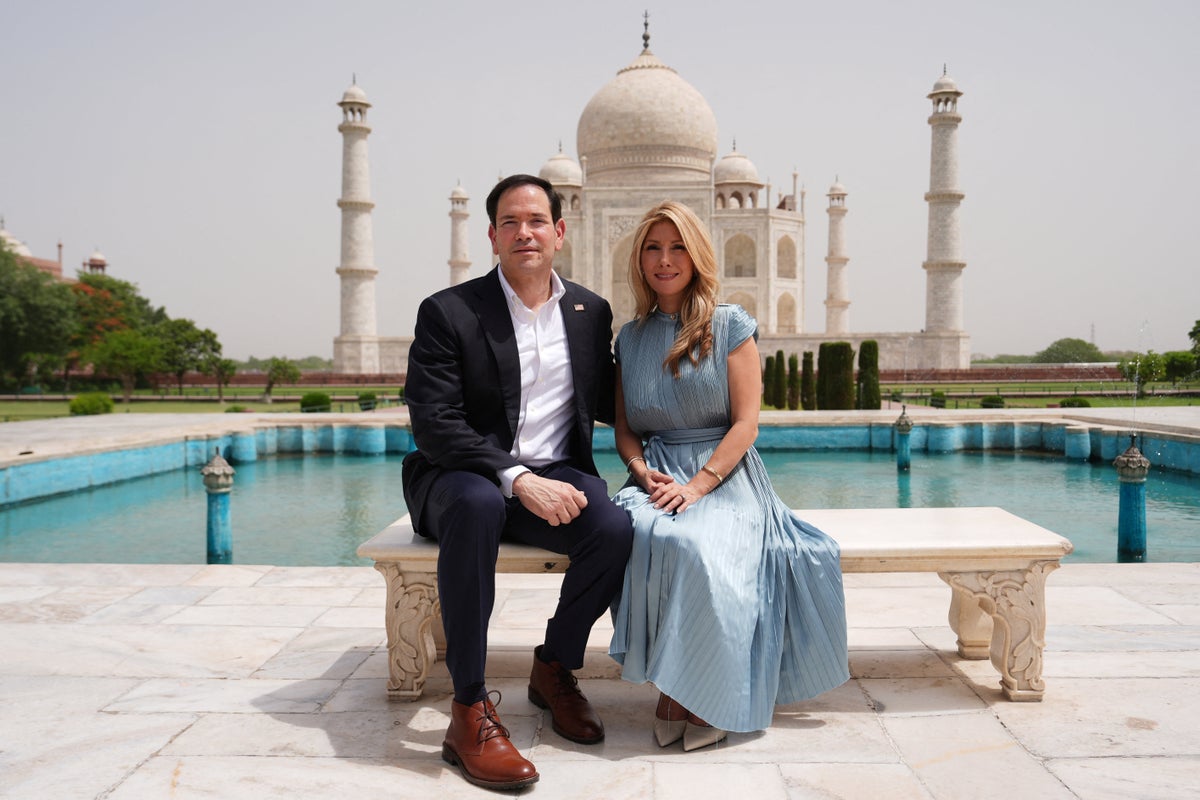
U.S. Secretary of State Marco Rubio did not explicitly call President Donald Trump "stupid" during his high-stakes bilateral press conference in New Delhi, but the frantic cleanup operation required to keep U.S.-India relations from fracturing further exposed the volatile intersection of online political rhetoric and global statecraft. Standing alongside Indian External Affairs Minister S. Jaishankar during his four-day diplomatic tour, Rubio was forced to field a pointed question regarding a wave of anti-India internet commentary that had been amplified by parts of the MAGA movement, including an incident where Trump reshared a post calling India a "hellhole." Rubio broke the tension with a blunt piece of damage control, stating that every country in the world has stupid people making dumb comments all the time, a rhetorical pivot that protected his boss while acknowledging the toxic friction threatening Washington's most vital Indo-Pacific partnership.
The incident highlights a broader diplomatic crisis that traditional statecraft is poorly equipped to handle. While Rubio and Jaishankar attempted to focus on a massive $500 billion trade target, critical energy partnerships, and an upcoming Quad security summit, the reality is that raw internet vitriol now possesses the power to derail decades of careful, bipartisan diplomacy.
The Anatomy of a Clean-Up Job
The press conference at Hyderabad House was supposed to be a tightly choreographed display of strategic alignment. U.S.-India ties have hit their lowest point in over two decades, heavily strained by Washington's aggressive tariff policies that penalize key Indian exports, forcing New Delhi to pivot toward sweeping trade agreements with Oman, New Zealand, the United Kingdom, and the European Union. Rubio’s primary mission was to fix this trust deficit.
Instead, the ghost of the American digital culture war crashed the room.
When an Indian journalist pressed Rubio on the rise of racist remarks directed at Indian Americans—specifically referencing high-profile social media endorsements—the Secretary of State had to choose between a full diplomatic retreat or a delicate semantic dance. By framing the offensive commentary as the product of ubiquitous, borderless ignorance rather than official policy, Rubio sought to decouple White House rhetoric from the institutional goals of the U.S. State Department.
It was a classic case of strategic ambiguity deployed to minimize domestic political damage while saving face abroad. Trump himself attempted a rapid course correction shortly after the initial online backlash, placing a surprise live phone call to an embassy event in New Delhi to reiterate his affection for Prime Minister Narendra Modi. Yet, the underlying friction remains plain to see.
The Subtext of Modern Trade and Tariff Wars
Beneath the rhetorical skirmishes lies a far harsher economic reality. The actual friction between Washington and New Delhi is driven by trade friction, not just internet comments.
India has grown increasingly skeptical of American reliability. The implementation of universal tariff frameworks by the administration has hit Indian steel, aluminum, and technology manufacturing sectors hard. In response, New Delhi has rapidly diversified its economic dependencies to insulate its markets from the unpredictable shifts of American domestic politics.
| Country/Bloc | Agreement Status (2025-2026) | Strategic Purpose |
|---|---|---|
| United Kingdom | Finalized | Post-Brexit supply chain integration |
| European Union | Signed (January 2026) | Access to a third of global trade volume |
| Oman & New Zealand | Operational | Energy security and agricultural diversification |
| United States | Pending | Stalled over agricultural tariffs and market access |
Rubio repeatedly expressed optimism that a comprehensive bilateral trade deal with India would be finalized soon. Achieving that goal will require navigating an incredibly narrow legislative needle.
The Immigration Modernization Friction
A secondary, highly volatile point of contention during the bilateral talks was the sweeping restructuring of the American immigration system. Tens of thousands of Indian tech professionals, skilled workers, and graduate students rely on predictable access to H-1B visas and employment-based immigration pipelines each year.
Rubio sought to reassure his hosts by arguing that the ongoing enforcement push and policy shifts are not India-specific. He pointed directly to the domestic political pressures shaping Washington’s outlook, noting that over 20 million undocumented crossings in recent years have forced a total systemic overhaul.
"Everything that you do as a country needs to be in your national interest, and that includes your immigration policy," Rubio noted during the press availability, attempting to normalize the tighter regulatory environment as a standard exercise of national sovereignty rather than a hostile action targeting South Asian talent.
For India, this argument is difficult to swallow. While the legal text of the new immigration rules may be globally uniform, the practical impact falls heavily on India’s booming technology sector, which provides the critical human capital driving Western enterprise infrastructure.
Quad Security vs. Energy Pragmatism
The true test of the relationship will occur during the upcoming Quad meetings, where Rubio joins his counterparts from India, Australia, and Japan. Here, the shared anxiety over regional stability in the Indo-Pacific keeps the two nations locked in a necessary embrace, regardless of the political noise coming out of Washington.
Yet, even within the security realm, major divergence persists regarding energy security and international conflict. With maritime trade routes through the Strait of Hormuz highly volatile following regional military engagements, global oil supplies face severe constraints.
Jaishankar made it clear that India’s approach to the energy crunch is rooted entirely in survival and domestic economic growth, not ideological alignments. India will continue to diversify its fuel sourcing from any available market, including heavily discounted Russian crude and independent Middle Eastern suppliers, to keep domestic pump prices low. Washington views these purchase agreements with immense frustration, but Rubio lacks the diplomatic leverage to force a change in New Delhi's strategy while the U.S. continues to wage an aggressive tariff campaign against Indian goods.
Chasing a $500 billion trade goal requires predictable governance, a luxury that current domestic political dynamics on both sides of the Pacific rarely afford. Rubio's whirlwind tour may have temporarily quieted the immediate controversy surrounding online insults, but the systemic economic and structural policy divisions between the world's two largest democracies cannot be wiped away with clever press conference deflections.