A standard shipping container is a remarkably unfeeling object. It is a corrugated steel box, usually painted a weathered blue or rust-red, measuring exactly forty feet long. It does not care about the shifting alliances of nations. It does not feel the anxiety of a small-scale textile manufacturer in Surat who pooled his life savings to fill it with intricate zari-work fabrics. It is blind to the ambitions of a tech startup founder in Austin waiting for the custom semiconductor components resting inside its belly.
Yet, these metal boxes are the true currency of modern geopolitics. When they move smoothly, store shelves are full, factories hum, and dinner tables are peaceful. When they stall at a port because of a missing signature or an overnight tariff hike, lives quietly fracture miles away.
Behind the dry headlines detailing trade delegations and bilateral frameworks sits a high-stakes chess game played by flesh-and-blood people. The announcement that United States Trade Representative Jamieson Greer is scheduling an official visit to India isn’t just a scheduling update for bureaucrats. It is a frantic, necessary attempt to untangle the knots that keep those steel boxes stuck at sea.
To understand why a single Washington official landing in New Delhi matters to someone buying groceries in Ohio or running a pharmacy in Mumbai, you have to look past the policy jargon. You have to look at the friction.
The Friction of Distance
Consider a hypothetical smartphone. We often think of technology as something born in a clean, sterile laboratory, springing fully formed from the mind of an engineer. The reality is much dirtier. A single device relies on a fragile, thousands-of-miles-long daisy chain of human hands. The rare earth elements might be mined under grueling conditions, refined across another continent, designed in California, and assembled in Tamil Nadu.
For years, this chain worked because everyone agreed to a basic set of rules. But those rules were written for a different era.
Today, an American company trying to source components from India faces a dizzying wall of paperwork. Customs duties act like sudden speed bumps on a highway. On the flip side, Indian agricultural exporters looking to tap into American supermarkets frequently find themselves blocked by stringent, sometimes mercurial, sanitary regulations that reject entire shipments of fruit because of a microscopic discrepancy.
When Jamieson Greer steps off the plane, he carries a briefcase literalized by these frustrations. His predecessor, Katherine Tai, spent years managing a complex, often defensive trade posture. Greer enters a room where the atmosphere has shifted. The global economy is fracturing into distinct blocs. Supply chains are no longer just about finding the cheapest place to make a plastic toy; they are about national security.
The United States wants to decouple its critical industries from hostile actors. India wants to become the undisputed factory floor of the world. On paper, it is a perfect marriage of convenience. In practice, it is a negotiation over pennies that feels like a battle over sovereignty.
The Ghost at the Negotiation Table
Every trade negotiation has a third, uninvited guest in the room: China.
For the past three decades, global manufacturing had a single, dominant gravitational center. That center is shifting. Western executives have realized that putting all their manufacturing eggs in a single geopolitical basket is a recipe for catastrophic vulnerability. They call the alternative "friendshoring"—routing supply chains through nations with shared values.
This is where India should be winning effortlessly. It possesses a massive, young workforce, a growing domestic market, and a democratic framework. Yet, switching a supply chain isn't as simple as changing a shipping address.
Think of a massive automotive plant. It requires thousands of tiny suppliers—companies that make nothing but a specific rubber seal or a precise copper washer—to be located within a short drive. China built those ecosystems over forty years. India is trying to build them in five.
When Greer sits across from Piyush Goyal, India’s Commerce Minister, the ghost of Beijing will dictate the urgency. The American side wants swift access to India's digital economy and lower tariffs on American agricultural goods and medical devices. The Indian side wants the restoration of its Generalized System of Preferences (GSP) status, which historically allowed billions of dollars of Indian goods to enter the US duty-free before it was revoked during a previous era of trade friction.
It is a barter system wrapped in institutional elegance. I will give you your tech access, but only if you let my mangoes and generic pharmaceuticals pass through your ports without endless delays.
The Human Cost of a Percentage Point
We lose the plot when we talk exclusively in billions of dollars. Let us shrink the scale.
Imagine a small electronics assembly unit on the outskirts of Bengaluru. The owner, a woman named Priya, employs forty local workers. She relies on specialized testing equipment imported from Ohio. If the import tariff on that equipment is twenty percent instead of five percent, she cannot afford to expand her line. Her forty workers remain forty; the ten young men and women waiting for an apprenticeship stay unemployed.
Now look at the other side of the ocean. A family-owned dairy farm in Wisconsin is struggling to survive on razor-thin margins. The owner knows there is a massive, dairy-loving middle class expanding rapidly across India. If he could export his whey protein powders or specialty cheeses without facing astronomical Indian duties, his farm survives another generation. If the barriers stay up, he sells his land to a suburban developer.
These are the silent stakeholders of the Greer-Goyal meetings. They will never read the joint statements issued at the end of the summit. They will never know the names of the deputy assistant secretaries who argued until 3:00 AM over the precise definition of an agricultural subsidy. But their survival hinges entirely on whether those officials can find a compromise.
Trade policy is often treated like a math problem, but it is actually a psychological thriller. It requires two proud nations to admit that they cannot survive entirely on their own. It demands that they tolerate the political pain of opening their domestic markets to foreign competition in exchange for the long-term health of their economies.
The Architecture of the Deal
The upcoming talks are expected to focus heavily on critical and emerging technologies. This is the jargon used to describe the brains of the future: artificial intelligence, quantum computing, and next-generation semiconductors.
The US recognizes that it cannot out-manufacture the world on raw labor power anymore. Its edge lies in intellectual property and high-value design. India recognizes that its traditional strength in software services needs to evolve into hardware manufacturing if it wants to provide high-quality jobs for its millions of engineering graduates.
But a collision occurs when the discussion turns to data localization. India wants the data of its citizens stored within its physical borders, viewing it as a national asset to be protected from foreign tech monopolies. The US argues that the free flow of data across borders is the very oxygen that allows modern tech businesses to function.
It is an ideological stalemate disguised as a technical disagreement. How Greer navigates this will determine whether the next generation of technological innovation is co-authored by Washington and New Delhi, or if they build parallel, incompatible digital ecosystems.
Beyond the Communiqué
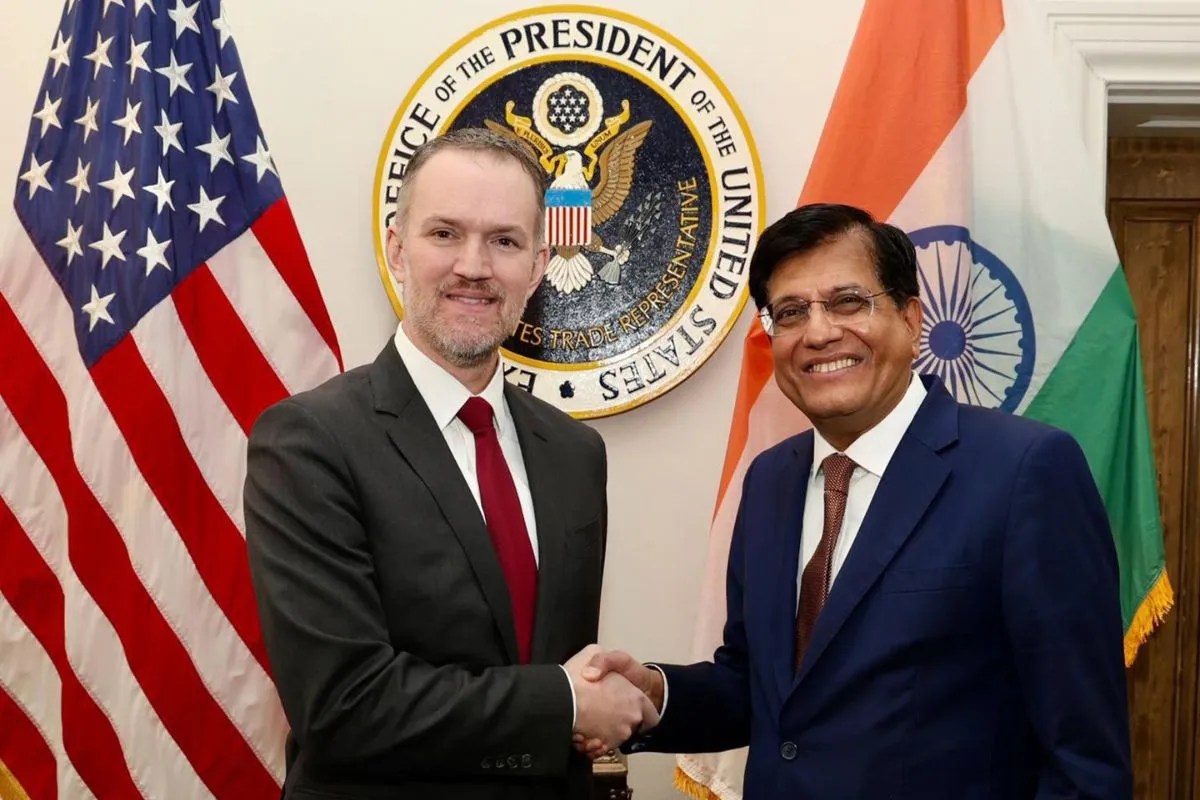
There will be a press conference. There will be photographs of smiling dignitaries shaking hands in front of a backdrop of intertwined flags. A carefully worded document will be released, full of verbs like "strengthened," "reaffirmed," and "explored."
Do not look at the smiles. Look at the specific commitments on tariff structures and regulatory alignments. The true measure of success for Greer's visit will not be measured in the warmth of the rhetoric, but in the velocity of the cargo.
If the mechanisms are greased, a truck driver in Ohio will soon haul a container filled with Indian components that arrived without a hitch at the Port of Los Angeles. A factory worker in Pune will uncrate an American machine tool that didn't require six months of bureaucratic clearance to import.
The world is growing louder, more volatile, and increasingly insular. The instinct of many nations is to pull up the drawbridge, to retreat behind high tariff walls and nationalistic economic policies. But the prosperity of the last half-century was built on the radical idea that we are better off relying on one another than trying to stand entirely alone.
As the diplomatic motorcade winds through the streets of New Delhi, the steel boxes continue to stack up on the docks of Mumbai and Savannah, waiting to see if the humans can finally clear the way.