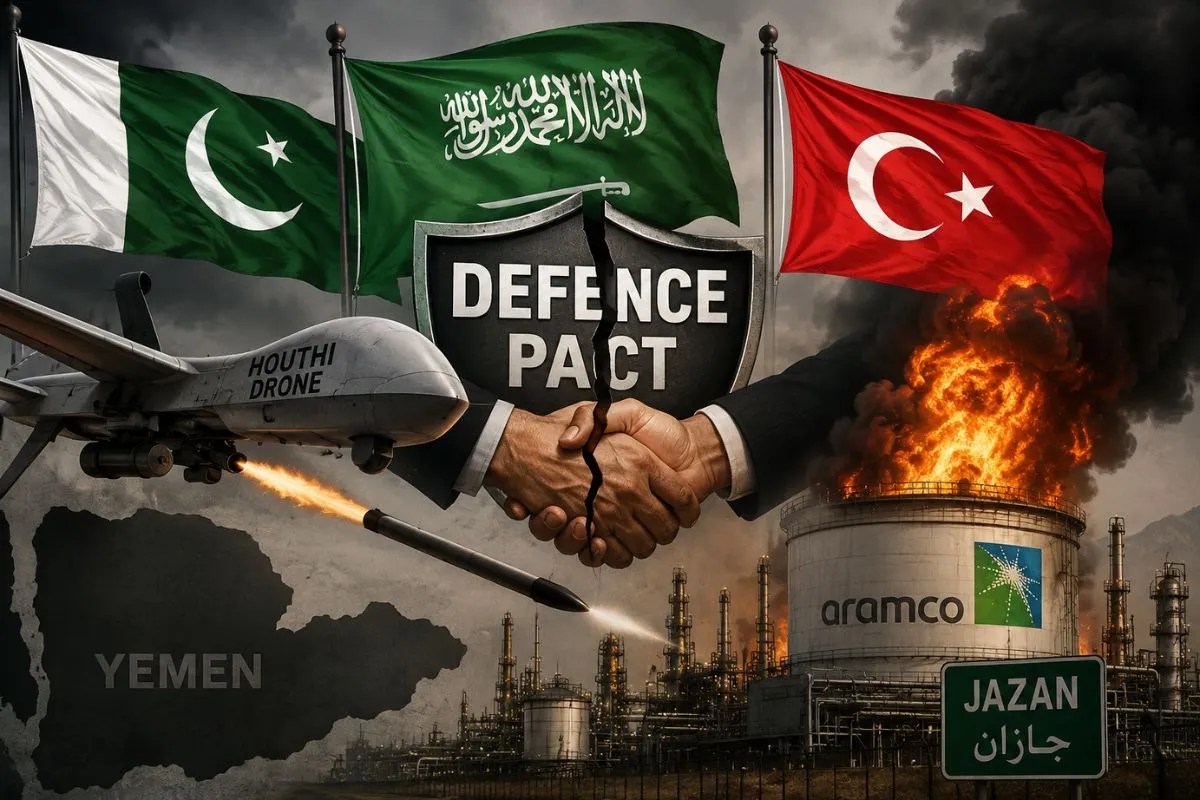
The coffee in the clay mug was already cold. Tariq did not drink it. He stared through the narrow slit of the concrete observation post, watching the predawn light bleed over the Red Sea coastline near Jazan. To the untrained eye, the horizon looked peaceful—a pale wash of amber and dusty violet stretching toward the mountains of Asir. But Tariq knew better. The air smelled of ozone and hot metal before the sun even cleared the dunes.
Then came the whine.
It was a low, insectoid buzz that grew into a mechanical shriek within seconds. A Houthi drone, sleek and packed with explosives, dropped out of the morning cloud cover, diving steeply toward the critical energy infrastructure lining the Saudi coast.
Tariq did not panic. He reached for the radio. But before his call could echo through the command network, a flash of white fire tore across the sky. The interceptor missile struck the incoming threat with brutal precision. A secondary bloom of orange flame blossomed against the empty heavens, followed by a heavy, concussive thud that rattled the sandbags at his feet.
Another attack stopped. Another crisis averted. Yet, as the smoke drifted lazily out over the water, a deeper, more unsettling question hung in the warm desert breeze. Who actually holds the shield?
This was not merely another localized skirmish in a decade-long regional conflict. This moment in Jazan marked the quiet, unannounced baptism by fire for a new axis of military alignment. For months, diplomatic cables in Islamabad, Ankara, and Riyadh had hummed with cautious optimism and strategic necessity. The newly whispered defense pact linking Pakistan, Saudi Arabia, and Türkiye was no longer just ink drying on parchment in a wood-paneled conference room. It had just been tested in real-time by a hostile wing of fiberglass and circuit boards.
To understand why this matters, step away from the maps and the dry press releases. Imagine the boardroom pressures in capitals thousands of miles apart. Pakistan possesses a battle-hardened military and nuclear deterrent capability, forged in decades of localized friction, yet wrestling with chronic economic fragility. Türkiye boasts a booming defense manufacturing sector, churning out Bayraktar drones and sophisticated electronic warfare systems that have rewritten modern military doctrine from Nagorno-Karabakh to Eastern Europe. Saudi Arabia commands immense financial capital and critical energy corridors, yet faces persistent asymmetric threats along its sprawling borders.
Individually, each nation carries a distinct vulnerability. Together, they form an intriguing geopolitical puzzle piece.
When the drone struck toward Jazan, it tested more than radar cross-sections and air defense reaction times. It tested an unspoken premise: Can a nuclear-armed South Asian giant, a rising Eurasian drone superpower, and an Arabian economic heavyweight forge an ironclad security architecture independent of traditional Western oversight?
The answer is complicated, messy, and unfolding right now.
Look closer at the mechanics of modern defense diplomacy. It rarely looks like grand parades or cinematic handshakes. It looks like logistics officers arguing over encrypted software protocols in modular container offices. It looks like Turkish engineers calibrating radar arrays manufactured in Anatolia to sync seamlessly with communications gear maintained by Pakistani technicians on Saudi soil.
When the Houthi projectile targeted Jazan, the defensive response relied on a sophisticated mosaic of detection and interception. While Saudi Patriot batteries and domestic systems bear the brunt of these daily incursions, the broader strategic umbrella relies on shared intelligence, joint manufacturing supply chains, and mutual deterrence doctrines.
(Note: The following scenario illustrates how defense analysts model these multi-national logistical loops during active threats.)
Imagine a secure command bunker three hundred miles inland. Screens flicker with telemetry data. A Turkish-made drone surveillance feed beams live infrared footage of launch sites in the mountains across the border. Pakistani advisors cross-reference the trajectory vectors against historical wind patterns and payload signatures. Meanwhile, Saudi commanders authorize the final defensive posture.
It is a dance of mutual reliance.
Yet, anxiety underpins every handshake. Critics whisper about command-and-control friction. Can armed forces with entirely different training backgrounds, linguistic barriers, and distinct operational histories truly fight as a unified front when seconds matter? History is littered with ambitious alliances that fractured the moment an unexpected shell landed in the trenches.
Furthermore, the regional fallout cannot be ignored. Tehran watches these developments with intense, quiet calculation. Washington and Brussels observe with a mixture of intrigue and diplomatic caution, wondering if this tripartite alignment signals a permanent shift toward multi-polar regional security, where middle powers take defense into their own hands rather than waiting for distant superpowers to intervene.
The smoke over Jazan cleared within an hour. The harbor workers returned to their posts. The oil tankers continued their slow, deliberate processions out toward global shipping lanes.
Back in his observation post, Tariq set down his cold coffee and wiped a layer of fine desert dust from his binoculars. The drone was gone, reduced to ash scattered across the coastal scrub. But the geopolitical tremors of its flight path were just beginning to register across three continents.
The shield held today. The real test is whether it can withstand tomorrow.


