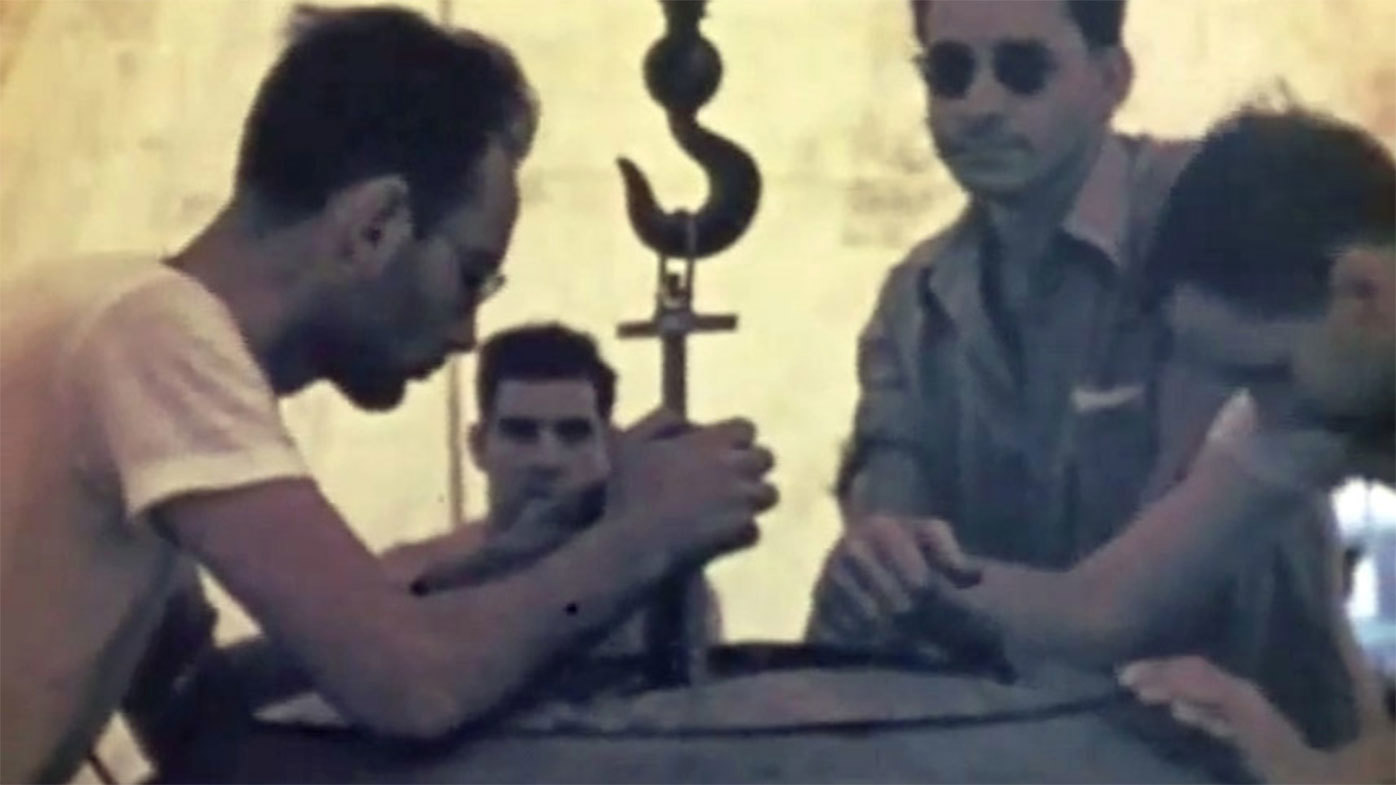
The metal was deceptively heavy, surprisingly warm, and entirely indifferent to the men who held it.
To the untrained eye, it looked like a harmless piece of industrial hardware. It was a smooth, silvery sphere of plutonium-239, weighing just over fourteen pounds and measuring a mere 3.5 inches in diameter—roughly the size of a cricket ball. It sat quietly on a wooden workbench in a rustic, canyon-walled laboratory in Los Alamos, New Mexico. It did not glow. It did not hum. But it possessed a terrifying, invisible appetite.
It wanted to awaken.
Two brilliant scientists, separated by a mere nine months, looked into the eyes of this exact same metallic sphere. Both men were masters of their craft. Both were driven by a mixture of intense patriotic duty and fierce intellectual curiosity. And both would be utterly destroyed by the exact same fourteen pounds of matter.
This is not just a historical ghost story about the dawn of the atomic age. It is a cautionary tale about the thin, fragile line between human genius and catastrophic hubris, and what happens when we mistake our absolute control over nature for absolute safety.
The Cold Anatomy of a Silent Monster
To understand what happened in that dusty desert laboratory, we have to look past the Cold War mythology and understand the sheer physics of what these men were playing with.
The sphere of plutonium was originally manufactured to be the heart of a third atomic bomb, intended to be dropped over Japan if the surrender after Nagasaki failed to materialize. When the war ended abruptly in August 1945, the military found themselves with a leftover core of pure, weaponized destruction. Scientists nicknamed it "Rufus." Later, it would earn a far more sinister moniker: the Demon Core.
Plutonium is inherently unstable. Left alone, its atoms naturally split, releasing a steady stream of subatomic particles called neutrons. If you pack enough plutonium together tightly enough, those released neutrons will strike other atoms, causing them to split in turn, releasing even more neutrons. This is a chain reaction.
If the reaction sustains itself perfectly, it reaches a state called "criticality." If it spins wildly out of control, it goes "supercritical," releasing a blinding, lethal flash of radiation.
The scientists at Los Alamos were tasked with a deeply perilous mission: to find out exactly how close they could push this sphere to the brink of supercriticality without crossing the line. They needed to know how to maximize the efficiency of America's new atomic arsenal. The problem was that they were doing this manually, using makeshift tools, in an era before remote-controlled robotic arms or automated safety protocols existed.
They called the practice "tickling the dragon’s tail." It was an apt metaphor. They were poking a sleeping monster with a stick, waiting to see how loud it would growl before they pulled back.
The August Heat: Harry Daghlian’s Lonely Mistake
The first man to feel the dragon's breath was Harry Daghlian.
He was only twenty-four years old, a brilliant graduate student from Connecticut with a soft face and a quiet disposition. On the night of August 21, 1945, the Los Alamos campus was winding down. The war was officially over, but the pressure to deliver scientific data remained relentless. Daghlian had spent the evening dining with colleagues, but his mind was tethered to the lab. He couldn't shake the urge to run one more test.
He walked back into the dimly lit, wooden laboratory building known as Omega Site. The room was empty except for a single security guard, Private Robert J. Hemmerly, who sat reading a newspaper in the corner, entirely unaware of the invisible stakes playing out just feet away.
Daghlian stood over the plutonium sphere. His goal was to build a wall around it using bricks made of tungsten carbide. Tungsten is a dense metal that acts like a mirror for neutrons; when neutrons fly out of the plutonium, the bricks bounce them right back into the core, forcing it closer to that critical tipping point.
Brick by brick, Daghlian built a small, grey fortress around the sphere. He monitored a nearby radiation counter, listening to the clicks accelerate. Click. Click. Click-click-click. The core was warming up. The invisible field of energy around it was tightening.
He picked up the final tungsten brick. It weighed over nine pounds. As he hovered his hand over the assembly to position it, the radiation counter didn't just speed up—it shrieked.
Daghlian realized, with a sudden jolt of adrenaline, that placing this final brick would push the core into total criticality. He went to pull his hand back.
His fingers slipped.
The heavy tungsten brick fell from his grasp, dropping squarely onto the top of the plutonium sphere.
Instantly, the air in the room transformed. A wave of intense heat washed over Daghlian’s face. A eerie, beautiful glow of blue-purple light erupted from the assembly, ionizing the very air he breathed. The radiation counter didn't just max out; it broke.
Panic is a cold, sharp blade. Daghlian reacted on pure instinct. He tried to knock the fallen brick away, but his hand burned at the touch. He began frantically dismantling the heavy wall, tearing the bricks away until the blue glow died and the room fell silent again.
It was over in a matter of seconds. But those seconds were an eternity.
Daghlian walked out of the lab into the cool New Mexico night air. He knew the physics. He knew the math. He didn't need a doctor to tell him what he had just done. He had absorbed a massive, lethal dose of ionizing radiation.
Over the next twenty-five days, the young scientist’s body disintegrated from the inside out. Ionizing radiation acts like billions of microscopic bullets, tearing through the human genetic code, shredding DNA, and rendering the body incapable of producing new cells. His hands swelled, blistered, and turned black. His internal organs began to fail. His skin literally peeled away from his flesh.
His mother and sister flew out to sit by his bedside, watching a brilliant young mind trapped in a dissolving shell. On September 15, Harry Daghlian slipped into a coma and died. The security guard, sitting just quite a few feet away that night, would succumb to radiation-induced leukemia years later.
The dragon had claimed its first victim. The sphere of plutonium was returned to its vault, wiped clean, waiting.
The May Rain: Louis Slotin and the Screwdriver
You would think that an institution like Los Alamos would immediately halt all manual testing after Daghlian’s horrific death. You would think they would implement rigid, foolproof mechanisms to ensure a stray slip of the hand could never happen again.
They did not.
Instead, they relied on the perceived genius and steady hands of the men in charge. Enter Louis Slotin.
Slotin was the antithesis of the cautious, quiet Daghlian. He was a thirty-five-year-old Canadian physicist with a brilliant mind and a daredevil streak. He had a PhD from King’s College London, had worked on the cyclotron at the University of Chicago, and possessed an aura of supreme confidence. He wore casual blue jeans and cowboy boots around the lab, a sharp contrast to the buttoned-up military atmosphere of wartime Los Alamos.
Slotin was widely considered the world’s foremost expert on "handling" the bomb. He had personally assembled the core for the Trinity test—the world's first nuclear detonation. He was fast, he was precise, and he was dangerously comfortable around death.
On May 21, 1946—exactly nine months after Daghlian’s accident—Slotin was leading a demonstration for seven other scientists and military personnel in the same Omega Site laboratory. He was preparing to leave Los Alamos to return to peaceful academic research, and he was showing his replacement, Alvin Graves, how to handle the specific quirks of the plutonium sphere.
Slotin’s method for tickling the dragon’s tail was even more reckless than Daghlian’s.
Instead of using bricks, Slotin used two hollow hemispheres of beryllium metal. Beryllium is another powerful neutron reflector. He placed the plutonium core inside the bottom beryllium bowl, and then lowered the top beryllium bowl over it, like a lid closing over an eyeball.
If the lid closed completely, the core would instantly go supercritical.
To prevent this from happening, Slotin didn't use safety shims or mechanical spacers. He used a simple, flathead screwdriver.
He held the top shell with his left thumb hooked into a hole at the apex, and with his right hand, he wedged the blade of the screwdriver under the lip of the dome. By tilting the screwdriver, he could manually raise and lower the dome, adjusting the flow of neutrons by fractions of a millimeter. It was a bravado performance.
Enrico Fermi, the legendary Nobel Prize-winning physicist, had famously warned Slotin months earlier that if he kept performing that specific experiment, he would be "dead within a year."
Slotin just smiled. He trusted his hands.
At 3:20 PM, the screwdriver slipped.
The blade shot outward. The top beryllium dome fell flush against the bottom shell with a dull, metallic clack.
The reaction was instantaneous. The air turned a brilliant, shimmering blue. A wall of heat hit the men in the room. The radiation detectors in the room jammed as they screamed toward infinity.
Slotin felt a sour, metallic taste erupt in his mouth—a classic symptom of massive radiation exposure, caused by the instant ionization of water molecules in his tongue.
But where Slotin’s judgment had failed him, his heroism did not.
In a fraction of a second, while the other men in the room were still processing the flash of light, Slotin flipped the top beryllium shell off the core with his bare hands, throwing it to the floor. He used his own physical body as a shield to block the brunt of the radiation from hitting the men standing directly behind him.
He stood up, the room suddenly silent except for the frantic gasps of his colleagues.
Slotin looked at his friend and colleague, Alvin Graves, who had been standing right over his shoulder.
"Well," Slotin said quietly, his voice devoid of emotion. "That does it."
The Invisible Ledger of the Omega Site
The math of nuclear physics is beautiful, rigid, and utterly without mercy. Within minutes of the accident, Slotin sat at a chalkboard in the hallway, drawing a map of where everyone had been standing in the room. He calculated the exact distance of each man from the core to determine how much radiation they had absorbed.
He knew his own numbers were off the charts.
Slotin had absorbed roughly 1,000 rads of radiation. To put that in perspective, a dose of 400 rads is generally considered fatal to fifty percent of humans. Slotin had taken more than double that amount in a single, agonizing heartbeat.
Consider what happens next: the human body tries to fight, but it has no ammunition. The cells cannot replicate. The lining of the gastrointestinal tract begins to shed.
As Slotin was rushed to the Los Alamos hospital, his body began a rapid, agonizing decline that mirrored Daghlian’s tragedy almost perfectly. His hands swelled and turned a deep, bruised purple. Large, agonizing blisters covered his skin.
His parents were flown in from Winnipeg to see their son. For nine days, Slotin suffered what doctors described as a "three-dimensional sunburn." His internal organs simply stopped functioning. His mind remained sharp and lucid almost until the very end, fully aware of the biological clock ticking down inside him.
On May 30, 1946, Louis Slotin died at the age of thirty-five.
The other men in the room fared better, largely thanks to Slotin’s instantaneous reaction to rip the dome away and shield them with his body. Alvin Graves suffered severe radiation sickness and permanent vision loss but survived, living for another nineteen years before dying of a heart attack. The others escaped with lesser doses, though the psychological trauma of that afternoon lingered for the rest of their lives.
The Legacy of the Sphere
Two men. One sphere of metal. One year apart.
The deaths of Harry Daghlian and Louis Slotin changed everything about how humanity handles the forces of the universe. The era of the cowboy scientist, touching the building blocks of existence with screwdrivers and bare hands, was over.
The military ordered that all future criticality experiments be conducted using remote control operations, with scientists shielded behind feet of heavy concrete and lead glass, miles away from the actual material. "Tickling the dragon's tail" was officially banned.
And what became of the Demon Core itself?
It had grown too hot, too notorious, and too steeped in tragedy to ever be used in a weapon dropped in anger. The military had planned to detonate it during the Operation Crossroads atomic bomb tests in the Marshall Islands later that summer. But following Slotin’s accident, the core required time to cool down, both radiologically and reputationally.
Eventually, the fourteen-pound sphere of plutonium was melted down. Its atoms were redistributed into other, newer cores, integrated into the vast, silent arsenal of the American nuclear deterrent.
Its physical form disappeared, but the lesson it carved into the history books remains entirely intact.
Nature does not negotiate with human confidence. It does not care about the brilliance of a young student or the steady hands of a legendary physicist. The forces we unlocked in the sands of New Mexico are indifferent to our intentions, our bravery, or our grief. They demand a reverence that matches their power—a lesson bought with the lives of two men who stared into the blue flash of tomorrow, and found only the cold reality of today.