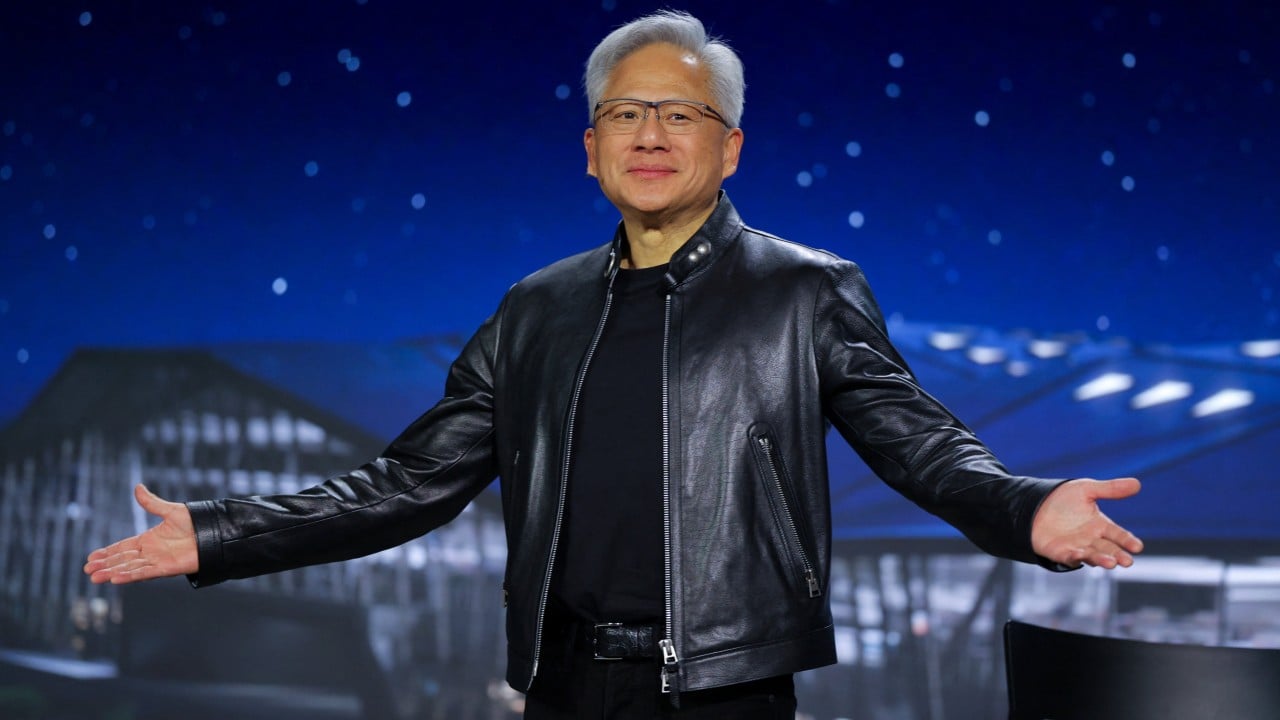
Jensen Huang is a master of the narrative. He has spent the last decade building a cathedral of compute out of green silicon and proprietary CUDA kernels. So, when the Nvidia CEO suggests that Huawei-powered DeepSeek models are a "horrible" development for the United States, he isn’t providing a geopolitical warning. He is protecting a moat.
The consensus view—the lazy view—is that China’s reliance on domestic chips like the Ascend 910C is a desperate pivot forced by export controls. The narrative suggests these chips are "enough to get by" but ultimately inferior to the H100 or Blackwell architectures. This is a fundamental misunderstanding of how software efficiency actually works. We are witnessing the end of the "Brute Force Era," and DeepSeek just proved that the hardware gap is a secondary concern.
The Myth of the Hardware Moat
For years, the industry operated under the assumption that $Total Intelligence = More GPU$. If you had more H100s, you won. This belief turned Nvidia into the most valuable company on the planet. But DeepSeek-V3 and its successors didn't win by out-muscling the West; they won by being poorer.
When you have infinite compute, you write lazy code. You build dense models that eat electricity and demand massive memory bandwidth. When you are starved of the latest Blackwell chips, you are forced to innovate at the algorithmic level. DeepSeek’s use of Multi-head Latent Attention (MLA) and specialized Mixture-of-Experts (MoE) architectures allowed them to achieve state-of-the-art performance for a fraction of the training cost.
Huang calls the rise of Huawei-DeepSeek integration "horrible" because it proves that the software can compensate for the hardware deficit. If China can produce GPT-4o level intelligence on "inferior" domestic silicon, the trillion-dollar justification for Nvidia’s pricing power evaporates. The "horrible" outcome isn't for US national security; it's for Nvidia's gross margins.
Huawei’s Vertical Integration is a Feature Not a Bug
The West views the decoupling of hardware and software as a pillar of innovation. We have Nvidia for the chips, Microsoft for the cloud, and OpenAI for the models. It’s a messy, fragmented supply chain.
Huawei is building a closed-loop ecosystem that mirrors the early days of Apple’s vertical integration, but for the data center. By co-designing the Ascend silicon, the CANN (Compute Architecture for Neural Networks) software layer, and the MindSpore framework, they are squeezing efficiencies out of the hardware that a general-purpose GPU cannot match.
I have watched enterprise teams waste six months just trying to optimize memory orchestration across a heterogeneous cluster of A100s and H100s. Huawei removes that friction. When the chip knows exactly how the model intends to move data, the "gap" in TFLOPS becomes irrelevant.
- The Latency Lie: Critics point to Huawei’s slower interconnect speeds. They miss the point. DeepSeek’s architecture is designed to minimize the need for high-frequency cross-node communication. They are engineering around the bottleneck while the West is just trying to build a bigger pipe.
- The Cost of Convenience: CUDA is a golden cage. US developers are so addicted to the CUDA ecosystem that they’ve stopped looking for better ways to compute. Huawei’s forced migration to its own stack is painful now, but it’s creating a generation of engineers who understand the "bare metal" better than their Silicon Valley counterparts.
Why the Export Ban Backfired
The US export controls were intended to freeze China’s AI capabilities in 2022. Instead, they acted as a massive R&D subsidy for Huawei.
Imagine a scenario where the US government banned the sale of Toyota and Honda to the domestic market in the 1970s. It wouldn’t have stopped Americans from driving; it would have forced a massive, accelerated investment into Detroit that would have otherwise never happened. By cutting off the supply of high-end GPUs, the US forced Chinese tech giants—who were previously happy to just buy from Nvidia—to pour billions into Huawei’s supply chain.
The result? Huawei’s Ascend 910C isn’t just a clone. It’s a chip born in a war zone. It is designed for resiliency and specific AI workloads, stripped of the legacy baggage that Nvidia maintains to support its broad customer base of gamers, researchers, and crypto miners.
The Software-Software Gap
The real threat isn't that Huawei will make a faster chip. The threat is that DeepSeek has shown the world that $100 billion clusters are a scam.
If a team can train a world-class model for $6 million while Silicon Valley is burning $1 billion on the same result, the economic advantage shifts. Huang’s "horrible" warning is an attempt to keep the US tied to the "Scaling Laws" dogma. If the industry accepts that we don't need 100,000-GPU clusters to reach AGI, then the hardware-centric worldview collapses.
We are entering a phase where "Efficiency-Adjusted Compute" is the only metric that matters. On that metric, the Huawei-DeepSeek stack is arguably outperforming the Nvidia-OpenAI stack.
The Brutal Reality of Sovereign AI
Huang often speaks about "Sovereign AI"—the idea that every country needs its own intelligence infrastructure. But he envisions that infrastructure running on Nvidia hardware. Huawei is offering a different version of sovereignty: one that doesn't require a permission slip from the US Department of Commerce.
For many nations in the Global South, the Huawei-DeepSeek model is far more attractive. It is cheaper, it is optimized for "low-spec" hardware, and it isn't subject to the whims of US trade policy. The "horrible" scenario Huang fears is a world where the US loses its monopoly on the entire AI value chain, from the sand to the chatbot.
Stop Asking if the Chips are Better
People keep asking: "Is the Ascend 910C better than the H100?"
This is the wrong question. It’s like asking if a specialized rally car is better than a Ferrari. On a paved track (standard benchmarks), the Ferrari wins. In the mud (real-world constrained environments), the rally car leaves it in the dust.
DeepSeek is the driver that learned to race in the mud. Huawei built the car. Nvidia is still trying to sell more asphalt.
The pivot to efficiency is not a sign of weakness; it is the next evolution of the industry. The West is currently bloated, over-capitalized, and lazy. We are relying on massive power consumption and expensive silicon to hide mediocre algorithmic progress. China, out of necessity, has stripped the fat away.
If you think a hardware lead lasts forever, you haven't been paying attention to the history of technology. The "horrible" truth is that the US advantage is built on a foundation of excess that is no longer sustainable. DeepSeek didn't just build a model; they provided a roadmap for how to beat a hardware monopoly with nothing but math and a chip that "shouldn't" work.
Stop waiting for the next generation of GPUs to save your margins. The game changed while you were waiting for your H100 shipment to arrive.