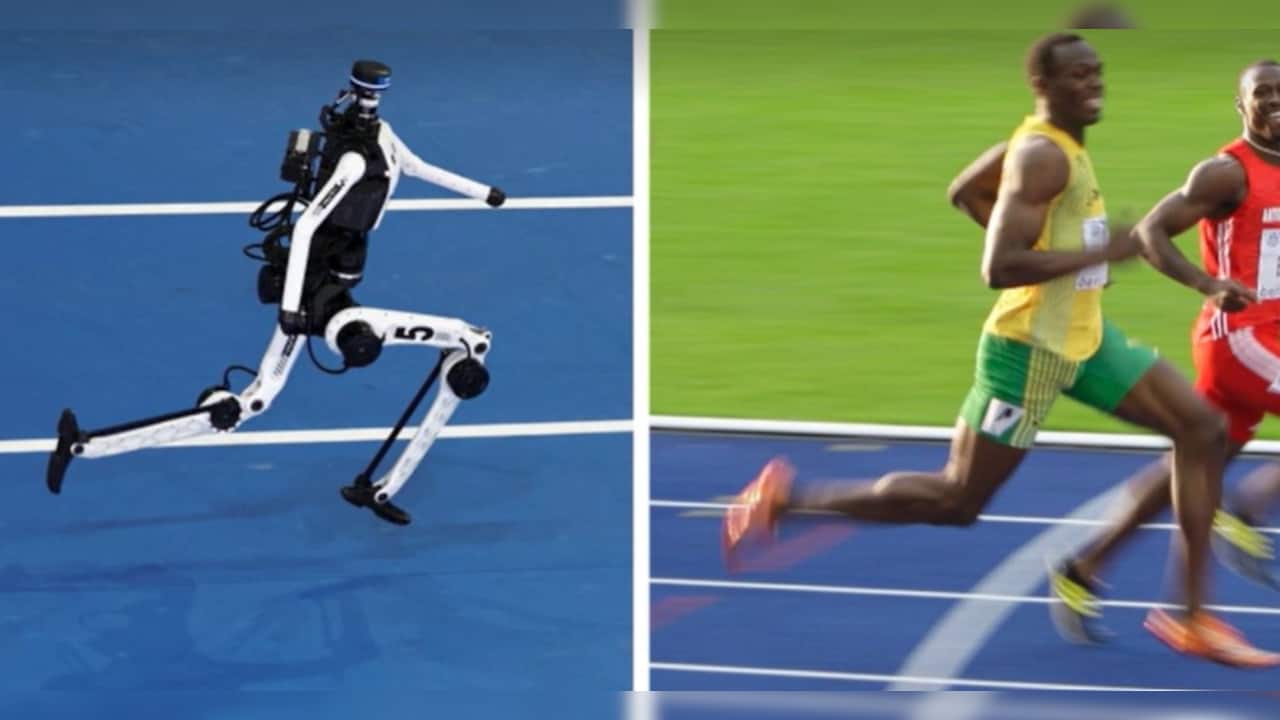
The recent exhibition of high-speed bipedal locomotion at the World Humanoid Robot Games in Beijing, where machines such as the TianGong Ultra completed the 100-meter dash in times eclipsing human records, signals a notable shift in actuator engineering and balance control. While public commentary focuses primarily on the novelty of beating a biological benchmark set by Usain Bolt, a rigorous technical audit reveals a stark divergence between sprint optimization and the operational requirements of real-world labor. Athletic performance in a controlled stadium environment relies on specialized parameters that frequently conflict with the durability, energy efficiency, and adaptability needed for commercial deployment.
The Kinematic Trade Off Between Sprinting And Utility
Designing a bipedal system for linear velocity requires maximizing power-to-weight ratios in the lower limbs, optimizing stride frequency, and tuning aggressive proportional-derivative control loops for rapid force application. Machines optimized for high-speed running typically employ lightweight skeletal frames, high-torque density actuators, and specialized foot designs optimized strictly for traction on flat rubberized tracks.
This narrow optimization creates distinct engineering penalties when transitioned to industrial floors or unstructured disaster zones.
- The Actuator Thermal Limit: Sustained high-output running generates intense thermal loads in joint motors. Without heavy cooling infrastructure, continuous peak performance causes rapid thermal throttling.
- The Energy Consumption Vector: Rapid acceleration drains onboard battery reserves within minutes, destroying the duty-cycle economics required for commercial viability.
- The Impact Vulnerability: As observed during recent competitive trials where machines collided with deceleration barriers or suffered catastrophic structural failures, high-speed kinetic profiles multiply the destructive force of a fall.
Industrial deployment demands the exact inverse of these traits. A factory floor worker or warehouse logistics unit prioritizes payload capacity, whole-body manipulation dexterity, collision compliance, and a minimum operational window of several hours between charges. A robot engineered to shave milliseconds off a linear sprint possesses control algorithms optimized for momentum maintenance rather than sudden impedance adaptation, making it fundamentally unsuited for delicate assembly or safe human-robot collaboration without extensive software re-architecting.
The Structural Bottlenecks Of Real World Autonomy
Moving bipedal systems from a linear racing strip to unstructured operational spaces exposes three core bottlenecks that publicity metrics fail to capture.
First, perception systems face an environmental complexity mismatch. Stadium tracks offer high-contrast lane markers, flat planar surfaces, and predictable friction coefficients. Conversely, real-world deployment requires simultaneous localization and mapping in dynamic spaces filled with transparent materials, shifting debris, and unpredictable human movement. The computational overhead required to process this sensory input in real-time strains current onboard edge-computing silicon, often forcing a trade-off between reaction latency and path-planning accuracy.
Second, the manipulation-locomotion coupling remains an unsolved control problem for high-speed frames. While bipedal systems can dedicate their entire computational load to maintaining balance while running forward, adding a dual-arm manipulation task alters the center of gravity dynamically. A machine optimized strictly for bipedal sprinting lacks the torso stabilization architecture required to lift heavy payloads or wield tools without destabilizing its gait.
Third, maintenance overhead dictates total cost of ownership. High-stress athletic trials regularly result in structural fatigue, sheared gears, and fried control boards requiring intensive engineering intervention between runs. Commercial enterprises evaluating robotics procurement look past peak performance benchmarks to analyze mean time between failures and field-repair simplicity. A platform that requires specialized laboratory technicians to reset its actuators after a minor trip cannot survive the operational friction of a standard fulfillment center.
The Commercial Migration Path
The utility of high-speed robotics research lies not in the race times themselves, but in the downstream components forced into maturity by the pursuit of those records. The development cycles required to build a machine capable of surviving the violent ground-reaction forces of an 8.64-second or 9.39-second 100-meter transit force rapid advancements in torque density, low-latency inertial measurement units, and real-time balance recovery algorithms.
Engineering teams that solve high-speed control instability gain foundational intellectual property applicable to shock absorption, slip detection, and dynamic recovery. When a robot trips on an uneven warehouse floor, the reflex subroutines developed to manage high-velocity missteps directly reduce catastrophic hardware damage.
Capital allocation must therefore shift away from headline-driven performance metrics toward core reliability engineering. Organizations seeking to integrate humanoid systems must evaluate vendors based on thermal management efficiency, payload-to-weight ratios, and open-architecture software stacks rather than peak athletic capability. The transition from stadium spectacles to commercial utility depends entirely on abandoning the pursuit of raw speed in favor of operational resilience, predictable error handling, and economic duty cycles.
To capture enterprise value from advanced bipedal platforms, deployment strategies must begin with constrained, highly repetitive payload transport tasks in controlled indoor facilities, systematically scaling up environmental complexity only as edge-compute reliability and thermal dissipation thresholds improve.
Chinese robot beats Usain Bolt's 100m record
This video provides an up-close look at the humanoid robots competing in the high-speed sprinting events and highlights the engineering challenges and physical dynamics observed during the trials.