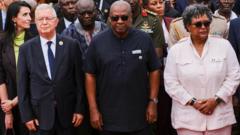
The room in Accra smelled of old paper, rain-damp cedar, and the sharp, metallic tang of an air conditioner fighting a losing battle against the Ghanaian heat. It was a modern conference space, sleek and glass-fronted, yet it felt heavy with the weight of centuries. A diplomat from a small Caribbean island state sat at the table, staring at a draft document. His fingers lightly traced the edge of the page. He wasn't thinking about the clauses or the sub-clauses. He was thinking about his great-grandmother, a woman who had known a woman who had been property.
This is where the grand, sweeping theater of international politics shrinks down to the size of a human heartbeat.
For decades, the global conversation around the transatlantic slave trade has been treated by former colonial powers as an accounting exercise. It is spoken of in the passive voice. Mistakes were made. Tragedies occurred. Ships sailed. But in recent diplomatic summits bridging the Atlantic, a unified front of African and Caribbean nations has fundamentally disrupted this comfortable detachment. They are no longer asking for vague expressions of regret. They are demanding a formal, binding apology.
To understand why a simple word causes such panic in the gilded halls of European capitals, we have to look past the financial ledgers. We have to look at the anatomy of an unhealed wound.
The Geography of an Empty Space
Imagine a family tree where the roots are intentionally burned away. In historical discussions, we often look at the macroeconomic scale—the millions of human beings transported, the tons of sugar harvested, the shipping routes that built the financial capitals of London, Amsterdam, and Paris. But the true scale of the tragedy is micro-historical. It is the story of stolen names, severed lineages, and the enduring psychological weight of being told your ancestors were commodities.
Consider a hypothetical citizen of modern-day Kingston or Bridgetown. When they look back into their ancestry, they hit a brick wall around the early nineteenth century. Before that, there are no birth certificates. There are only cargo manifests. A human being listed next to barrels of molasses and bolts of calico.
This is not ancient history. The psychological ripples of that objectification persist. When African and Caribbean leaders gathered at recent summits, the core of their argument was built on this very reality: the past is not dead, and it isn't even past. The structural inequalities governing global trade, the wealth disparities between the Global North and South, and the systemic underdevelopment of nations that were once exploited as resource colonies are the direct, traceable descendants of the slave ships.
The resistance to a formal apology from nations like Great Britain, France, and Spain is rarely about emotional stubbornness. It is about legal liability. In the architecture of international law, a formal admission of wrongdoing is the first domino. If a state officially apologizes for a historical crime, it establishes a legal foundation for reparations. The cold math of economics collides brutally with the moral imperative of justice.
The Alchemy of Regret
Former colonial powers have mastered a specific vocabulary. They offer "deep regret," "profound sorrow," and acknowledgments of "the suffering of the past." To the casual observer, this sounds like an apology.
It is not.
In diplomacy, "regret" is a shield. It expresses sadness that an event occurred without accepting agency or responsibility for causing it. It is the linguistic equivalent of saying, "I am sorry you feel that way." A formal apology, however, requires a confession of fault. It names the perpetrator, identifies the crime, and acknowledges that the wealth enjoyed by the descendants of the colonizers was built on the stolen lives of the colonized.
Let us look at the numbers that haunt these negotiations. Historians estimate that over twelve million Africans were forced onto ships during the transatlantic trade. The wealth generated by their unpaid labor funded the Industrial Revolution. It built insurance empires like Lloyd’s of London. It paved the streets of Bristol and Liverpool. Meanwhile, the regions they were stolen from were destabilized, their social fabrics torn apart to feed the insatiable demand for human labor.
When Caribbean leaders through CARICOM (the Caribbean Community) and African leaders through the African Union join voices, they are shifting the paradigm. They are pointing out the hypocrisy of a global rule of law that punishes modern theft but protects the ancestral fortunes made from the greatest theft in human history.
The argument against these demands usually follows a familiar, tired script: Why should modern generations pay for the sins of their ancestors? The people who ran the ships are dead. The people who worked the fields are dead.
But the institutions are not dead. The banks that financed the voyages still exist. The governments that sanctioned the monopolies still sit in parliament. The descendants of the slave owners often still hold the land, while the descendants of the enslaved still rent from them. The structural architecture remains standing; it has merely been given a fresh coat of paint.
The True Cost of Silence
To sit in on these diplomatic discussions is to witness a profound clashing of worldviews. On one side are the legalistic, risk-averse teams representing Western governments, armed with briefs designed to minimize financial exposure. On the other side are representatives of nations for whom this is an existential reckoning.
It is an uncomfortable, messy process. It forces us to confront the reality that our modern, interconnected global economy has a dark, unacknowledged foundation. True reconciliation cannot be bought with development aid or patronizing charity. It begins with the humility of looking an injured party in the eye and admitting the truth without qualifiers, without escape clauses, and without fear of the bill.
The diplomat in Accra finally capped his pen. The draft document was signed, another small step in a centuries-long march toward acknowledgment. Outside, the tropical rain began to fall, washing the dust from the streets, a quiet reminder that nature eventually cleanses everything. But history requires human hands, human voices, and the courage to speak a single, terrifyingly honest word.