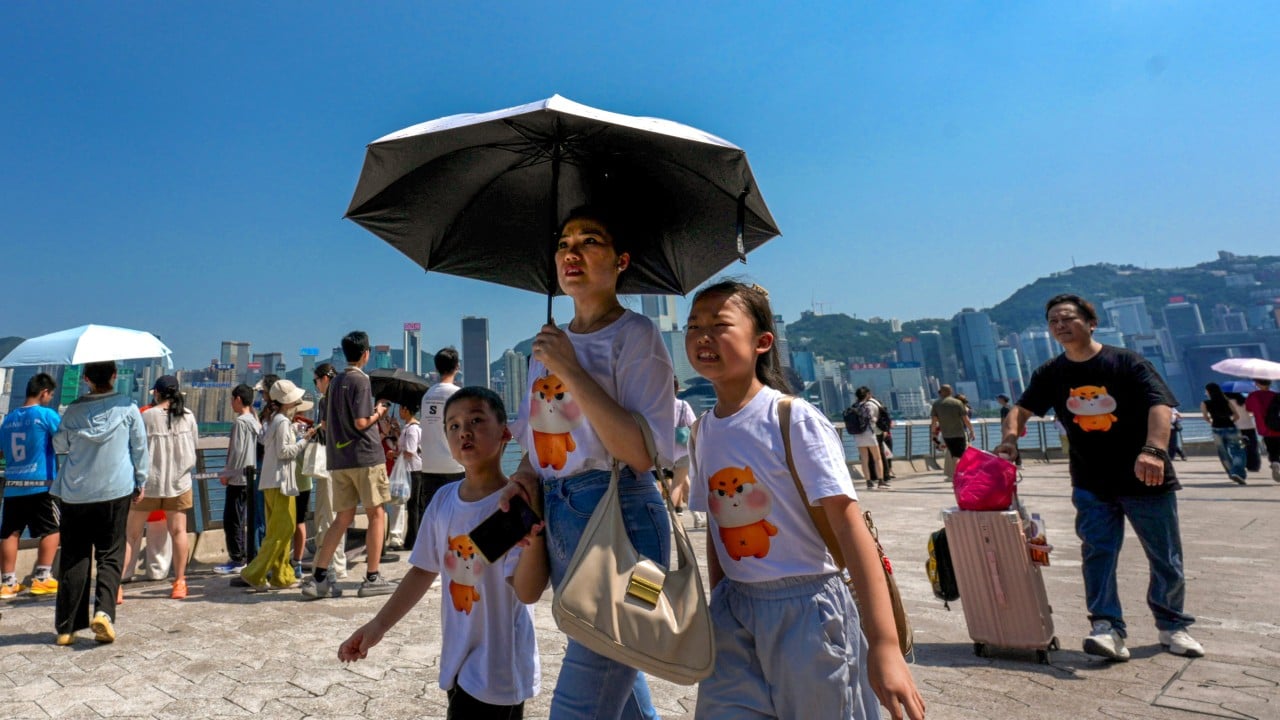
The air did not move. That was the first thing you noticed when you stepped outside into the early morning hours of that historic July in Hong Kong. It hung heavy, thick with moisture and an ancient, suffocating weight that seemed to press directly against your chest.
Sweat did not evaporate. It simply accumulated, pooling on skin within seconds of exposure, rendering the simple act of breathing feel like an underwater endeavor.
Down in the concrete canyons of Central, the skyscrapers cast shadows that offered no mercy. The asphalt radiated heat back upward, a relentless, invisible furnace door held permanently ajar. Thermometers across the territory began their inevitable, dizzying climb, ticking past previous thresholds with cold mathematical indifference.
By afternoon, the digital boards flashed a number that rewrote the history books.
Hong Kong had broken its all-time record for its hottest day ever recorded.
And Typhoon Dolphin was to blame.
To understand why a tropical cyclone brought not cooling rain, but a suffocating shroud of fire, you have to look past the dramatic satellite imagery. You have to look at the invisible machinery of the atmosphere. Dolphin, churning hundreds of miles away in the western Pacific, acted as a giant atmospheric straw. Instead of sweeping across the coast with cleansing gales, its outer bands performed a sinister magic trick. It sucked up scorching air from the continental interior, dragging it downward over the territory in a process meteorologists call subsidence.
Think of it like blowing air through a bicycle pump. When you compress air, it heats up. Now imagine that pump being driven by the raw, kinetic energy of a massive weather system thousands of times larger than any human creation.
The result was a thermal dome.
High above Victoria Harbour, the air compressed, dried, and baked. The mercury soared to unprecedented heights, shattering records that had stood for generations. In the city, the numbers translated immediately into visceral, human friction.
Consider a hypothetical delivery worker named Chan, navigating the narrow alleyways of Sham Shui Po. He has spent thirty years carrying boxes up steep stairwells in buildings where elevators are an afterthought or a luxury. On ordinary days, the humidity is a familiar companion, an annoyance he has learned to tune out like the hum of neon signs.
Today was different.
By midday, his vision blurred at the edges. His shirt was soaked through, salt stinging his eyes with every blink. He leaned against a rusted corrugated metal wall, finding it hot enough to sear skin. The air felt less like something to breathe and more like a dense, warm soup forcing its way down his throat.
Chan is not an abstraction. He is one of millions whose daily survival relies on a fragile equilibrium between human physiology and environmental tolerance. When that equilibrium breaks, the consequences are immediate and unforgiving.
Medical emergency lines lit up across the city. Hospitals braced for an influx of heatstroke victims, elderly residents trapped in poorly ventilated subdivided flats, and outdoor laborers whose bodies simply refused to cool down. The city that never sleeps found itself gasping for breath, desperately seeking refuge in air-conditioned MTR stations and air-conditioned convenience stores that doubled as brief sanctuaries from the furnace outside.
We like to think of climate records as academic milestones. We read them in the morning paper over coffee, noting the numbers with a detached, clinical interest. A new high. A broken barrier. An anomaly.
Numbers lie by omission.
They sanitize the reality of what it feels like to live through a shifting world. They turn human suffering into data points. When a city of seven million people becomes a pressure cooker, the metrics fail to capture the quiet desperation of a mother trying to keep a sleeping toddler cool with a battery-powered fan that only pushes lukewarm air around a tiny bedroom. They fail to capture the way concrete retains heat long after the sun has set, turning the night into an extension of the day's torment.
Typhoon Dolphin eventually moved on, its winds dissipating, its immediate threat fading into the broader tapestry of seasonal storms. But the record it left behind is not an outlier. It is a preview.
As global weather patterns shift and intensify, the boundaries of what humans can comfortably endure are being redrawn. The storms are changing character. The heat is growing teeth.
When you step outside tomorrow, pay attention to the air. Notice the weight of it. Listen to the hum of air conditioning units working overtime in every window, a chorus of mechanical desperation humming against the rising tide.
The sky did not turn to glass overnight. It happened slowly, degree by degree, record by record, until we finally looked up and realized the temperature had changed the rules of life itself.


