Silence.
It is the heavy, pressurized quiet of a server room in Shenzhen at three in the morning, where the cooling fans still hum at forty decibels, blowing chilled air across empty aluminum racks that were supposed to be bolted full of silicon by dawn.
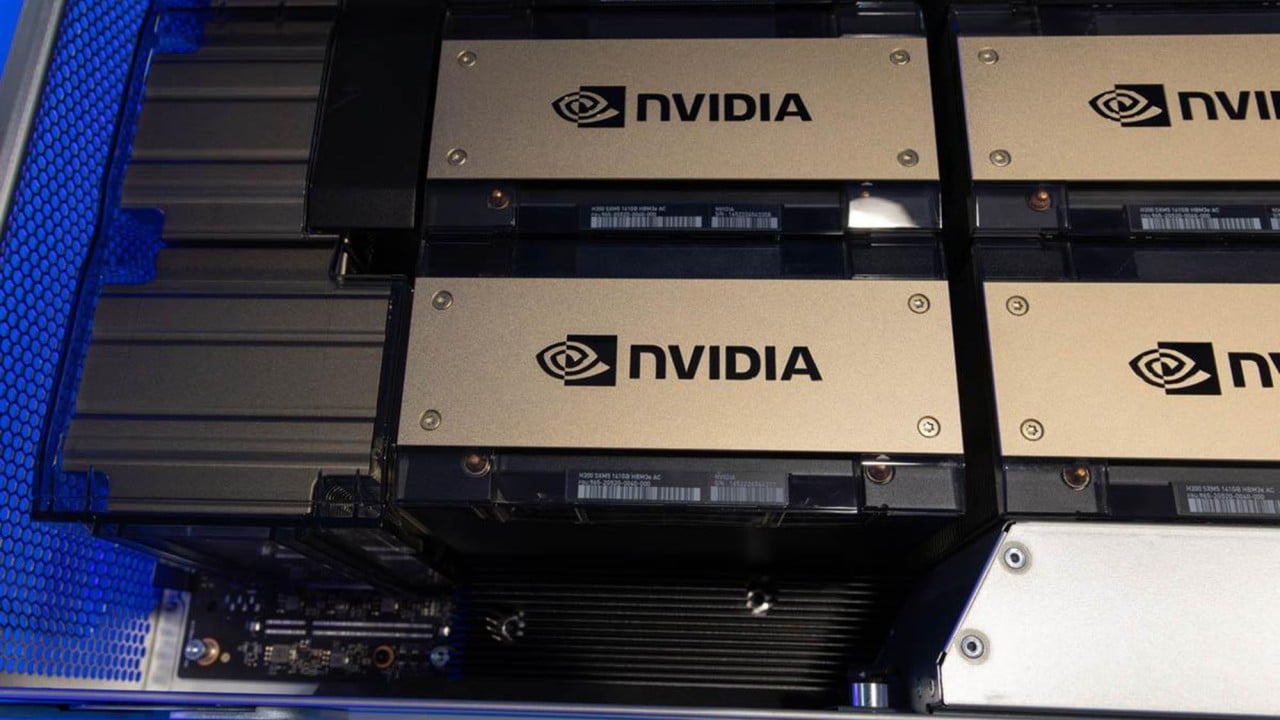
For months, that room had a reservation. It was waiting for boxes stamped with the green-and-black eye of Nvidia, carrying the H20—the last legal off-ramp of the Hopper architecture that American export controls had left open for the Chinese market. Then, almost overnight, the manifests went blank. The shipments stopped. And in the fluorescent glare of the data center floor, a generation of engineers realized that the bridge they had been running across had just been pulled up from the other side.
To understand how a routine quarterly supply adjustment turned into a geopolitical tremor, you have to look past the ticker symbols and the press releases. You have to look at a man in a black leather jacket standing at the center of a tug-of-war that no longer allows anyone to hold the middle of the rope.
The Man in the Leather Jacket
Jensen Huang built Nvidia on a simple, relentless premise: compute should be ubiquitous, frictionless, and sold to everyone who can afford it. For thirty years, that philosophy turned a graphics card maker born in a Denny’s booth into the most consequential hardware company on earth.
When Washington first tightened export controls in 2022 and 2023, banning the flagship A100 and H100 processors from crossing the Pacific, Huang did what any pragmatic industrialist does when a door slams shut. He found a window. Nvidia engineered watered-down variants—the A800, the H800, and eventually the Hopper-based H20—specifically calibrated to sit just beneath the U.S. Commerce Department’s performance thresholds. They were slower at talking to one another across massive clusters, clipped at the knees in interconnect bandwidth, yet still ferocious enough to train and run the large language models powering China’s artificial intelligence boom.
It was an uneasy truce. Washington kept its regulatory red lines intact; Beijing kept its domestic tech giants fed; Nvidia booked billions of dollars in revenue that would otherwise have evaporated.
Then came the row.
Public friction between Huang’s vocal pushback against U.S. export restrictions and the hardening consensus in Washington collided with a blunt reality in Beijing. In public appearances, Huang warned repeatedly that locking American chipmakers out of China would not stop Chinese AI—it would only force Chinese companies to build an independent, domestic alternative faster, permanently ceding a fifty-billion-dollar market to local rivals. The remarks drew sharp scrutiny from hawks in Washington who viewed Nvidia’s tailored China chips as a loophole subverting national security, while regulators in Beijing simultaneously began pressuring domestic firms to favor homegrown silicon over foreign hardware.
Caught between a government suspicious of his compliance and a customer market increasingly told to buy local, Huang’s middle ground vanished. Nvidia halted shipments of its Hopper-based chips to China, writing down billions in inventory and bringing the H20 era to an abrupt, grinding stop.
What Hopper Actually Meant
To most people outside a data center, "Hopper" sounds like an insect or a train car. Inside the walls of an AI lab, it is oxygen.
Think of training a frontier artificial intelligence model like trying to move an entire ocean using ten thousand buckets at the exact same time. A standard computer processor—the kind sitting inside your laptop—is a single worker with a Dixie cup, doing one smart task after another in neat sequence. A graphics processing unit built on Nvidia’s Hopper architecture is an army of thousands of workers standing shoulder to shoulder, moving millions of gallons in a single synchronized heave.
Even in its restricted H20 form, Hopper carried two things that made it irreplaceable for Chinese engineers: massive high-bandwidth memory and CUDA.
High-bandwidth memory is the workbench right next to the assembly line. If the workbench is too small, the fastest workers in the world spend half their shift walking back and forth to the warehouse to fetch parts. The H20 retained generous memory capacity, making it exceptionally good at inference—the moment an AI model actually thinks, answers a prompt, writes code, or diagnoses a scan in real time.
And then there is CUDA, Nvidia’s proprietary software layer. Over nearly two decades, millions of developers wrote their tools, libraries, and habits directly onto CUDA. Switching off Nvidia hardware is not like swapping a Dell monitor for an LG; it is like asking a symphony orchestra to play their instruments upside down in the dark while someone rewrites the sheet music mid-performance.
Consider a hypothetical scenario—a composite drawn from dozens of mid-sized AI startups operating between Hangzhou and Beijing during the spring freeze. Picture a twenty-nine-year-old infrastructure lead named Lin, staring at a procurement dashboard at midnight. His company has just raised a Series B round to build medical imaging models for rural clinics. Every line of his training pipeline is tuned for Hopper. His cloud provider promised forty-eight H20 nodes by the end of the quarter. When the shipment freeze hits, the cloud broker calls with an apology and a price hike of forty percent on gray-market stock that comes with no warranty, no firmware updates, and no guarantee it wasn't pulled out of a crypto mine two years ago.
Lin isn't thinking about trade deficits or Senate committee hearings. He is staring at a burn-rate spreadsheet, realizing his startup just lost six months of runway overnight.
The Invisible Mechanics of a Chip Freeze
When headlines announce that a company has "stopped shipping" a chip, people often picture a single cargo plane turning around mid-flight. The reality is slower, weirder, and far more pervasive.
Semiconductor supply chains are less like a highway and more like a multi-stage chemical reaction. A Hopper chip begins as ultra-pure silicon wafers etched in Taiwan by TSMC using extreme ultraviolet lithography machines built in the Netherlands, gets packaged with memory stacks sourced from South Korea, is tested, mounted onto server boards, and finally slotted into liquid-cooled racks before reaching a customer.
When Nvidia halts Hopper shipments to China, three things happen in rapid succession:
- The Inventory Cliff: Existing orders still sitting in bonded warehouses or awaiting final export clearance are frozen or rerouted to buyers in the United States, Europe, and the Middle East, where hyperscalers are still desperate for compute.
- The Secondary Market Spike: Overnight, existing H20 and older A800 servers already inside mainland China transform from depreciating capital assets into appreciating commodities. Brokers begin trading single server nodes like rare art.
- The Architectural Pivot: Engineering teams stop optimizing for the hardware they wish they had and start rewriting code for the hardware they can actually get—chiefly Huawei’s Ascend series, alongside emerging silicon from Cambricon, Biren, and Moore Threads.
I remember walking through a cramped hardware testing lab in Taipei a couple of years ago, watching an engineer try to port a vision model off an Nvidia card onto an alternative accelerator. The air smelled like hot solder and stale instant coffee. Every twenty minutes, the terminal spat out a cryptic memory-allocation error that didn't exist in any public documentation. He rubbed his eyes, laughed without humor, and told me that the silicon itself was fast enough—the problem was the ten thousand invisible software bridges Nvidia had spent fifteen years paving while everyone else was still arguing about hardware specs.
That gap—the quiet, unglamorous distance between raw transistor count and usable software—is where the real battle is being fought.
The Paradox of the Wall
History has a stubborn habit of punishing walls built to contain technology.
In the early 1970s, when the United States restricted exports of high-end mainframe components and precision machine tools during the Cold War, the short-term effect was undeniable: adversary programs slowed down, budgets bloated, and engineers spent years reverse-engineering what they could have bought off a shelf. Yet the long-term consequence was the creation of entirely parallel, insulated industrial ecosystems that answered to no external regulator.
That historical pattern is precisely what kept Jensen Huang awake at night—and what fueled the tension between his company and policymakers on both sides of the Pacific.
From Washington’s perspective, the logic is straightforward and urgent. Advanced AI models have unmistakable dual-use potential, from cyber operations and autonomous drone swarms to bio-design and intelligence analysis. If American-designed silicon sits at the core of those breakthroughs, restricting access to Hopper-class accelerators buys the United States and its allies precious lead time. In a race where compute scales exponentially, even an eighteen-month advantage can widen into a generational gulf.
From Nvidia’s vantage point, however, starving the Chinese market of tailored American chips does not eliminate demand; it subsidizes the competition. Every dollar that Alibaba, Tencent, ByteDance, or DeepSeek cannot spend on an Nvidia Hopper chip flows directly into Huawei’s R&D budget.
Watch what happens next: when a domestic champion like Huawei suddenly receives guaranteed purchase orders from China’s largest cloud providers, it gains the two things a chipmaker needs most—capital and feedback loops. Hardware gets better only when thousands of frustrated engineers push it to its breaking point in production and file bug reports. By cutting off Hopper, the market just handed domestic Chinese chipmakers the largest stress-testing laboratory on earth.
Inside the Scramble for Alternatives
Walk down the corridors of any major AI lab in Shanghai today, and the vocabulary has changed. Two years ago, conversations revolved around parameter counts and token windows. Now, engineers talk like mechanics nursing vintage cars across a desert: quantization tricks, mixture-of-experts routing, memory-compression kernels, and cluster fault tolerance.
When you cannot buy bigger engines, you learn to make the chassis lighter.
Consider what happened when Chinese AI labs realized they could no longer rely on uninterrupted supplies of top-tier Nvidia Hopper hardware. Instead of brute-forcing models with massive, uniform clusters of identical GPUs, teams began designing architectures specifically built to squeeze frontier performance out of fewer, slower, or mixed-generation chips. They stripped redundant precision out of neural network weights, overlapped communication with computation to hide slower interconnect speeds, and built software schedulers capable of surviving frequent hardware dropouts across heterogeneous clusters.
It is messy work. It is exhausting work. And it is working far better than Washington expected.
At the same time, the human cost inside these organizations is rarely captured in market-cap charts. Engineers who spent their twenties mastering PyTorch on CUDA are suddenly spending half their week debugging low-level compiler bugs on nascent domestic toolchains. Product launches slip by weeks. Research papers get delayed because the cluster went down over the weekend and nobody had the right diagnostic firmware.
Yet beneath the frustration sits a quiet, hardening resolve. When access to a tool becomes a political vulnerability, dependence stops looking like convenience and starts looking like a trap.
The Fog of the Next Generation
I will admit something that few analysts like to say out loud: nobody—not in Washington, not in Beijing, and not inside Nvidia’s spaceship-shaped headquarters in Santa Clara—truly knows where the equilibrium lands from here.
We are watching two massive, conflicting forces collide in real time. On one side stands the sheer physics of semiconductor manufacturing, where extreme ultraviolet lithography and packaging bottlenecks remain overwhelmingly concentrated in a handful of allied choke points. On the other stands the relentless ingenuity of software engineering, which repeatedly finds ways to route around hardware scarcity faster than export lists can be updated.
Even Nvidia’s attempts to navigate the maze remain shrouded in uncertainty. Whenever one architecture is blocked, rumors immediately swirl around stripped-down derivatives of newer architectures—whether modified Blackwell variants or custom inference cards engineered to pass regulatory muster. Yet every iteration narrows the margin for error. Washington has made clear that it will not tolerate chips engineered simply to skirt the spirit of export rules, while Beijing has signaled just as clearly that it does not want its critical infrastructure dependent on silicon that can be turned off by an executive signature four thousand miles away.
For Nvidia, the financial blow is real—billions in stranded inventory and lost quarterly revenue—yet the company remains cushioned by insatiable demand from American cloud giants, sovereign AI initiatives in Europe and the Middle East, and enterprise buyers scrambling to build out their own data centers. Nvidia will survive without China.
The deeper question is what happens to the global technology order when the world’s largest semiconductor company and the world’s second-largest economy formally decouple their compute pipelines.
Two Worlds, Two Clocks
Picture that server room in Shenzhen again.
Six months after the Hopper shipments stopped, the lights are back on, and the forty-decibel hum of the cooling fans has risen to a seventy-decibel roar. The racks are full now. Not with the green-and-black shrouds of Nvidia, but with unbranded silver blades carrying domestic processors, wired together with thicker cables and running a patched-together software stack that didn't exist eighteen months ago.
Down the hall, a young engineer watches a training run inch forward on a dark monitor. The loss curve drops—slowly at first, hiccuping over a memory bottleneck, then smoothing out into a steady downward slope. Across the Pacific in Silicon Valley, another engineer watches a similar curve drop on a cluster of next-generation American silicon, running faster, cleaner, and entirely isolated from its counterpart across the ocean.
Two rooms. Two grids. Two clocks ticking at different speeds, no longer synchronized by a single supply chain.
The boxes stopped arriving at the loading dock, and in the space they left behind, the world split quietly in two.