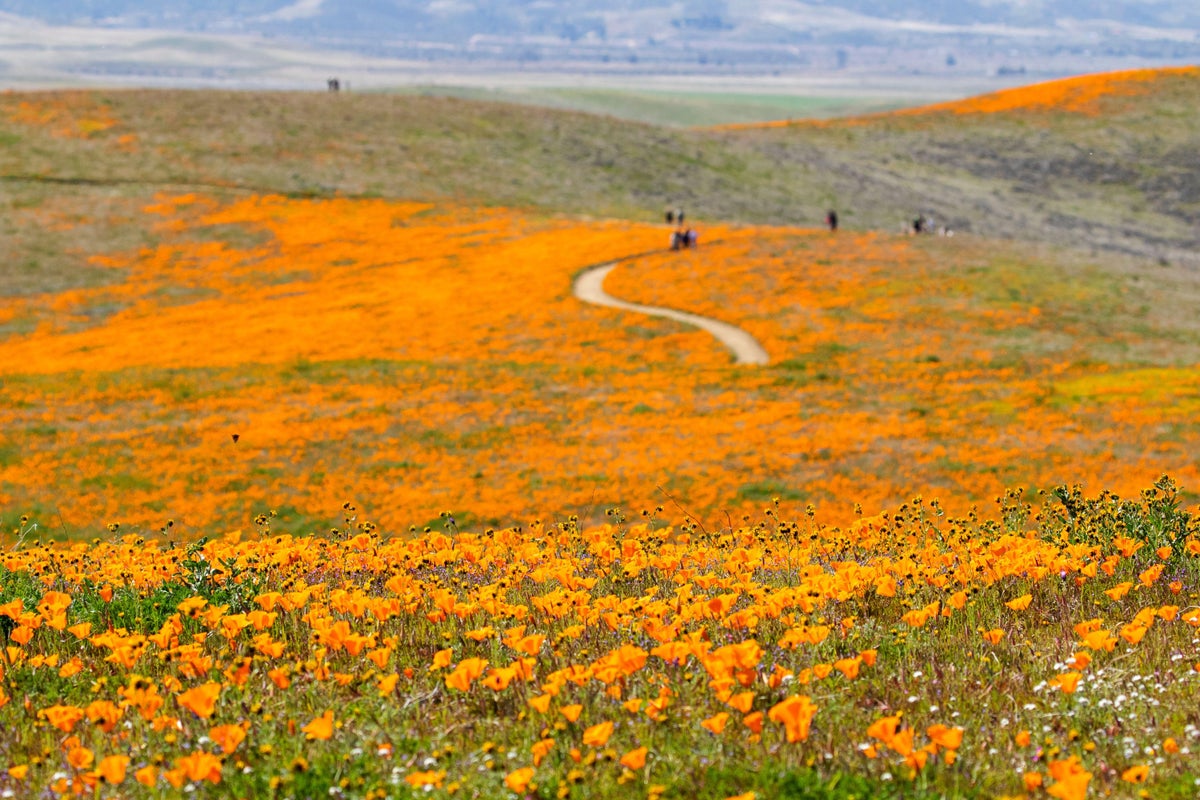
The air in the Antelope Valley doesn't smell like flowers. Not at first. It smells like baked grit and the exhausted heat of the Mojave. But if you stand still long enough—if you stop checking your signal and let the wind actually hit your face—there is a faint, honeyed sweetness underneath the sagebrush. It is the smell of a million tiny lives fighting to exist before the sun kills them.
Sarah didn’t come here for the "trend." She came because her father’s memory was fading, and he had spent forty years talking about a spring in 1991 when the hills turned so orange they looked like they were on fire. She drove three hours into the high desert with a printout of a "top five blooming places" list tucked into her visor, expecting a botanical garden.
Instead, she found a traffic jam of people in white linen dresses stepping on the very things they came to admire.
This is the strange, fragile reality of wildflower tourism. It is a hunt for a ghost that only appears when the math of the universe lines up perfectly. We call it a superbloom, but that’s a marketing term for a biological miracle. It requires a specific sequence of autumn rains to soak the dormant seeds, followed by a winter cold enough to lock that moisture in, and a spring gentle enough not to scorched the sprouts before they can breathe.
The Mathematics of a Miracle
When you look at a hillside covered in California Poppies or Purple Owl’s Clover, you aren't just looking at scenery. You are looking at a bank vault that has finally been cracked open. Wildflower seeds are time travelers. Some species, like the desert evening primrose, can wait in the dirt for decades. They sit in the dust, wrapped in protective coats, enduring droughts that kill trees and heat that cracks stone. They are waiting for a signal.
The signal is precise. If the rain comes too late, the heat of May will fry the seedlings. If the rain comes too early, the invasive grasses will grow taller and choke out the light. It is a high-stakes gamble where the house usually wins. But every few years, the atmosphere relents. The result is a sensory explosion that pulls humans out of their temperature-controlled lives and drags them into the dirt.
Antelope Valley, California: The epicenter of the orange flame. This is where the California Poppy reigns. It is a brutal beauty. The flowers close up when the wind gets too high, protecting their pollen like a secret. To see them open is to witness a valley inhaling light.
Anza-Borrego Desert, California: Here, the flowers are survivors. You’ll find the Desert Lily and the Bigelow’s Monkeyflower. These aren't the soft, lush blooms of an English garden. They are tough, waxy, and defiant, growing out of cracks in the canyon floor.
Enchanted Rock, Texas: Bluebonnets are the state’s soul, but at Enchanted Rock, they frame massive pink granite domes. The contrast between the ancient, unmoving stone and the fleeting, sapphire petals is a reminder of how short our own seasons are.
Crested Butte, Colorado: The "Wildflower Capital of the World" waits until July. While the deserts are burning, the sub-alpine meadows here erupt in Sunflowers, Columbine, and Delphinium. It feels like high-altitude theater.
Namaqualand, South Africa: For those who need to see the world shifted on its axis, this arid region transforms into a carpet of orange and white daisies that stretches to the Atlantic Ocean. It is arguably the most dramatic transformation on the planet.
The Invisible Stakes of a Selfie
Sarah watched a woman in a wide-brimmed hat step off the designated trail. The woman wanted a photo where it looked like she was floating in a sea of orange. She sat down, her weight crushing dozens of delicate stems.
In that moment, she wasn't just killing flowers. She was killing the future.
Wildflowers rely on a process called "seed set." When a flower is crushed before it can be pollinated and drop its seeds, that genetic line ends. When thousands of people step off the trail to get the same "untouched" shot, they create "social trails"—brown scars in the earth that may not recover for years. The soil becomes compacted. The seeds can't penetrate the hardened ground. The miracle stops happening.
The paradox of wildflower tourism is that we are loving these places to death. We crave the connection to something wild and ephemeral because our daily lives are so static and digital. We want to prove we were there, that we saw the fire before it went out. But the very act of proving it often ensures that the next person—or the next generation—won't see it at all.
A Different Kind of Seeing
If you want to experience the bloom, you have to accept that you are a guest in a very old, very private house.
The secret isn't finding the "best" spot on a map. The secret is the timing. If you go at noon, the light is harsh and the colors are washed out. If you go at sunrise, the world is blue and silver. Then, as the sun clears the ridge, the petals begin to unfurl. There is a sound to it—a soft, collective rustle that you can only hear if the crowd is quiet.
Sarah eventually walked away from the crowded trailhead. She found a spot on a designated bench, sat down, and simply waited. She watched a bumblebee, heavy with pollen, move from one poppy to the next. She thought about her father. She realized that the flowers weren't there for her. They weren't a backdrop for her life. They were a biological franticness, a desperate race to reproduce before the water ran out.
We often treat nature like a gallery where we are the critics. We judge the "peak" of the bloom. We complain if the colors aren't as vibrant as the edited photos we saw on social media. But the desert doesn't owe us a show. The fact that anything grows here at all is a statistical impossibility that we should approach with hushed breath.
The Ethics of the Ephemeral
There is a way to do this right. It involves staying on the path, even when the path is dusty and the flowers are twenty feet away. It involves leaving the drone at home so the birds don't panic. It involves understanding that the "best" blooming place is wherever you can stand without leaving a footprint.
The stakes are higher than just aesthetics. These flowers are the foundation of entire ecosystems. They feed the insects that feed the birds that keep the desert alive. When the bloom fails because of human interference or shifting climates, the ripple effect is felt all the way up the food chain.
As the sun began to dip behind the Tehachapi Mountains, the orange hills started to glow with a deep, bruised purple. The flowers began to close for the night, tucking their petals inward. Sarah took one photo—not of herself, but of the way the light caught a single stem swaying in the wind.
She got back in her car and drove home, the scent of the desert clinging to her clothes. She didn't have a viral photo. She didn't have a "hack" for the best view. But she had seen the fire.
The desert was reclaiming its silence. The seeds were already preparing for the long sleep that follows the glory. They will wait in the dark, under the weight of the world, trusting that the rain will eventually return. We should be so patient.
The wind picked up, erasing the footprints of the day's tourists, turning the orange back into dust.