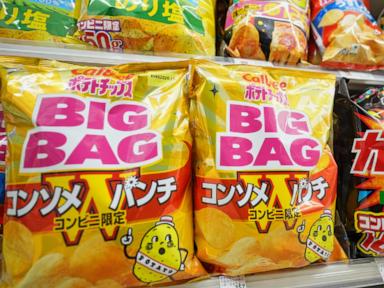
Walk into a Lawson in central Tokyo at midnight, and the neon hum usually promises a predictable, vibrant sanctuary. The shelves are typically a riot of primary colors—fiery reds for spicy potato sticks, electric greens for matcha wafers, and deep, glossy blues for salted seaweed crisps. It is a sensory overload designed to trigger a Pavlovian response before you even touch the crinkling plastic.
But something is shifting. If you liked this piece, you might want to look at: this related article.
In the back row of a neighborhood convenience store, a row of chocolate-covered biscuits sits in a wrapper that looks like a photocopy of its former self. Gone is the rich, warm cocoa-brown ink. In its place is a stark, jarring grayscale. To the casual shopper, it looks like a printing error or perhaps a minimalist marketing stunt. It is neither. It is the first visible symptom of a supply chain hemorrhaging under the weight of a distant, brutal conflict.
The vibrancy of a snack bag might seem trivial, but color is the secret language of global commerce. When that language goes mute, it means the world’s machinery has seized. For another perspective on this story, refer to the latest coverage from MarketWatch.
The Invisible Ingredient
Consider a man named Hiroshi. He works at a mid-sized packaging plant in Saitama. For twenty years, his job has been to ensure that the "Strawberry Pink" on a certain brand of spring-edition sweets is exactly the same shade in March as it was the year before. To Hiroshi, ink is not just a liquid. It is a complex cocktail of resins, solvents, and pigments sourced from a global web of refineries.
Lately, Hiroshi’s job has become an exercise in managed despair.
The primary ingredient in most commercial printing inks is a series of petroleum-based chemicals and specialty carbon blacks. Much of the global supply chain for these components relies on the stability of the Middle East, specifically the flow of raw materials through corridors now choked by the escalating war involving Iran. When tankers are diverted and refineries are shuttered or prioritized for military fuel, the "extraneous" stuff—the pigments that make our trash look pretty—is the first to vanish.
Japan imports nearly all of its oil. When the sparks fly in the Middle East, the lights dim in Tokyo. But before the lights dim, the colors fade.
A Monopoly on Shade
It is easy to assume that we can just "make more" ink. We can't. The production of high-grade industrial ink is a high-stakes chemistry experiment performed at a massive scale. It requires specific catalysts that are often produced in just a handful of facilities worldwide.
The conflict in Iran hasn't just spiked the price of a barrel of crude; it has fractured the logistics of "just-in-time" manufacturing. Shipping lanes that used to take weeks now take months as vessels circumnavigate entire continents to avoid drone strikes and seizures. For a snack company operating on razor-thin margins, the cost of flying in pigments from alternative markets in South America or Europe is a death sentence for their bottom line.
So, they made a choice.
They stripped the art. They realized that while a customer might hesitate to buy a black-and-white bag of chips, they definitely won't buy a bag that isn't on the shelf at all. By pivoting to "monochrome" packaging, companies are drastically reducing their reliance on cyan, magenta, and yellow pigments, which are currently the most volatile and expensive to procure.
The Psychological Toll of a Gray Shelf
Imagine the supermarket as a map of our collective psyche. We use color to navigate. Red is "stop and look." Green is "healthy or fresh." Yellow is "joy and energy."
When these cues are removed, the act of shopping becomes clinical. It becomes eerie. In a hypothetical—though increasingly plausible—scenario, a mother reaches for her child’s favorite snack but pauses. The bag looks "wrong." It looks like a relic from the 1940s. There is a subtle, creeping anxiety that comes with this visual austerity. It is a reminder that the world outside is not okay.
The black-and-white packaging is a "memento mori" for the age of excess. It tells us, without saying a word, that the era of effortless availability is stuttering.
Economists call this "skimpflation"—not just raising the price or shrinking the product (shrinkflation), but degrading the quality of the experience itself. The product inside remains the same, but the "vibe" of the brand is sacrificed to keep the gears turning. It is a tactical retreat.
The Logistics of a Pale Future
The ink shortage isn't a localized hiccup. It is a warning shot.
- Cost of Pigment: Some specialized resins have seen a 40% price increase in a single quarter.
- Energy Intensity: Creating the carbon black used in the new "minimalist" packaging is energy-intensive, but it uses a different, more stable feedstock than the vibrant chemical dyes.
- The Lead Time Trap: Orders for packaging materials that used to be fulfilled in 14 days are now stretching to 60 or 90 days.
For the CEOs of Japanese confectionery giants, the decision to go gray was likely a grueling boardroom battle. Marketing teams would have argued that brand identity is everything. Logistics teams would have countered that you can’t sell a brand identity if you can’t print the bags.
Logistics won.
This transition requires a total recalibration of the printing presses. You don't just "turn off" the color. You have to redesign the plates, adjust the viscosity of the remaining black ink to ensure it doesn't smudge on the high-speed rollers, and pray that the consumer understands this is a necessity, not a design choice.
The Human Cost of the Hue
We often think of war in terms of frontline reports and geopolitical maps. We talk about troop movements and drone counts. But the ripples of war are far more domestic and strange.
The war in Iran is felt in the shaking hands of a small business owner in Osaka who can no longer afford to print the colorful labels for his artisanal plum soda. It is felt by the graphic designer who spent months perfecting a vibrant gradient, only to see it flattened into a charcoal smudge.
There is a profound vulnerability in realizing how much of our daily "normal" depends on a ship being able to pass through a specific narrow stretch of water ten thousand miles away.
We are addicted to the aesthetics of plenty. We have grown accustomed to a world where every object we touch is saturated with artificial brilliance. The return to black and white isn't just a business pivot; it’s a stripping away of the mask. It’s the skeleton of the global economy showing through the skin.
The Silent Aisle
Late at night, the fluorescent lights of the convenience store reflect off the glossy plastic of the few remaining colored bags. They look like survivors.
Next to them, the new arrivals—the black, white, and gray wrappers—stand like tombstones. They are efficient. They are cost-effective. They are resilient. But they are also a confession. They admit that the world is currently too broken to afford the luxury of a purple grape or a golden corn cob.
Hiroshi, the plant worker in Saitama, watches the black ink feed into the press. It is thick and dark, a liquid shadow. He misses the pinks. He misses the way the factory used to smell like a fruit garden when the solvent-based dyes were in full swing. Now, it just smells like chemicals and hot metal.
He knows that as long as the missiles fly in the Middle East, his world will remain in grayscale.
The snack aisle is no longer just a place to satisfy a craving. It is a real-time data visualization of a planet in pain. We are learning, one bag of chips at a time, that color is a privilege of peace. When that peace fractures, the world doesn't just get more dangerous.
It gets dimmer.
A teenager reaches for a bag of "Classic Salt" crackers. He looks at the new, monochromatic design for a second, a flicker of confusion crossing his face, before he tosses it into his basket. He doesn't know about the refineries in Abadan or the blocked straits. He just knows the bag looks cold.
He pays his yen, the automatic doors slide open, and he walks out into the night, clutching a small, gray piece of a global tragedy.