The failure of the twenty-one-day interim peace agreement between the United States and the Islamic Republic of Iran reveals a fundamental misalignment in strategic risk tolerances and domestic signaling requirements. The truce, initiated to pause hostilities following the assassination of Supreme Leader Ali Khamenei, collapsed not from a single diplomatic misstep, but due to structural instabilities inherent in an asymmetric ceasefire framework. For Washington, the pause was intended to freeze the conflict theater and stabilize maritime trade routes. For Tehran, the multi-city state funeral served as a critical operational window to manage internal security, execute a high-stakes leadership transition, and project ideological continuity. When tactical actions collided with these incompatible domestic imperatives, the escalatory spiral became mathematically inevitable.
The Asymmetric Incentive Matrix of the Interim Agreement
The structural fragility of the three-week ceasefire stems from a mismatch in how both state actors calculated the utility of a temporary cessation of hostilities. This divergence can be modeled through the conflicting operational goals that each administration sought to maximize during the twenty-one-day window.
- The United States Objective Function: Washington sought to minimize immediate deployment costs and mitigate shipping insurance premium spikes in the Persian Gulf without conceding permanent regional architecture. The interim agreement was treated as a low-cost mechanism to gauge the compliance capacity of a post-Khamenei leadership core, assuming that the threat of renewed kinetic strikes would enforce deterrence.
- The Iranian Objective Function: Tehran viewed the ceasefire as an essential operational buffer to manage internal instability. With the death of its centralized authority figure, the regime faced immediate risks of domestic unrest, military fragmentation, and elite-level succession disputes. The six-day, multi-city funeral procession for Khamenei was utilized to consolidate internal control, mobilize the core ideological base, and signal regime resilience.
This asymmetry meant that actions deemed trivial or purely defensive by one side were interpreted as existential threats by the other. The truce lacked a formalized verification mechanism or a neutral third-party arbiter, relying entirely on highly volatile statements from leadership figures. When the temporary pause was treated as a tool for political posturing rather than a foundation for structured negotiations, the threshold for escalation dropped precipitously.
Succession Friction and Domestic Signaling Imperatives
The domestic political situation inside Iran during the state funeral introduced severe friction into the decision-making chain. The physical absence of a definitively consolidated successor—exemplified by Mojtaba Khamenei’s limited public appearances and distancing from early negotiations—created a fragmented command structure.
[Command Fragment] ---> Hardline IRGC Factions ---> Asymmetric Naval Deployments
              ---> Diplomatic Negotiators ---> Ceasefire Commitments
In a consolidated political system, a state funeral acts as a symbolic transition point. In a highly polarized theocratic state under active military pressure, the event became a theater for competitive radicalism among rival factions within the Islamic Revolutionary Guard Corps (IRGC) and the political elite.
To prevent internal challenges from opposition groups and to demonstrate authority to the traditional security apparatus, hardline elements within the IRGC increased their reliance on anti-Western rhetoric and localized provocations. This internal signaling required public displays of defiance that directly violated the implicit terms of the American-enforced deterrence model. The leadership framework could not tolerate the appearance of capitulation while burying its supreme leader, creating an environment where moderate diplomatic signaling was penalized domestically.
The second limitation of the transition phase was the breakdown of reliable backchannel communications. The assassination of multiple senior commanders and intelligence officials alongside Khamenei disrupted established protocols for de-escalation. Without a single, authoritative clearinghouse for strategic decisions in Tehran, localized military units operated with broader autonomy, increasing the probability of a tactical miscalculation that Washington would interpret as a coordinated state action.
The Operational Cost Function of Tactical Escalation
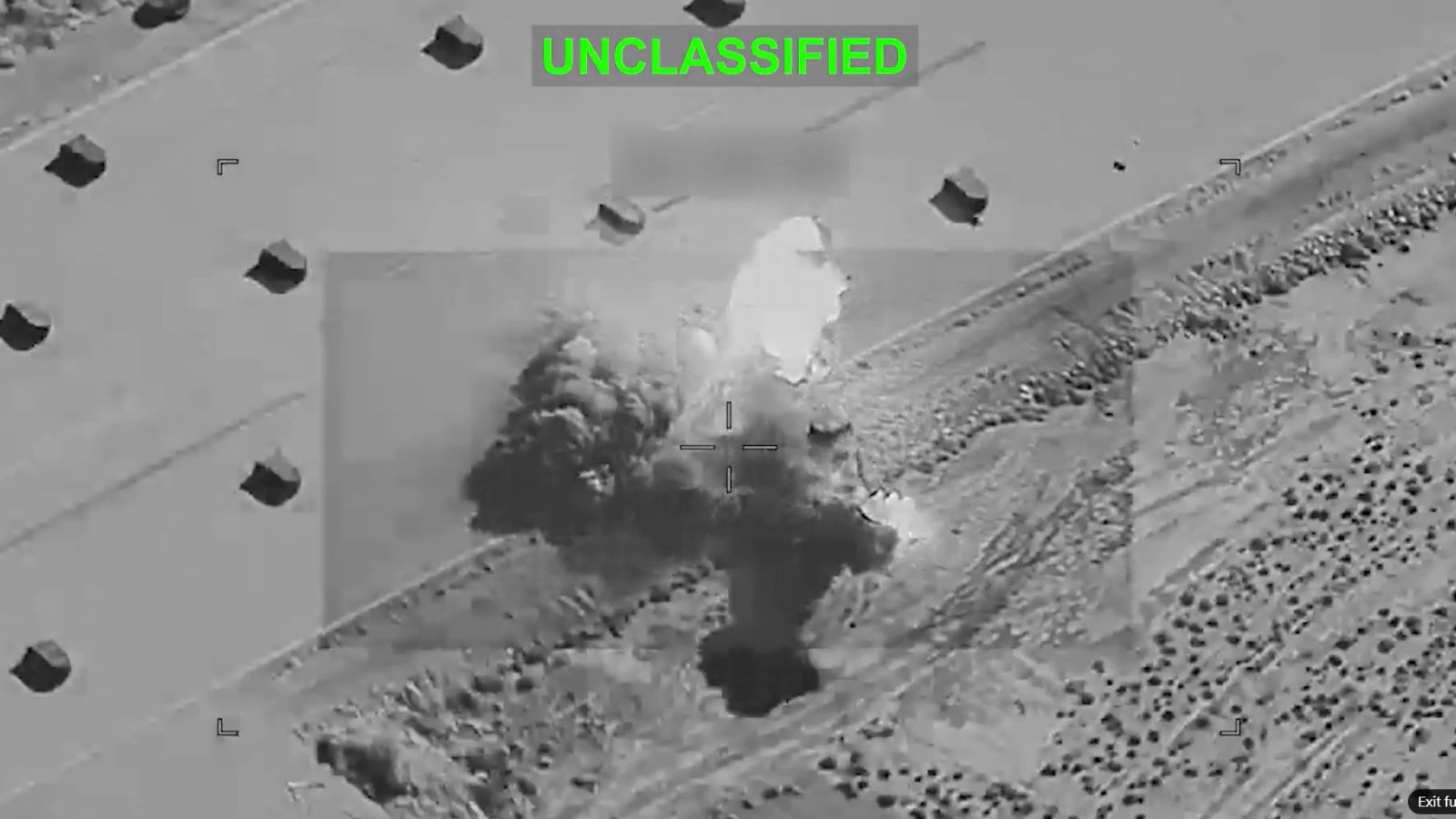
The transition from a fragile peace to renewed kinetic engagements occurred when tactical movements intersected with critical supply lines and infrastructure during the funeral processions. The US strike on railway bridges fifty-five kilometers from Mashhad demonstrates the mismatch between tactical intentions and geopolitical outcomes.
From an American operational perspective, targeting transport infrastructure on routes leading to Mashhad was designed as a calibrated message to disrupt potential military reinforcements or asymmetric asset transfers occurring under the cover of the funeral logistics. The strike was intended as a localized disruption rather than an all-out offensive action.
The Iranian calculus, however, evaluated the cost of this strike through the lens of regime legitimacy and sovereign survival. Hitting a transport link filled with civilian mourners and state officials during the culmination of a national mourning period forced a mandatory retaliatory response to maintain domestic credibility. The regime shifted its defensive assets to protect its nuclear infrastructure, such as the Bushehr plant, interpreting the railway strikes as a preliminary phase for deeper strikes against strategic state targets.
US Tactical Strike (Mashhad Route)
   │
   └───> Iranian Perception: Existential Threat to Sovereignty & Legitimacy
            │
            └───> Retaliatory Output: Asymmetric Strikes on Regional Partners
This structural bottleneck forced Iran to deploy its most effective asymmetric tools: regional missile strikes and maritime interdiction. The retaliatory launches targeting assets in Kuwait, Qatar, and Bahrain, alongside the interception of missiles by Jordan, transformed a bilateral breakdown into a regional security crisis. This reaction illustrates the classic security dilemma where defensive maneuvers designed to signal strength are perceived by the adversary as offensive preparations, compelling an equal or greater counter-response.
Maritime Interdiction and Global Supply Chain Vulnerabilities
The immediate economic impact of the ceasefire collapse is concentrated in the Strait of Hormuz, a choke point responsible for the transit of approximately twenty percent of the world’s petroleum liquids. The complete halt of tanker traffic through the waterway provides a quantifiable metric of the geopolitical risk premium now embedded in global markets.
The mechanics of this shipping freeze operate through three primary variables:
- Insurance Risk Premium Escalation: Marine insurers track war-risk premiums dynamically based on active kinetic engagements. The introduction of anti-ship cruise missiles, fast-attack craft deployments by the IRGC, and US naval counter-strikes causes insurance rates to rise exponentially, making commercial transit economically non-viable regardless of official state declarations.
- Physical Denial Capabilities: The geography of the Strait allows Iran to utilize low-cost, asymmetric denial strategies, including mobile anti-ship missile batteries along the rugged coastline and defensive mining. These tactics do not require total naval superiority to achieve a denial-of-access outcome; they merely require the credible threat of hull destruction to deter commercial operators.
- Naval Escort Bottlenecks: While the United States Navy possesses the technical capacity to conduct mine clearance and provide defensive escorts for commercial shipping, the operational layout requires significant time and asset reallocation. Escort operations draw strike groups away from broader regional deterrence missions, creating vulnerabilities elsewhere in the theater.
The cessation of commercial traffic confirms that risk perception among private shipping consortia responds to physical indicators on the water rather than diplomatic rhetoric from Washington or state media reports from Tehran. The economic cost function is no longer speculative; it is actively modifying global energy distribution networks as tankers divert around the Cape of Good Hope, adding significant transit time and fuel overhead to global trade.
Strategic Forecast and Escalation Scenarios
The current operational posture of both actors suggests that a return to the status quo ante is structurally improbable without a fundamental shift in the underlying variables. The conflict is transitioning into a prolonged war of attrition defined by localized kinetic exchanges and economic disruption.
Scenario A: Controlled Attrition and Managed Escalation
In this path, both sides limit their targeting profiles to maintain a high-intensity but geographically bounded conflict. The United States focuses exclusively on degrading Iran’s maritime denial capabilities and defensive missile infrastructure along the southern coast, avoiding deep strikes into major population centers or political hubs. Iran confines its responses to asymmetric harassment in the Persian Gulf and proxy engagements through remaining regional networks. This scenario maintains a high geopolitical risk premium and keeps the Strait of Hormuz closed to standard commercial traffic, forcing a structural realignment of global energy flows over a multi-month timeline.
Scenario B: Full-Scale Infrastructure Degradation
This path is triggered if Iranian asymmetric strikes successfully inflict significant casualties on American naval assets or launch successful attacks against high-value infrastructure inside Gulf Cooperation Council state partners. The US response would shift from calibrated deterrence to a comprehensive air campaign designed to systematically dismantle Iran's military command infrastructure, internal energy refining capabilities, and hardened nuclear facilities. The domestic political consequence for Iran would be severe, either forcing an immediate internal collapse of the transition leadership or driving the regime to deploy its ultimate defensive options, completely destabilizing regional governance structures.
The operational reality dictates that any future diplomatic framework cannot rely on vague, unverified pauses in hostilities. Peace initiatives that fail to address the internal political transition requirements within Tehran or the explicit maritime security mandates of Washington will consistently fracture under the pressure of localized tactical engagements. Security architectures in the region must either account for these structural asymmetries or prepare for an extended period of kinetic friction.