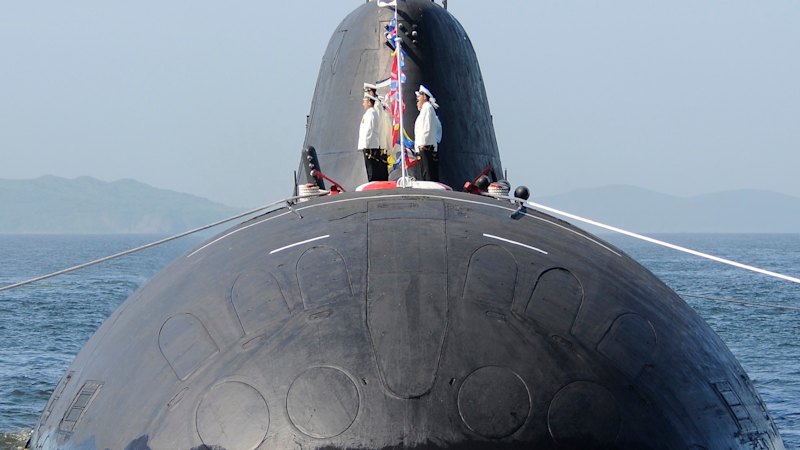
The recent surge in Royal Navy deployments to intercept Russian submarines in UK-adjacent waters is not a routine patrol cycle. It is a desperate high-stakes chess match. Over the last several months, the Ministry of Defence has been forced to scramble Type 23 frigates and P-8A Poseidon maritime patrol aircraft to track Akula and Improved Kilo-class vessels loitering near the GIUK (Greenland-Iceland-UK) Gap. While the public narrative focuses on "sovereignty" and "deterrence," the tactical reality is far more concerning. Russia is testing the response times and acoustic signatures of a British fleet that has shrunk to its smallest size in modern history.
Britain's ability to guard its backyard is under unprecedented strain. The Kremlin knows it. By pushing Kilo-class diesel-electric boats—renowned for being "Black Holes" due to their silent propulsion—into the North Sea, Moscow is forcing the UK to burn through limited operational hours on its aging frigate fleet. This is an asymmetric war of attrition where the prize isn't territory, but the integrity of the undersea cables that carry 97% of global communications and trillions of dollars in daily financial transactions. If you found value in this article, you might want to read: this related article.
The Silence of the Kilo Class
The technical challenge of modern anti-submarine warfare (ASW) has shifted. During the 1980s, Soviet boats were loud, clattering machines that could be picked up by passive sonar from hundreds of miles away. Today, the Improved Kilo-class 636.3 submarines utilize advanced vibration-damping technology and an-echoic coatings that make them nearly indistinguishable from the background noise of the ocean.
When one of these vessels enters the English Channel or the North Atlantic, the Royal Navy cannot rely on a single sensor. It requires a "layered" hunt. First, the P-8A Poseidon drops sonobuoys to create an acoustic net. Then, a Type 23 frigate, equipped with the Type 2087 towed array sonar, must literally "listen" for the faint hum of a cooling pump or the cavitation of a propeller. If the Russian captain is skilled, he will hide in "thermal layers"—patches of water where temperature shifts bend sound waves, creating blind spots for British sonar. For another perspective on this event, check out the latest coverage from Al Jazeera.
Why the GIUK Gap Still Matters
Geography is a brutal master. The GIUK Gap remains the primary choke point for any Russian Northern Fleet vessel attempting to reach the open Atlantic. If a Russian submarine slips through undetected, it gains the ability to threaten the US Eastern Seaboard or, more importantly, to sit silently atop the fiber-optic cables that link London to New York.
The Vulnerability of Subsea Infrastructure
We are no longer talking about simple wiretapping. Modern Russian naval research vessels, often escorted by the submarines the UK is currently deterring, carry autonomous underwater vehicles (AUVs) capable of cutting or manipulating cables at extreme depths.
- Financial Impact: A coordinated strike on three major Atlantic cables would freeze the SWIFT banking system.
- Military Impact: Secure satellite uplinks are often backed up by physical cables; losing them forces military comms onto slower, more interceptable channels.
- Energy Security: The recent sabotage of the Nord Stream pipeline proved that underwater infrastructure is the new "soft underbelly" of European security.
The Royal Navy’s deployments are a frantic effort to keep the "eyes-on" status of these Russian assets. Once a submarine is "lost" in the vastness of the Atlantic, finding it again is like looking for a specific grain of sand in a desert during a windstorm.
The Hardware Deficit
The British government frequently boasts about its "Global Britain" reach, but the math on the ground—or rather, in the water—tells a darker story. The Royal Navy currently operates a handful of dedicated ASW frigates. These ships are being worked to the point of mechanical failure.
When a Russian submarine appears off the coast of Scotland, the Navy often has to divert a ship from a scheduled NATO exercise or a carrier escort duty just to maintain a shadow. This creates a "readiness hole." If two or three Russian boats appear simultaneously in different sectors, the UK’s "deterrence" becomes a game of bluff.
The transition to the Type 26 City-class frigates cannot come soon enough. These new vessels are designed from the keel up to be the world’s most advanced submarine hunters, but they are years away from full operational capability. In the interim, the UK is relying on the sheer grit of crews operating ships that were built when the Berlin Wall was still standing.
The Psychological Front
Moscow isn't just looking for cables; they are looking for a reaction. Every time a British frigate is forced to intercept a Russian vessel, the Russian Navy collects data. They record the "ping" of the British sonar. They measure how long it takes for a P-8A to arrive from RAF Lossiemouth. They are mapping the UK's nervous system.
This is a classic "Grey Zone" tactic. It falls below the threshold of open conflict but stays well above the level of peaceful coexistence. By constantly probing, Russia forces the UK to spend millions in fuel, maintenance, and personnel costs, while the Russian boats—often operating closer to their own ports—incur a fraction of the expense.
The Role of the Nuclear Deterrent
There is a final, more chilling reason for these intercepts. The UK’s Continuous At-Sea Deterrent (CASD), the Vanguard-class submarines carrying Trident missiles, must exit their base at Faslane and reach the deep waters of the Atlantic without being trailed.
If a Russian Akula-class submarine is sitting off the coast of Scotland, it is likely waiting for a "V-boat" to emerge. If a Russian captain can successfully "tail" a British nuclear submarine, the UK’s entire nuclear deterrent is effectively neutralized. The frigate deployments are the "sweepers" that ensure the exit path for the Vanguard is clear. Without these intercepts, the very foundation of British national security is compromised.
Beyond the Surface
The public sees a photo of a grey ship next to a black submarine and thinks the job is done. They don't see the acoustic analysts in windowless rooms in Northwood, staring at waterfalls of data, trying to distinguish a Russian reactor pump from the sound of a passing whale. They don't see the fatigue of engineers trying to keep 30-year-old engines running for one more week of pursuit.
The UK is currently engaged in the most significant underwater confrontation since 1985. The difference today is that the margin for error has vanished. Britain is no longer a superpower with a massive fleet; it is a specialized maritime power that is currently being stretched to its absolute limit by an adversary that knows exactly where the cracks are forming.
The navy is holding the line, but the line is getting thinner every year. It is not enough to simply "deter" with presence; the UK must reinvest in the unglamorous, expensive, and invisible world of underwater warfare before the "Black Holes" of the Russian Navy stop being a nuisance and start being a catastrophe. Stop looking at the ships on the horizon and start worrying about what is gliding silently beneath them.