The metal identifier tag on a decommissioned Type 094 ballistic missile submarine feels surprisingly cold, even under the heavy, humid air of a shipyard. It is a mass of steel, wires, and silent potential. For decades, the global conversation around nuclear weapons felt like an old movie—a black-and-white relic of the Cold War, filed away under history alongside rotary phones and fallout shelters. We convinced ourselves that the danger had receded, that treaties signed by men in oversized suits during the 1980s had permanently bent the arc of history toward safety.
We were wrong.
While the world was looking elsewhere, focusing on economic trade wars and digital algorithms, the fundamental architecture of global security quietly shifted. The Stockholms Internationella Fredsforskningsinstitut, known globally as SIPRI, recently released data that shatters our collective complacency. The numbers do not lie, but they rarely tell the whole story. To understand what is happening, you have to look past the spreadsheets and look at the silos.
The Silence of the Silos
Picture a vast, empty stretch of the desert in northwestern China, near Yumen. To a satellite orbiting hundreds of miles above, the landscape looks like a grid of heavy concrete plugs set into the earth. These are not construction sites. They are missile silos.
For a long time, Beijing maintained what military strategists call a "lean and effective" nuclear deterrent. It was a boutique arsenal. The philosophy was simple: keep just enough weapons to ensure that if anyone struck first, China could strike back. It was a defensive crouch.
That crouch has turned into a sprint.
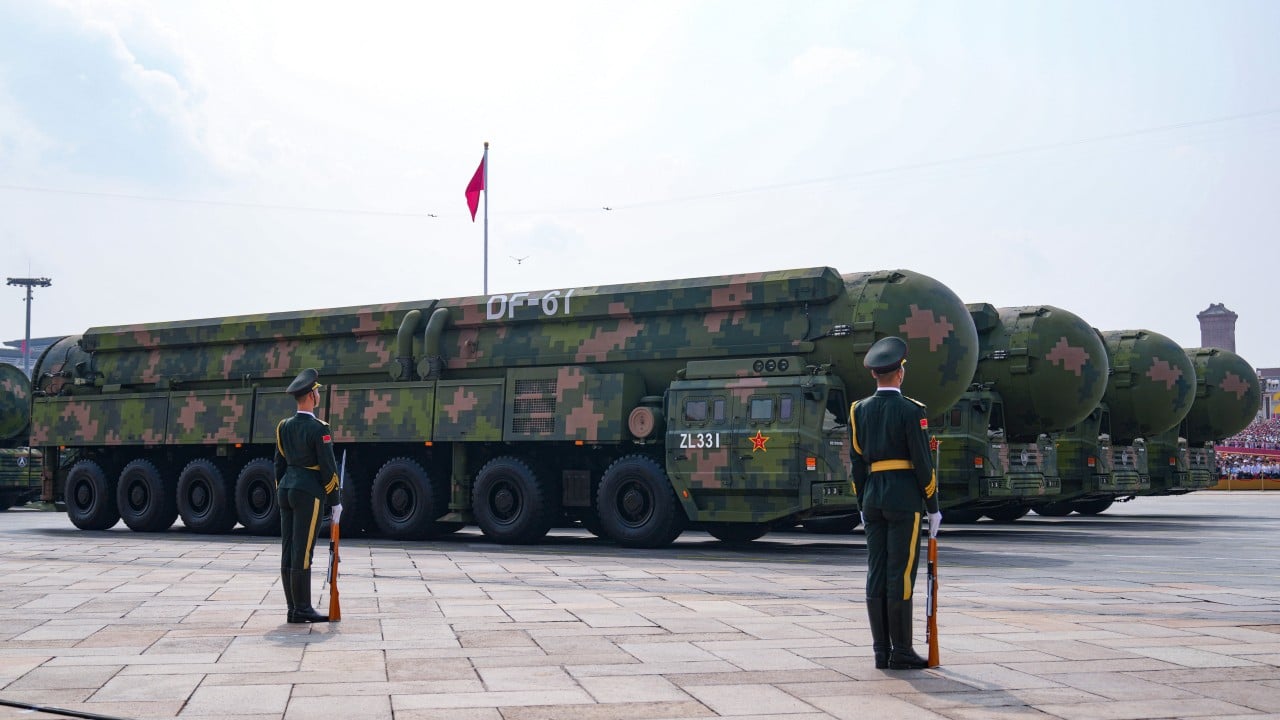
According to the latest tracking data, China’s nuclear stockpile expanded from roughly 410 warheads to over 500 in a matter of months. By the turn of the decade, that number is projected to compete directly with the deployments of the world’s traditional nuclear superpowers, the United States and Russia.
This is not a minor adjustment. It is a structural overhaul.
Consider a hypothetical engineer named Chen, working within one of these sprawling defense complexes. Chen does not think about geopolitical dominance when he clocks in. He thinks about metallurgy. He thinks about the precise shelf-life of tritium, a radioactive isotope of hydrogen used to boost the yield of nuclear explosions. He monitors the steady refinement of miniaturized warheads designed to fit atop Multiple Independently Targetable Reentry Vehicles, or MIRVs.
When Chen successfully mounts multiple warheads onto a single Intercontinental Ballistic Missile, the math changes instantly. One missile is no longer one threat; it is a cluster of independent entries screaming through the upper atmosphere toward different targets. For decades, China ran its program on the assumption that its weapons would be stored separately from their launchers until a crisis occurred. Now, state forces are moving toward a state of "launch-on-warning" readiness. The warheads are already mated to the missiles. The engines are warm.
The Great Unraveling
To understand why this expansion is happening now, we have to look at the collapse of the scaffolding that kept the peace for a generation. Nuclear deterrence is not just about hardware; it is about psychology and trust. And right now, trust is a bankrupt currency.
For thirty years, bilateral treaties between Washington and Moscow acted as a pair of heavy brakes on a steep hill. The Strategic Arms Reduction Treaty, or New START, was the last remaining pillar of that system. It capped the number of deployed strategic nuclear warheads at 1,550 for both sides. It allowed inspectors to literally walk into each other’s military bases, count the missiles, and look at the warheads.
That transparency is gone.
Russia suspended its participation in the treaty. The inspections stopped. The daily notifications that kept both sides from misinterpreting a sudden troop movement or a missile test ended. At the same time, the United States is embarking on a trillion-dollar modernization of its own nuclear triad, replacing aging Minuteman III missiles with the new Sentinel system and rolling out B-21 Raider stealth bombers.
When the two largest nuclear powers stop talking and start upgrading, smaller powers do not sit idly by. They calculate.
Imagine a room where three people are holding firearms. For years, two of them agreed to slowly take bullets out of their magazines while the third kept a single shot ready just in case. Suddenly, the first two start reloading their weapons in plain sight. They stop talking to each other. They stop showing each other their holsters. The third person in the room faces a brutal, terrifying logic: stack more ammunition, or risk being completely outgunned if the room descends into chaos.
China’s buildup is a direct response to this atmosphere of profound isolation. It is an insurance policy against a world where the old rules have completely dissolved.
The Global Cascade
The ripple effects of this buildup extend far beyond Beijing and Washington. The entire global balance is tilting, creating a chain reaction across continents.
Look at India. New Delhi watches China’s expanding arsenal with growing alarm. In response, India is developing its own longer-range weapons, like the Agni-V, capable of striking targets across the entirety of the Chinese mainland.
Look at Pakistan. Islamabad, viewing India’s military modernization as an existential threat, accelerates its own production of tactical nuclear weapons designed for use on the battlefield.
Look at North Korea. Pyongyang has transitioned from treating its nuclear program as a bargaining chip to cementing it as a permanent pillar of state identity, assembling highly enriched uranium and testing long-range delivery vehicles with unprecedented frequency.
Even in Western Europe, the tone has shifted. The United Kingdom and France, the continent's two nuclear-armed nations, are reassessing their postures. The British government recently raised the ceiling on its maximum warhead stockpile, reversing a decades-long policy of gradual reduction.
The entire planet is participating in a quiet, synchronized rearmament. The SIPRI report estimates that out of the world’s total inventory of roughly 12,121 nuclear warheads, nearly 9,585 are kept in military stockpiles for potential use. Approximately 2,100 of those are kept in a state of high operational alert—ready to fly at a moment's notice.
The Myth of the Rational Actor
The most terrifying aspect of the current nuclear landscape is not the technology itself. It is the human element.
We like to think that the concept of Mutually Assured Destruction keeps us safe. The theory states that because a nuclear war would result in the total annihilation of both sides, no rational leader would ever press the button. It treats geopolitics like a grand game of chess played by flawless grandmasters who never lose their temper, never misunderstand a signal, and never suffer from sleep deprivation.
History tells a different story.
During the Cuban Missile Crisis of 1962, catastrophe was averted not by flawless institutional logic, but by pure luck and individual human restraint. At the height of the tension, a Soviet submarine, B-59, was targeted by non-lethal American depth charges meant to force it to surface. The crew on board, cut off from communication with Moscow, believed World War III had already begun. The captain wanted to launch a nuclear torpedo. The political officer agreed. It required the unanimous consent of three officers on board to fire. The second-in-command, Vasili Arkhipov, refused to authorize the launch. He argued that they should wait for orders.
Arkhipov’s stubbornness saved millions of lives. He was not a computer running a deterrence algorithm. He was a tired, hot man in a stifling submarine who decided to hesitate.
Today, the time windows for hesitation are shrinking. The introduction of hypersonic missiles, which travel at more than five times the speed of sound, means that a president or premier may have less than ten minutes to decide whether an incoming blip on a radar screen is a glitch or an apocalyptic first strike.
As artificial intelligence is increasingly integrated into early-warning systems and command structures, the human buffer is being whittled away. We are replacing the Vasili Arkhipovs of the world with lines of code optimized for speed, not hesitation.
The Price of Admission
There is a financial cost to this race that hits closer to home than most realize. Every dollar, yuan, or ruble spent on refining the trigger mechanism of a thermonuclear warhead is capital diverted from somewhere else.
The modernization of these arsenals requires specialized talent. It pulls the brightest minds out of universities—the physicists, the data scientists, the aerospace engineers—and places them in classified laboratories. It consumes immense amounts of rare earth elements, specialized polymers, and advanced computing power.
We are paying for our insecurity by starving our future.
The transformation is visible in the communities that host these facilities. In regions where missile production facilities operate, towns experience a strange, artificial economic boom. High-paying defense contracts fill local restaurants and buy real estate. But it is an economy built on the production of items designed specifically to never be used, items whose sole purpose is to sit in darkness beneath the earth until they rot or destroy civilization.
It is a deeply fragile existence.
The Horizon
The true tragedy of the current moment is the loss of imagination. We have forgotten how to negotiate. Diplomacy has come to be viewed as a sign of weakness, an admission that your opponent holds better cards than you do.
When international bodies try to sound the alarm, their reports are treated as white noise. The news cycle moves on to the next viral video or the latest corporate scandal. We have lived under the shadow of the bomb for so long that we have mistaken the shadow for a natural part of the scenery.
But shadows grow longer as the sun sets.
The build-up in East Asia, the breakdown of treaties in Europe, and the frantic modernization programs across the globe are all symptoms of a singular disease: the belief that security can be achieved through total dominance. It is an old illusion, one that has buried every empire that ever tried to realize it.
Deep inside the command centers, the monitors continue to flicker. The tracking software monitors the movement of mobile missile launchers across the Siberian tundra, the patrol routes of stealth submarines in the Pacific, and the construction of new silos in the Chinese desert. The machines are working exactly as intended. They are calculating the end of the world with absolute precision, waiting for a human hand to tell them that the time for calculations has finally ended.