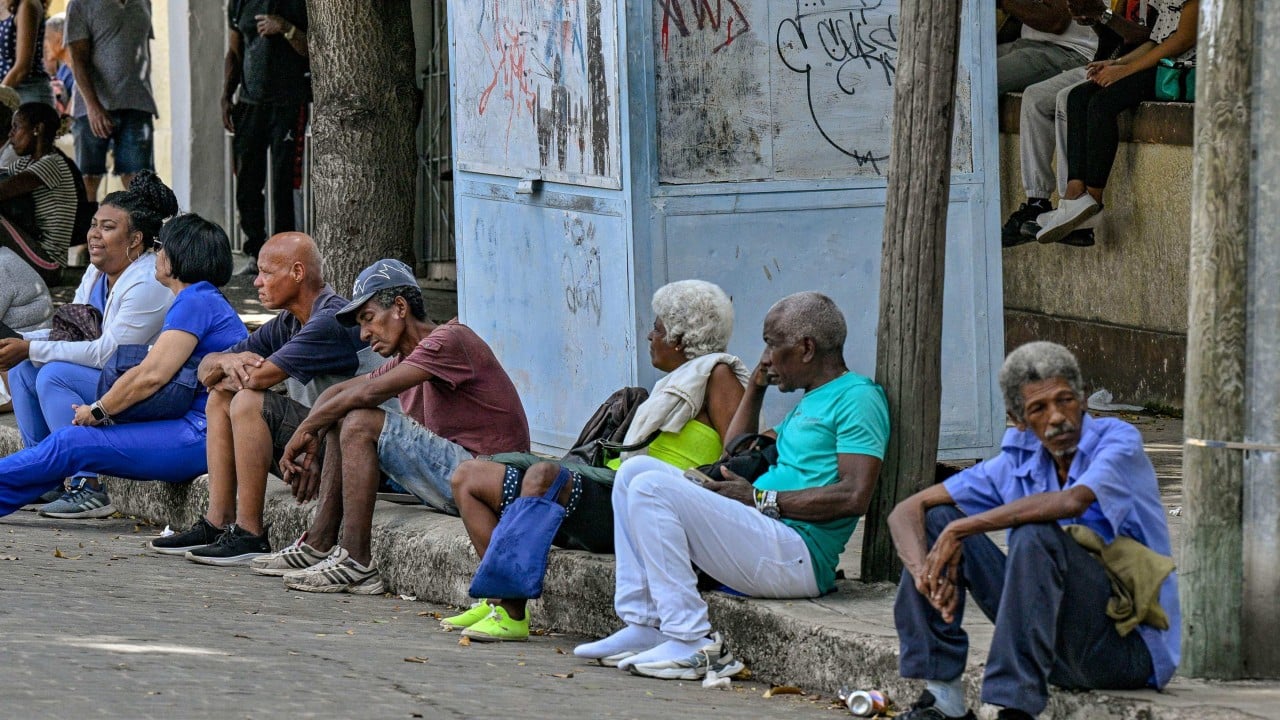
The headlines are predictable. They smell like 1962. They scream about a total power collapse in Havana, blame a decades-old embargo, and frame Donald Trump’s rhetoric of "taking" the island as a display of strength. It is a lazy, outdated narrative.
If you believe the island’s darkness is a victory for democratic pressure, you are reading the map upside down. Cuba’s grid failure isn't a precursor to a democratic spring; it’s a laboratory for a new kind of decentralized, chaotic instability that the United States is fundamentally unprepared to manage. We are not "taking" anything. We are inheriting a cemetery of infrastructure that will cost billions to resurrect, all while handed a bill we can't afford to pay.
The Myth of the Strategic Blackout
The common consensus suggests that if you squeeze the energy supply hard enough, the populace will rise, the regime will crumble, and a pro-Western government will slide into place like a Tetris block.
I’ve spent twenty years watching energy markets and political risk. It never works that way.
When a grid dies, the first thing that goes isn't the government’s resolve. It’s the middle class. The people with enough resources to form an opposition are the ones who flee first. What’s left is a hollowed-out shell of subsistence and black markets. By weaponizing the oil embargo to the point of total systemic failure, we aren't fueling a revolution. We are fueling a mass migration event that will make the 1980 Mariel boatlift look like a weekend harbor cruise.
The Efficiency Trap
The Cuban electrical grid is a Frankenstein’s monster of 1970s Soviet technology and patched-up thermo-electric plants. The "lazy consensus" says the embargo is the sole culprit. That’s a half-truth. The deeper reality is a catastrophic failure of centralized planning that no amount of lifted sanctions could fix overnight.
Even if the U.S. opened the taps tomorrow, the Cuban grid is physically incapable of handling a modern load. It is a thermal-heavy system in a world moving toward modularity.
- Thermoelectric dependency: Over 80% of their power comes from aging plants that require constant, high-sulfur crude.
- Maintenance debt: We are talking about fifty years of deferred CAPEX (Capital Expenditure).
- Distribution loss: Their lines lose nearly double the energy of a standard Western grid before the power even reaches a lightbulb.
When Trump talks about "taking" the island, he isn't talking about a land grab. He’s talking about an unfunded liability. To "take" Cuba is to take responsibility for 11 million people without running water, refrigeration, or a functional economy. It is a nation-building project that makes Afghanistan look like a DIY home renovation.
Why the Embargo is Actually Protecting the Regime
This is the pill no one wants to swallow: The embargo provides the Cuban Communist Party with the only thing more valuable than oil—an eternal excuse.
Every failure of the central committee, every corrupted procurement deal, and every crumbling bridge is blamed on Washington. By maintaining a total blockade, we provide the ultimate rhetorical shield. If you want to actually disrupt the Cuban status quo, you don’t starve them of oil. You drown them in capitalism.
Imagine a scenario where American small-scale solar providers were allowed to flood the Cuban market.
If every Cuban home had an independent power source, the state’s primary lever of control—the ability to turn off the lights—evaporates. Centralized regimes hate distributed energy. They need a big, clunky, centralized grid because it’s easier to police. By blocking energy technology, we are inadvertently helping the regime maintain its monopoly on the most basic necessity of modern life.
The China-Russia Pivot
Nature—and geopolitics—abhors a vacuum. While we post bellicose tweets about "taking" islands, other players are actually moving in.
Russia isn't sending oil out of the goodness of its heart. They are trading fuel for strategic positioning. China isn't "investing" in Cuban solar farms for a quick ROI. They are building a digital and physical infrastructure footprint 90 miles from Key West.
While the U.S. uses the grid collapse as a talking point, our adversaries are using it as an entry point. We are playing 1950s checkers while they are installing the 5G routers.
The Cost of the "Take"
Let’s talk numbers. To stabilize the Cuban grid and bring it to a baseline functional level would require an estimated $10 billion to $15 billion in immediate infrastructure investment. That doesn't include the environmental cleanup of their antiquated plants.
- The fantasy: We "take" Cuba, and it becomes a Caribbean Singapore.
- The reality: We "take" Cuba, and the American taxpayer becomes the guarantor for a failed socialist utility company.
If the goal is truly to help the Cuban people and secure the region, the strategy must shift from "strangle" to "bypass."
We should be incentivizing the export of modular, off-grid energy solutions. We should be encouraging the "Grey Market" of Starlink and Tesla Powerwalls. If you want to break a centralized dictatorship, you decentralize their power—literally.
The Wrong Question
People often ask: "When will the Cuban government finally fall?"
That is the wrong question. The right question is: "What happens to the Florida Straits when the Cuban state fails completely?"
Total power failure leads to total social failure. When the hospitals stop working because the generators ran out of diesel, the people don't go to the plaza to protest. They go to the beach to find a raft.
The current policy isn't "toughness." It’s a lack of imagination. We are clinging to a Cold War playbook in an era of distributed networks. We are cheering for a blackout, forgetting that we are the ones who will have to deal with the ghosts when the lights stay off for good.
Stop cheering for the collapse. Start planning for the decentralization. The grid is dead, and "taking" the island won't bring it back. Only a radical shift toward individual energy independence will break the cycle. Everything else is just noise.
Get ready to pay for the lights, or get out of the way of the people trying to build their own.