A Vessel in the Mist
Picture a steel hull slicing through dark water, carrying twenty thousand shipping containers filled with everything from coffee beans to microchips. The captain on the bridge looks out at a narrow stretch of sea, barely twenty-one miles wide at its tightest bend. On one side lies rugged coastline; on the other, open sea.
This is the Strait of Hormuz.
Every single day, roughly a fifth of the world’s petroleum flows through this tiny geographical needle’s eye. It is the jugular vein of the global energy supply. When a state sits beside that narrow corridor and decides to alter the rules of transit, the ripple effects do not stay in the Persian Gulf. They hit gas stations in Ohio, grocery stores in Manila, and factory floors in Stuttgart.
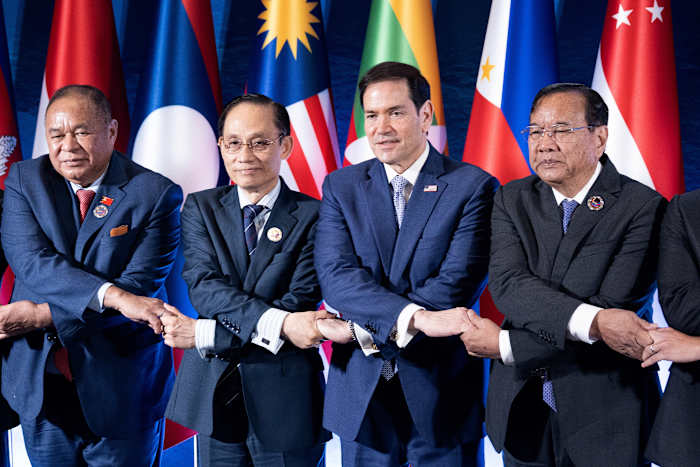
At a recent gathering of Southeast Asian leaders, U.S. Secretary of State Marco Rubio laid out a stark warning regarding demands surrounding this critical passageway. The argument was simple: allowing a nation to dictate terms over an international maritime corridor sets a precedent that threatens the entire global economy.
The Invisible Engine of Global Commerce
We rarely think about maritime law while waiting in line for morning coffee or filling up a car. Yet, the price of almost every physical item in our hands is tethered to the safety of ocean shipping lanes.
Freedom of navigation is not a dry legal concept invented by diplomats in suits. It is an unwritten promise that keeps the global engine running. Under the United Nations Convention on the Law of the Sea, vessels enjoy the right of transit passage through straits used for international navigation. This rule ensures that no single country can arbitrarily lock the gate to global trade simply because it controls the surrounding shorelines.
Consider what happens when that principle begins to fray.
If one nation establishes a precedent that it can demand tolls, inspect cargoes, or restrict passage through an international strait, other nations along critical trade routes will notice. The Malacca Strait, which connects the Indian Ocean to the Pacific, carries a massive share of the world's trade. If the rules governing straits crumble in the Middle East, the uncertainty spreads instantly to East Asia.
Uncertainty is the enemy of stability. Insurance rates for cargo ships skyrocket. Shipping lines reroute vessels around entire continents, adding weeks to transit times. Fuel costs surge. The final bill for all of this delay does not disappear into thin air. It lands squarely on the consumer.
The High Stakes in Southeast Asia
Why bring this message to ASEAN leaders? Because Southeast Asian economies depend on the stability of sea lines for their survival.
Nations across the region import vast quantities of energy from the Middle East to power their rapidly growing industrial sectors. A disruption in the Persian Gulf directly translates to energy shortages, inflation, and economic drag across Asia.
More importantly, the region faces its own maritime tensions. The South China Sea remains one of the most contested bodies of water on Earth. If international consensus tolerates unilateral control over vital waterways in the West, it weakens the legal and diplomatic shields protecting small nations in the East.
Rubio’s emphasis to ASEAN was clear: sovereign rights must yield to established international laws when it comes to shared global corridors. Allowing any power to weaponize geographical chokepoints creates a blueprint for instability that others will surely copy.
Beyond the Diplomatic Tables
Decisions made in quiet summit halls eventually touch millions of daily lives. A sudden spike in oil prices caused by maritime friction can derail small businesses, stretch household budgets, and trigger broader economic anxiety.
The maritime order built over the last several decades relies on a shared commitment to keep the highways of the sea open to all. When those rules are challenged, the response cannot be passive.
The sea does not belong to any single power. The moment we forget that fundamental truth, the world grows smaller, darker, and infinitely more fragile.