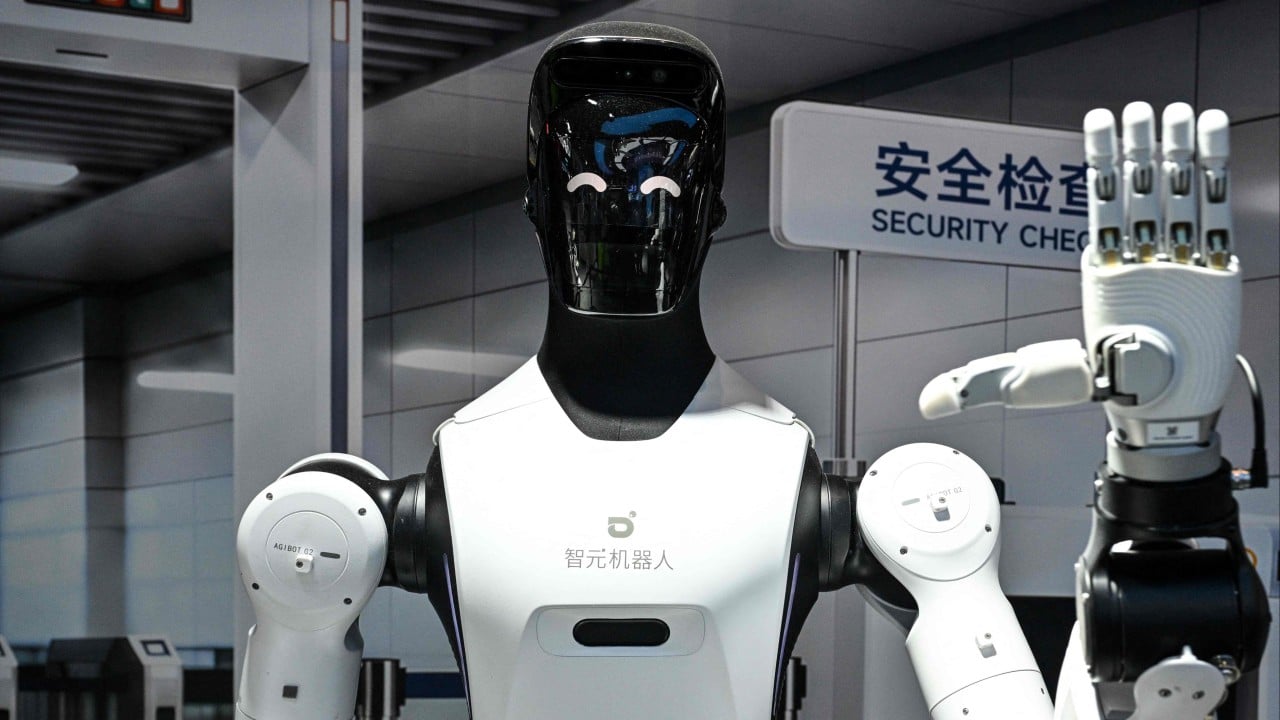
China can build hardware faster than almost anyone else on the planet. Walk through the tech hubs of Shenzhen or Hangzhou, and you'll see sleek, metal humanoid robots walking, flexing, and doing backflips. On paper, it looks like a total victory for Chinese robotics.
It isn't.
Despite hardware that competes directly with Boston Dynamics or Tesla, local engineers face a massive roadblock. These machines are brilliant at physical movement, but they lack real intelligence. China's humanoid robot push is hitting a wall because the hardware is running way ahead of the AI software required to make these machines truly autonomous.
If you want a robot to pick up a coffee cup, clean a factory desk, or adjust its grip when an object slips, raw physical mechanics won't cut it. You need a massive dataset of real-world interactions and an AI model trained to interpret that data in real time. Right now, Chinese developers are running desperately low on both.
Hardware Supremacy Means Nothing Without Embodied AI
Building a robot body is mostly an engineering and supply chain problem. China already dominates the supply chain for electric motors, harmonic reducers, joint actuators, and lithium batteries. That's why local companies can pump out bipedal prototypes at a fraction of the cost seen in Western markets.
Making that body act smart in an unpredictable world is an entirely different battle.
Industry insiders refer to the missing link as "embodied AI"—software that connects digital reasoning directly to physical movement. Traditional large language models process text. Embodied models have to process visual inputs, tactile sensors, spatial geometry, and motor feedback simultaneously.
Without high-quality embodied models, a multi-thousand-dollar humanoid robot is basically just a fancy, remote-controlled toy.
Take a look at what happens in real factory trials. A robot programmed to move boxes works fine when the lighting is perfect and the box is placed at an exact angle. Shift that box three inches to the left or dim the room lights, and the machine stalls out or drops the load. That isn't a mechanical failure. It's a cognitive failure.
The Massive Shortage of Physical World Data
How do you make an AI model smart enough to handle random daily friction? You feed it millions of hours of real-world data. And that brings us to the biggest bottleneck facing Chinese developers today.
Digital data is easy to grab. Web scrapers can pull billions of text files and images from the internet to train tools like ChatGPT. Physical data is a nightmare to collect. You can't scrape the physical world from a server. You have to physically record a robot attempting a task—and failing—thousands of times over.
Right now, dataset gathering happens through three main methods:
- Teleoperation: Human operators wear motion-capture suits or VR rigs to control robots manually, recording every motion and sensor feedback point. It's precise, but it's excruciatingly slow and expensive.
- Synthetic Simulation: Engineers build virtual environments using game engines like Nvidia Isaac Sim to train virtual robots in digital space. It scales fast, but models often suffer from the "simulation-to-reality gap" when transferred to real physical hardware.
- Video Mining: Models attempt to learn by watching thousands of hours of human YouTube or Bilibili videos. Translating human muscle movements into robot motor commands, however, remains mathematically messy.
Western tech firms currently hold a distinct advantage in software infrastructure and simulation frameworks. While Chinese companies excel at churning out physical joints, gears, and frames, they're playing catch-up on the centralized data platforms needed to train general-purpose physical foundation models.
Why Open Source Models Haven't Fixed the Problem Yet
Some developers hoped that open-source AI architectures would level the playing field quickly. While open-source software helped jumpstart China's digital AI ecosystem, physical robotics presents unique hurdles.
A text model runs on standardized cloud servers. A physical robot, on the other hand, carries custom actuators, different sensor arrays, varying joint flexibility, and unique weight distributions. An embodied AI model trained on one hardware setup rarely works on another without extensive retraining.
Because every Chinese robot manufacturer is rushing out its own proprietary hardware design, the industry is terribly fragmented. There is no unified operating system or standardized data format for humanoid motion. Engineers are spending hundreds of hours tweaking software just to fit their specific custom-built hardware arms, rather than improving the core intelligence of the machine itself.
Until the industry agrees on common standards or builds a shared, massive repository of motion data, every company is essentially reinventing the wheel in isolation.
The Strategy Shift to Simple Workspaces
Frustrated by the limits of current AI models, several Chinese manufacturers are changing their immediate market strategy. Instead of trying to build a fully autonomous humanoid that can cook dinner, clean a house, and hold a conversation, they're narrowing their focus drastically.
They're targeting structured industrial settings where variables are controlled.
Think automotive assembly lines, electronics logistics centers, and standardized warehouse sorting. In these environments, you don't need a general-intelligence brain. You just need a model trained on a tight set of repetitive physical tasks.
By putting these machines onto real factory floors today—even in limited roles—companies are attempting to solve their data problem in real-time. Every shift a robot works on a factory floor yields real operational data that gets fed back into the training pipeline.
It's a practical, grind-it-out approach: deployment drives data collection, and data collection drives model intelligence.
How to Track Which Companies Will Actually Win
If you're watching the robotics space, don't get blinded by impressive video demos showing bipedal robots doing flips or walking up stairs. Stunted movement routines are pre-programmed; they don't reflect actual intelligence.
To spot the real leaders over the next few years, watch these specific indicators instead:
- Data pipeline scale: Look at which firms are deploying real hardware in actual factories, not just showing prototypes at trade shows. Real floor time means real training data.
- Simulation fidelity: Pay attention to teams investing heavily in high-physics digital twins that minimize the gap between simulated training and real-world execution.
- Hardware standardization: Watch for companies moving toward modular, standardized components that allow software models to run across different hardware platforms without total recalibration.
If a company can't show you how it collects and processes terabytes of physical interaction data daily, its hardware is going to sit idle on a shelf very soon. Focus on the data strategy, skip the flashy media presentations, and evaluate the underlying software stack before taking any claims at face value.