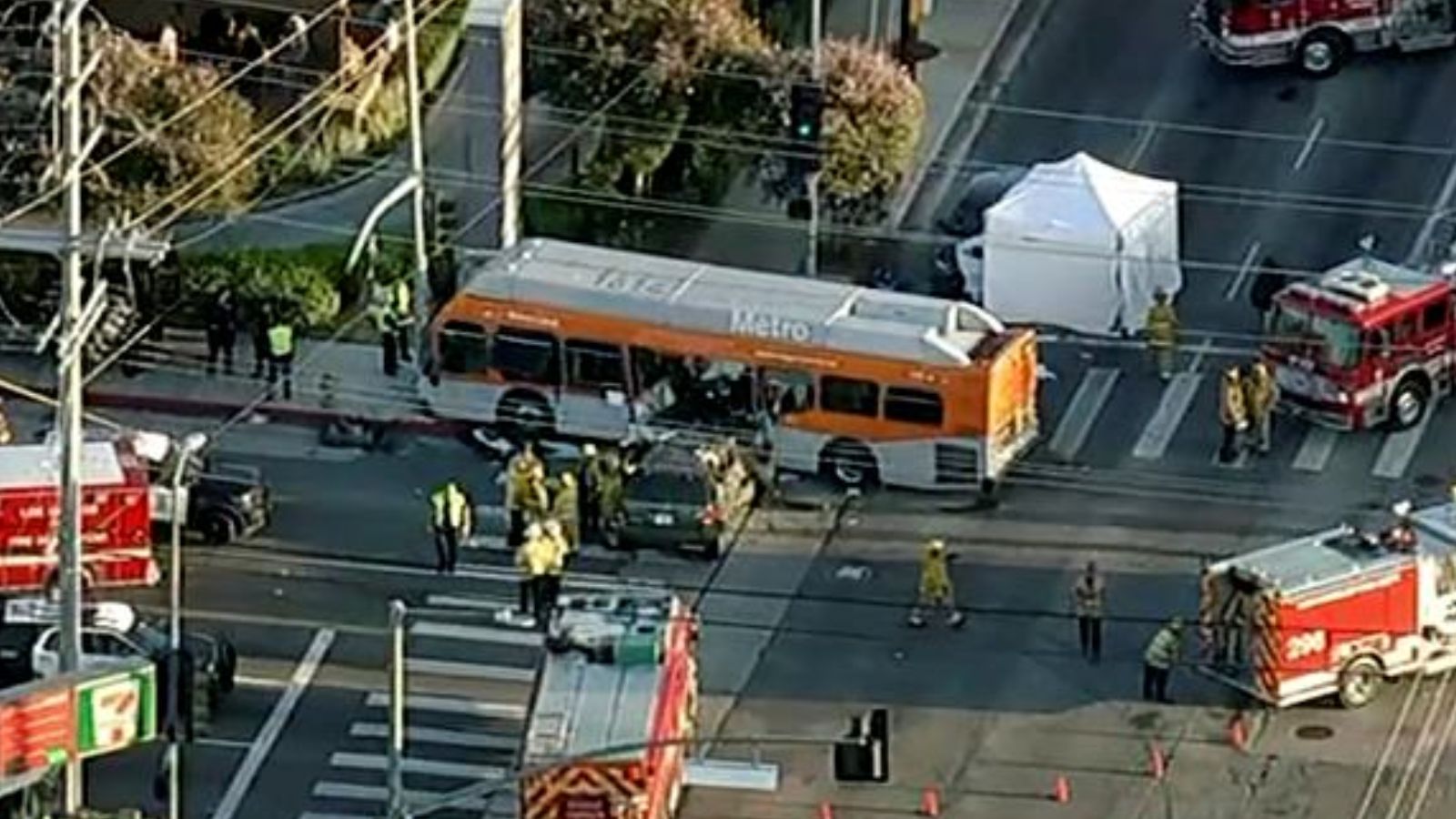
Three people died on September 15, 2026, when a Los Angeles television news helicopter went down while covering a fatal bus crash in Chatsworth. That single sentence captures the headline, sure. It misses why this tragedy hit the city like a gut punch—and why newsrooms across the country are quietly rethinking how they send crews into the sky.
A live-update ticker reduces a complex, heartbreaking sequence of events to a punchy alert. Real life doesn't work like a push notification. On that Tuesday evening in the San Fernando Valley, a horrific traffic collision set off a chain reaction that claimed five lives across two separate scenes.
First, a speeding 2004 Ford Expedition ran a red light and slammed into the midsection of a Los Angeles Metro Line 166 bus near Nordhoff Street and De Soto Avenue. Two people died at the bus crash site, and six others went to hospitals. TV stations scrambled their airborne units to capture the aftermath.
Just before 7 p.m. PDT, NewsChopper4—an Angel City Air Eurocopter AS350 B2 flying for NBC4 Los Angeles and Telemundo 52—lost contact and crashed into a commercial parking lot on the 9100 block of North Mason Avenue. Broadcast audio captured low rotor RPM tones and shifting engine speed before impact. Journalist Eliana Moreno and pilot George Marciniw were killed aboard the aircraft. On the ground, 29-year-old Edy Gutierrez Mejia, a tourist from Guatemala who'd arrived in Los Angeles earlier that day, lost his life when the chopper came down and caught fire. Two other people were hospitalized.
What Actually Happened in the Chatsworth News Helicopter Crash
Generic live-blog summaries make it sound like a freak coincidence—a news crew flew out, got unlucky, and crashed. That framing erases the mechanics, the airspace dynamics, and the human reality of aerial newsgathering.
Multiple news helicopters converged over Chatsworth to cover the Metro bus collision. When you put several single-engine helicopters into a tight urban pocket during twilight hours, workload spikes fast. Pilots juggle traffic separation, broadcast routing, camera framing, and terrain awareness all at once.
National Transportation Safety Board investigators examined wreckage from the 9100 block of North Mason Avenue and focused heavily on live broadcast feeds and audio recordings. NTSB investigator Fabian Salazar noted that audio from the broadcast contained sounds consistent with engine speed changes, and tones likely tied to pilot advisories. Crucially, fuel was onboard when the aircraft went down. This wasn't a simple case of running dry.
Let's be honest about what that means. When fuel is in the tank and rotor RPM drops, investigators look at fuel control units, governor systems, turbine components, or pilot-induced rotor stall during low-altitude maneuvering. Federal teams hauled the wreckage away for off-site teardown, checking maintenance logs, mechanical parts, and weather conditions. Preliminary NTSB findings take weeks, and full probable-cause determinations often take a year or more. Anyone claiming to know the exact mechanical root cause right now is guessing.
The Human Cost Behind "Eyes in the Sky"
Local TV stations love calling their aerial teams "eyes in the sky". It sounds slick on a promo. Behind the microphone and camera, though, those jobs rely on tight-knit crews who know Southern California's canyons, power lines, and traffic bottlenecks by heart.
Eliana Moreno was 38, a Chapman University grad from Orange County who joined Angel City Air in 2010. She wasn't just reading scripts from above. Colleagues described her as a bilingual photojournalist and editor who handled camera work and storytelling on the fly. Viewers of NBC4 and Telemundo 52 knew her voice from wildfire coverage, police pursuits, and evening breaking news. She was engaged to be married.
George Marciniw was 70, a longtime Southern California pilot with more than 14,000 flight hours who also taught aspiring pilots and was planning to retire. People who knew him—from fellow aviators at the airport to neighbors in Burbank—talked about how steady and approachable he was. Both Moreno and Marciniw were slated for inclusion in the Fallen Journalists Memorial Foundation's planned memorial in Washington, D.C.
Then there's Edy Gutierrez Mejia. He had nothing to do with television ratings, traffic alerts, or aviation. He was a 29-year-old visitor from Cuilapa, Guatemala, standing in a parking lot on a Tuesday evening when a burning helicopter fell out of the sky. Mayor Karen Bass called it a devastating loss of five Angelenos and visitors in a single night. You can't talk about aerial safety without keeping someone like Mejia front and center.
Why News Helicopters Still Fly Low Over Crowded Cities
If you've ever watched a local newscast during rush hour, you've seen how close these choppers fly to apartment blocks, freeway overpasses, and commercial strips. Why do stations keep doing it when drones exist?
Drones can't legally fly beyond visual line of sight without special waivers, and they lack the range, live microwave/IP relay power, and endurance to cover sprawling multi-scene events across a county the size of Los Angeles. A helicopter like the Eurocopter AS350 B2—the workhorse light single-engine platform across U.S. newsrooms—carries stabilized gyro gimbals, live uplink gear, and a trained journalist who can interview ground sources or spot secondary hazards.
Still, single-engine helicopters over dense neighborhoods carry inherent risk. Unlike twin-engine transport helicopters, a single-engine aircraft has no second turbine to fall back on if power drops at low altitude. Autorotation works when you have altitude and open terrain. Over warehouses, storage facilities, and parked cars in Chatsworth, margin for error shrinks to seconds.
I've watched newsroom budgets tighten for years while pressure to beat rivals to live video stays relentless. Even when pilots have 14,000 hours, the pressure to get "the shot" before competitors can subtly shape flight paths. Not because pilots are reckless—Marciniw had a stellar reputation—but because mission profiles put machines in tight spaces.
Misconceptions Around Breaking News Crashes
People throw around a lot of half-truths after high-profile aviation tragedies. Let's clear a few up.
- Myth: Live broadcast audio tells the whole story. Broadcast audio is a huge clue, and the NTSB explicitly called the chopper's live footage and audio vital evidence. Still, audio without flight data recorders doesn't prove whether a governor failed, a sensor glitched, or a control input occurred.
- Myth: News helicopters are flying illegally low. FAA rules (14 CFR Part 91) set minimum safe altitudes, though takeoff, landing, and certain operational contexts have specific parameters. Investigators check whether the aircraft complied with rules and standard operating procedures.
- Myth: The bus crash caused the helicopter crash directly. The Metro bus collision triggered the news coverage, not a physical collision in the air. Treating them as one single crash blurs two separate legal and safety tracks: criminal DUI charges against the SUV driver (booked on suspicion of second-degree murder with bail set at $4 million) and the federal aviation probe into NewsChopper4.
What Newsrooms and Viewers Can Do Next
Tragedy doesn't fix itself with a vigil at St. John Eudes Parish, even though that community gathering mattered deeply to grieving neighbors. Practical changes start with how information is gathered, shared, and verified.
If you work in media or communications:
- Audit airborne risk thresholds. Review minimum altitude buffers, multi-aircraft deconfliction protocols, and weather/workload triggers before dispatching crews to chaotic scenes.
- Separate editorial urgency from flight decisions. Make sure pilots have explicit, unchallenged authority to hold back or climb higher without feeling pressured by live-desk producers.
- Invest in safer standoff optics. Push for longer-lens stabilized cameras that deliver crisp shots from higher, safer altitudes instead of tighter orbits.
If you're a reader or viewer following developing stories:
- Skip live-update rumor mills. Early alerts often mix up victim counts, aircraft types, or causes. Wait for official statements from agencies like the National Transportation Safety Board and local fire or medical examiner offices.
- Support verified victim and family funds. Look for confirmed community or institutional channels rather than unvetted social media fundraisers.
The Chatsworth news helicopter crash exposed a hard truth about modern breaking news. We demand instant video from everywhere at once, and real people pay the price when things go wrong in the air.