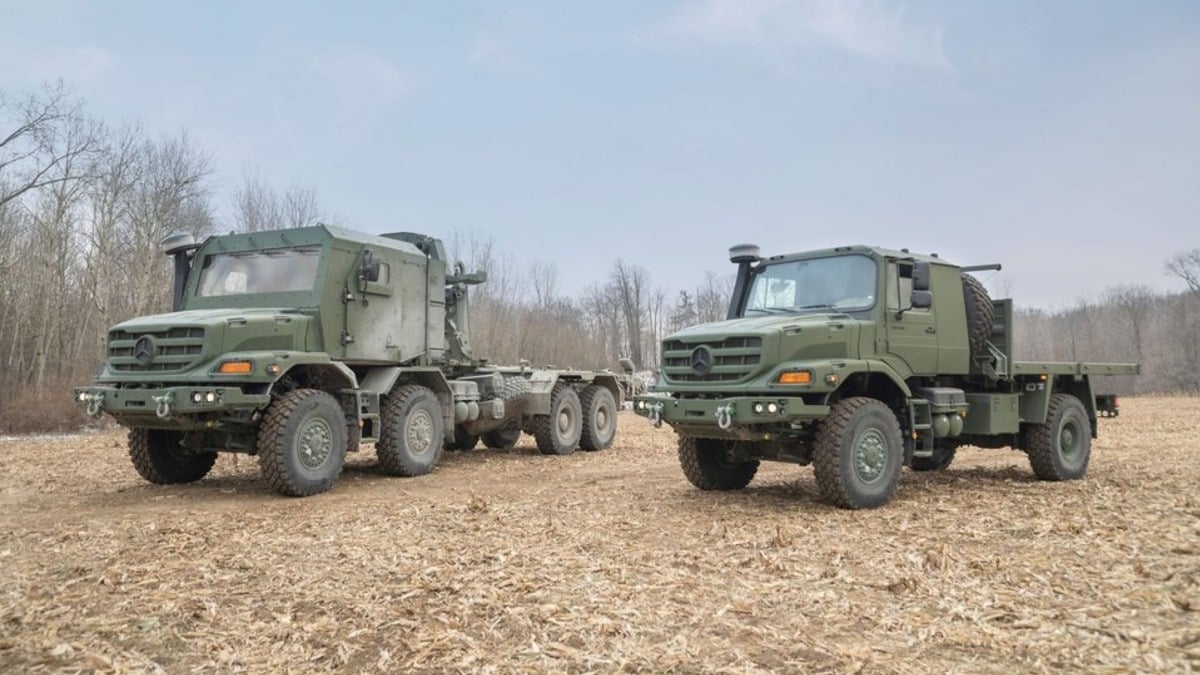
The air inside a heavy truck manufacturing plant has a specific weight. It smells of scorched weld points, hydraulic fluid, and the sharp, metallic tang of cold roll steel. For decades, this scent belonged exclusively to the backbone of global commerce. It belonged to the long-haul rigs that carry fresh produce across borders, the delivery vehicles that keep supermarket shelves stocked, and the construction vehicles building our cities.
Lately, the tone on the factory floor has shifted. The neon vests worn by visiting executives are being replaced by the muted wool suits of defense procurement officers.
Europe’s largest commercial truck manufacturers are quietly pivoting. The massive assembly lines that once lived and died by the cyclical nature of global shipping are turning their attention toward a different kind of customer. They are betting heavily on the military market.
This is not a sudden, erratic twitch of the corporate steering wheel. It is a calculated, multi-billion-dollar realignment driven by a sobering reality. The civilian market is sputtering, choked by economic stagnation and the immense, capital-intensive pressure to decarbonize. Meanwhile, geopolitical stability in Europe has fractured. Governments that once debated the necessity of standing armies are now opening their checkbooks, desperate for logistics, transport, and supply-chain resilience.
To understand why a company built on moving consumer goods would pivot to moving artillery, you have to look at the math, the mechanics, and the human beings caught in the middle.
The Friction of the Road
Consider a fleet manager. Let us call him Thomas. For twenty years, Thomas has managed logistics for a mid-sized shipping firm based out of Frankfurt. His world is governed by razor-thin margins. When diesel prices spike, Thomas bleeds cash. When governments mandate a shift to zero-emission battery-electric or hydrogen fuel-cell fleets, Thomas looks at the price tags—often three times the cost of a traditional internal combustion engine—and feels a knot tighten in his stomach.
The commercial vehicle industry is notoriously cyclical. When the economy booms, everyone needs trucks. When it slows, ordering halts. Right now, commercial truck makers are staring down a prolonged trough in civilian demand. High interest rates have made financing new fleets agonizingly expensive for buyers like Thomas.
On top of that, the regulatory pressure to eliminate carbon emissions has forced manufacturers to spend billions on research and development for electric drivetrains. They are pouring money into a future that the current infrastructure cannot yet support. There are not enough heavy-duty charging stations. The grid is not ready. The buyers are hesitant.
The manufacturers are caught in a vise. They need steady, predictable revenue to fund the green transition, but the civilian market is too volatile to provide it.
Then, the world changed.
The outbreak of large-scale conflict on the European continent shattered decades of geopolitical assumptions. Suddenly, defense budgets that had been dwindling since the end of the Cold War were revitalized. The North Atlantic Treaty Organization (NATO) issued stark reminders about spending targets. Countries realized that a modern army is entirely useless if it cannot move.
Military planners do not buy vehicles the way Thomas does. They do not care about a three-year return on investment. They care about survivability, standardization, and immediate availability. Most importantly, their contracts are backed by state treasury departments. They do not evaporate during a retail recession.
For a massive truck manufacturer, the military sector represents something incredibly rare in modern business: absolute certainty.
The Anatomy of a Military Rig
It is easy to assume that a military truck is just a civilian commercial rig painted olive drab. The reality is far more complex, a lesson in engineering contradictions.
A standard commercial truck is optimized for efficiency. It features aerodynamic plastic fairings, low-rolling-resistance tires, and a cab designed to maximize driver comfort over long, smooth highway stretches. It is a creature of the asphalt.
A tactical military vehicle must survive the absence of infrastructure.
+-------------------------------------------------------------+
|               THE DUAL-TRACK MANUFACTURING ARCHITECTURE     |
+-------------------------------------------------------------+
|                                                             |
|   [ CIVILIAN SUPPLY CHAIN ]      [ MILITARY SUPPLY CHAIN ]  |
|      Optimized for Cost             Optimized for Security  |
|      Just-in-Time Delivery          Strategic Stockpiling   |
|               |                              |              |
|               v                              v              |
|   +-----------------------------------------------------+   |
|   |             COMMON ASSEMBLY PLATFORM                |   |
|   |  Shares core engine block, chassis, and drivetrain  |   |
|   +-----------------------------------------------------+   |
|               |                              |              |
|               v                              v              |
|   [ STANDARD CAB & HIGHWAY ]     [ ARMORED CAB & OFF-ROAD ] |
|   Aerodynamic plastics           Ballistic steel plating    |
|   Consumer electronics           Blackout lighting systems  |
|   Emissions-heavy exhaust        High-clearance suspension  |
|                                                             |
+-------------------------------------------------------------+
Take the chassis. A military variant requires a reinforced frame capable of enduring violent twisting forces when crossing trenches or rocky terrain. The suspension cannot rely on delicate air bags that might pop from a stray piece of shrapnel; it uses heavy-duty leaf springs or independent setups designed to absorb immense impacts.
The cabin is where the divergence becomes truly stark. Where Thomas’s drivers enjoy ergonomic seats, touchscreen infotainment systems, and large glass windshields for maximum visibility, a soldier sits inside an armored capsule. The glass is inches thick, heavy enough to warp the light passing through it. The doors require hydraulic assistance just to swing open because the ballistic steel plating weighs thousands of pounds.
Yet, despite these differences, the world's most successful truck makers have mastered a crucial trick: modularity.
They build their military trucks on the exact same base assembly lines as their civilian models. The engine block, the transmission gears, the axles—they are largely identical. This allows a factory to swap from building a commercial dump truck to a military logistics hauler with minimal downtime.
This dual-use strategy provides an incredible hedge. When global trade softens, the assembly line switches its focus to fulfilling state defense contracts. The workers keep their jobs. The factories stay warm. The corporate balance sheet remains steady.
The Ethics of the Pivot
There is an undeniable discomfort in this transition. For a company that has spent generations branding itself around safety, environmental sustainability, and the peaceful connectivity of global commerce, leaning into the defense sector requires a delicate internal alignment.
Employees who spent their careers optimizing fuel injectors to save a fraction of a gram of carbon dioxide are now tasked with ensuring an engine can run on low-quality, high-sulfur fuel found in conflict zones. Marketing teams accustomed to filming pristine rigs driving through scenic Alpine passes must now discuss blast-mitigation ratings and payload capacities for ammunition transport.
But inside the boardrooms, the argument is framed not as a departure from values, but as a defense of them. Corporate leadership argues that economic security and national security are inextricably linked. If European industry cannot provide the logistical backbone for its own defense, it remains vulnerable.
Moreover, there is a technical irony at play here. The massive profits generated by securing long-term, multi-decade military contracts are actively funding the civilian sector's green transition. The money paid by ministries of defense for rugged, diesel-slurping tactical trucks is the very capital being used to engineer the zero-emission electric hydrogen rigs of tomorrow.
The defense market acts as a financial shock absorber. It allows these industrial giants to survive the volatile, expensive bridge between the age of fossil fuels and the era of sustainable transport.
The Road Ahead
Walk through the shipping yard of a major European manufacturer late in the afternoon. The rows of vehicles tell the story of our current historical moment.
On one side sit the clean, white commercial trucks, waiting for buyers who are nervous about inflation, hesitant about new regulations, and cautious about the future. They represent the fragile, integrated global economy we have taken for granted for decades.
On the other side sit the rows of dark, matte-green tactical vehicles. They look brutalist, heavy, and indifferent to aesthetics. They are headed for deployments along eastern borders, into strategic reserves, and into the fleets of nations rearming for an unpredictable century.
They represent stability of a different kind—one bought with state contracts and geopolitical necessity.
The heavy truck industry is no longer just a mirror of global trade. It has become a barometer of global tension. As the assembly lines continue to adjust their speed, the distinction between the vehicles that feed our societies and the vehicles that defend them is growing smaller by the day. The industrial giants of Europe have made their choice. They are betting that the road to the future runs directly through the realities of defense.