Restoring degraded temperate ecosystems across a century-long horizon requires shifting from short-term agricultural subsidies to permanent natural capital underwriting. The Scottish Highlands 100-year restoration initiative—focused on reversing centuries of deforestation, peatland drainage, and trophic collapse—is fundamentally an infrastructure and asset-management problem disguised as an environmental project. Executing this requires solving three interlocking structural failures: hydrological degradation in upland peat bogs, unnatural herbivore browsing pressure that prevents natural regeneration, and a fragmented land-ownership model that misaligns short-term cash flows with multi-generational ecological returns.
Most public reporting treats large-scale rewilding as a passive exercise in planting trees and waiting. In operational reality, the Scottish Highlands represent a severely arrested ecological state. Centuries of intensive sheep grazing, commercial forestry monocultures, and sporting estate management have stripped the region of its native Caledonian pinewoods, drained its blanket bogs, and eliminated apex predators. Returning this terrain to a self-regulating state demands sequenced capital deployment, strict biological controls, and financial instruments capable of surviving multiple political and economic cycles.
The Structural Deficit of the Modern Highland Ecosystem
To understand the mechanics of a 100-year recovery plan, you must first quantify the baseline degradation. The Scottish Highlands are not a pristine wilderness; they are an ecologically depleted, human-maintained grazing system. Roughly 17 to 18 percent of Scotland is currently forested, but native woodland accounts for only about 4 percent of the total land area—a fraction of its post-glacial climax cover. The remaining open moorland is dominated by heather, bracken, and degraded peat, maintained in an artificially static state through rotational burning (muirburn) and heavy herbivore pressure.
This baseline creates three compounding ecological bottlenecks:
- Trophic Truncation: Without apex predators such as the Eurasian lynx or gray wolf, herbivore populations—specifically red deer (Cervus elaphus) and domestic sheep—operate without top-down population regulation. When deer densities exceed 4 to 5 animals per square kilometer, natural tree regeneration stalls entirely because saplings are browsed before they can establish a canopy.
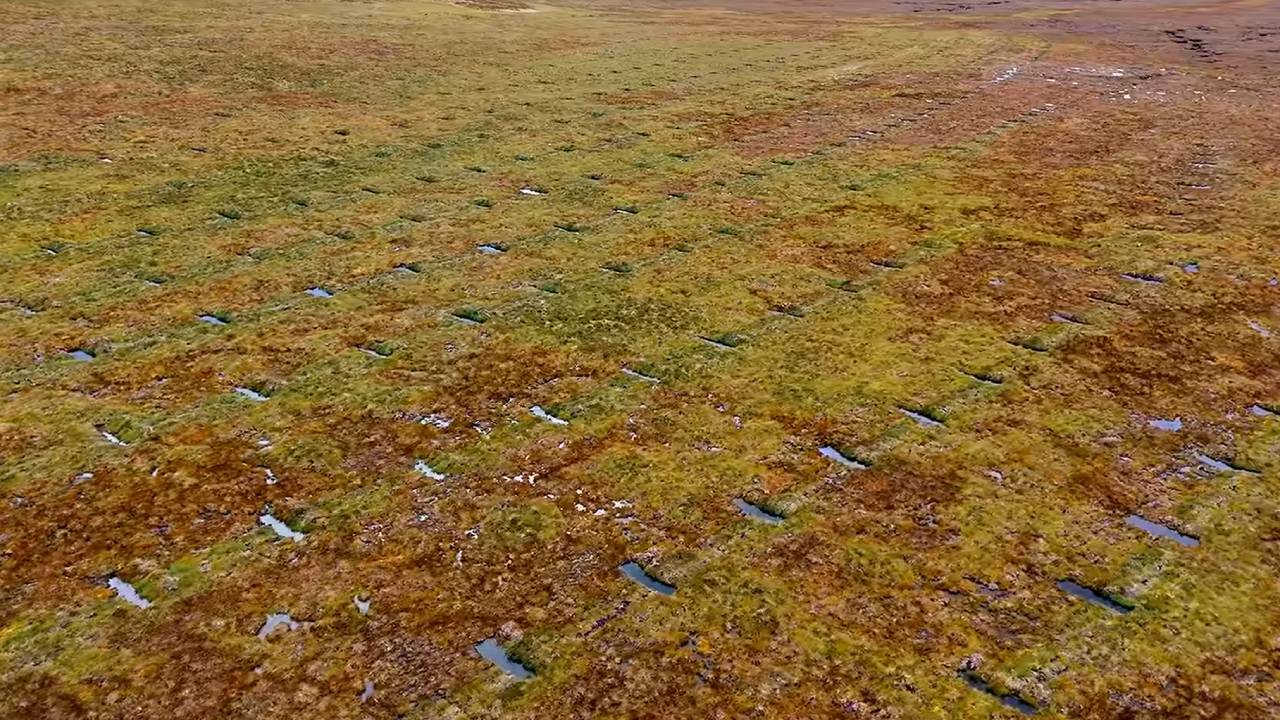
- Hydrological Short-Circuiting: Over the past two centuries, vast expanses of Highland blanket bog were drained using mechanical ditching (grips) to improve grazing yields and grouse moor productivity. Draining peat lowers the water table, exposing ancient organic matter to oxygen. Instead of sequestering carbon, these dried peatlands oxidize, releasing stored carbon dioxide into the atmosphere and accelerating downstream flood peaks during heavy rainfall events.
- Seed-Source Isolation: Native broadleaf species (birch, rowan, alder, oak) and Scots pine require proximate seed banks to colonize open ground. Because surviving fragments of the Caledonian forest are isolated in steep gorges or fenced enclosures, natural wind- and animal-dispersed seeding cannot bridge the spatial gaps across vast stretches of barren hillside without targeted human intervention.
A 100-year timeline is not arbitrary marketing; it is the minimum biological threshold required to overcome these three bottlenecks. Soil mycorrhizal networks take decades to re-establish after prolonged agricultural disturbance, and slow-growing native hardwoods require 60 to 80 years simply to reach structural maturity and produce deadwood habitats necessary for saproxylic insects and cavity-nesting birds.
The Three-Phase Operational Sequence
Deploying capital across a century fails if all interventions happen simultaneously. Planting trees into high-density deer zones wastes capital, and reintroducing fauna before habitat connectivity exists guarantees population failure. Effective execution follows a strict operational sequence divided into stabilization, structural establishment, and trophic self-regulation.
Phase 1: Hydrological and Herbivore Stabilization (Years 1–15)
The immediate priority is halting active degradation. In wetland zones, this involves blocking drainage ditches using peat dams, installing wooden or plastic piling, and reprofiling eroded peat hags to raise the water table back to the surface. Re-wetting stops peat oxidation immediately and creates the anaerobic conditions required for Sphagnum moss—the primary peat-forming genus—to recolonize.
Simultaneously, managers must execute aggressive herbivore reduction. There are only two operational mechanisms to achieve this: erecting deer fencing or conducting sustained culling. Fencing creates immediate regeneration zones but introduces high capital expenditure, ongoing maintenance liabilities, and lethal collision risks for low-flying woodland birds like the capercaillie and black grouse. Landscape-scale culling—bringing deer densities down to 2 to 4 animals per square kilometer—eliminates fence maintenance and preserves wildlife corridors, though it demands continuous annual labor and faces fierce resistance from neighboring sporting estates reliant on high stag numbers for commercial stalking revenue.
Phase 2: Pioneer Canopy and Riparian Engineering (Years 15–45)
Once browsing pressure drops and hydrology stabilizes, the system can support active botanical recovery. Rather than planting uniform grids of commercial conifers, restoration teams establish irregular, mixed-species pioneer nuclei—primarily downy birch, willow, and Scots pine—positioned strategically upslope so gravity and wind carry seeds downward over subsequent decades.
Riparian zones receive concentrated intervention during this phase. Planting native alder and willow along upland burns stabilizes eroding banks, shades water courses to keep temperatures below lethal thresholds for Atlantic salmon and trout, and introduces leaf litter that rebuilds aquatic invertebrate food webs. During this window, managers also deploy ecosystem engineers—most notably the Eurasian beaver (Castor fiber). Beavers construct leaky dams that slow water velocity, trap sediment, create complex wetland mosaics, and raise local water tables at a fraction of the cost of heavy civil engineering machinery.
Phase 3: Trophic Cascade and Autonomous Dynamics (Years 45–100)
By year 50, pioneer woodlands begin self-thinning, creating canopy gaps, deadwood, and a complex understory of blaeberry, mosses, and fungi. At this stage, active human planting ceases. Management shifts from physical intervention to monitoring and selective species reintroduction.
The ultimate test of a 100-year project is whether the ecosystem can transition from human-managed to self-regulating. In the final half-century, the system has sufficient biomass and habitat connectivity to support higher-order predators—such as pine martens, white-tailed eagles, golden eagles, and potentially reintroduced mesopredators like the wildcat or lynx. These predators suppress mid-sized herbivores and invasive species (such as non-native grey squirrels, which pine martens naturally control), locking in a self-sustaining trophic cascade that reduces long-term human operational costs.
The Capital Stack and Revenue Mechanics
A century-long ecological project cannot survive on volatile government grants or philanthropic donations alone; political administrations change every five years, and charitable endowments shift priorities. To survive 100 years, the land must generate durable, diversified cash flows that exceed the opportunity cost of traditional sheep farming or commercial Sitka spruce forestry.
Institutional investors and conservation partnerships structure these projects around blended natural capital finance:
- Voluntary and Compliance Carbon Markets: Restoring degraded peatlands and establishing native woodlands generate verified carbon units under frameworks like the UK Peatland Code and the Woodland Carbon Code. Peatland restoration yields immediate emissions reductions by halting oxidation, providing front-loaded carbon credits in years 1 through 15. Woodland creation generates sequestered carbon units on a back-loaded curve, peaking between years 20 and 60 as tree biomass accelerates.
- Biodiversity Net Gain and Nature Credits: Corporate buyers increasingly purchase verified biodiversity units to offset unavoidable supply-chain impacts or meet nature-related financial disclosure standards. Unlike carbon, which measures a single metric (tonnes of $CO_2$ equivalent), biodiversity credits are priced on habitat condition, species richness, and ecosystem connectivity, commanding higher premiums per hectare when verified by acoustic monitoring and environmental DNA (eDNA) sampling.
- Public Subsidy Restructuring: Replacing legacy area-based agricultural payments with outcome-based public contracts—paying landowners specifically for flood mitigation, water purification, and carbon storage—provides a baseline sovereign revenue floor that de-risks private institutional investment.
- Low-Impact Eco-Tourism and Venison Processing: High-end nature tourism, wildlife photography hides, and sustainable wild venison supply chains generate immediate operational cash flow to fund local rangers, ecologists, and estate staff.
This financial architecture aligns incentives: institutional capital funds the high upfront capital expenditure (land acquisition, peatland civil engineering, initial culling), while long-dated carbon and biodiversity contracts provide yield over decades 2 through 8.
Structural Risks and Operational Bottlenecks
No century-scale land-use transition operates without severe friction. Treating this initiative as a guaranteed ecological triumph ignores four critical failure modes that routinely derail landscape restoration.
1. The Boundary Leakage Problem
Ecological processes do not respect cadastral property lines. If a 10,000-hectare restoration estate reduces its red deer density to 3 per square kilometer, deer from neighboring, unmanaged sporting estates—where densities often exceed 15 to 20 per square kilometer—will continuously migrate into the newly regenerating woodland to exploit the superior forage. Unless restoration projects form contiguous, multi-landowner collaboratives operating under unified deer management plans, the core estate becomes an expensive sink that requires permanent, lethal perimeter culling just to hold the line.
2. Invasive Non-Native Seed Rain
The Scottish Highlands are heavily interspersed with commercial plantations of non-native conifers, particularly Sitka spruce (Picea sitchensis) and lodgepole pine. These species are aggressive wind-dispersed colonizers. Once grazing pressure is removed from an adjacent restoration site, windblown Sitka spruce seeds will germinate rapidly across open peatland and native woodland zones. Left unmanaged, these invasive conifers shade out native flora and dry out peat bogs, forcing conservation managers into permanent, labor-intensive mechanical removal programs.
3. Wildfire Risk in Transition Phases
During the first 15 to 25 years after grazing animals are removed—before a closed forest canopy forms and shades out the ground layer—rank heather, purple moor-grass, and dead vegetation accumulate rapidly. This creates a massive, contiguous fuel load. Combined with warmer, drier spring weather patterns driven by climate change, transitioning landscapes face extreme wildfire risk. A single severe peat fire during this vulnerable window can incinerate decades of accumulated biomass and ignite the underlying peat layer, releasing catastrophic amounts of stored carbon and resetting the ecological clock to zero.
4. Socio-Economic Displacement and Local Resistance
Highland communities have fragile, narrow economies heavily dependent on traditional crofting, estate employment, and seasonal tourism. When institutional funds or conservation charities acquire large estates and rapidly destock sheep or scale back commercial deer stalking, local agricultural supply chains contract. If restoration projects import external consultants rather than retraining local gamekeepers, stalkers, and crofters into conservation land managers, they generate entrenched political hostility. Without local social license, projects face regulatory delays, planning objections, and persistent friction over predator reintroductions.
Execution Blueprint for Long-Term Viability
To prevent a 100-year Highland restoration initiative from stalling in its second decade, project directors must lock in structural safeguards before deploying major capital:
- Enforce Conservation Covenants on Title: Attach legally binding conservation burdens directly to the land title. This prevents future landowners or insolvent corporate entities from liquidating the restored timber or reverting the land to intensive agriculture if carbon markets fluctuate.
- Establish Dedicated Endowment Sinking Funds: Ring-fence a percentage of early-stage carbon credit revenues into a sovereign-grade endowment fund. The investment yield from this fund must cover baseline maintenance—specifically invasive conifer removal, firebreak management, and boundary deer control—in perpetuity after carbon issuance schedules expire.
- Mandate Contiguous Landscape Agreements: Do not acquire or invest in isolated land parcels surrounded by high-density deer estates unless perimeter fencing is fully funded in the initial capital expenditure budget, or binding cross-boundary deer management agreements are signed with adjacent landowners.
- Integrate Local Equity and Employment: Structure community benefit agreements that transfer specific operational contracts—such as nursery propagation, fencing, peatland restoration engineering, and venison processing—directly to local Highland enterprises, converting potential political opposition into vested economic stakeholders.