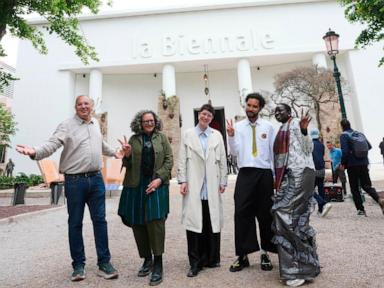
The Giardini della Biennale is usually a place where the air smells of jasmine and salt water. It is a sanctuary of gravel paths and modernist pavilions, a manicured park at the edge of Venice where the world agrees to speak the same language for a few months every two years. But this spring, the air is heavy with something else. It is the scent of wet paint mixed with the metallic tang of anxiety.
Outside the Russian Pavilion, the doors are locked. They have been locked for years. This time, the silence is different. It isn’t just an empty building; it is a void. Down the path, the Israeli Pavilion stands under the watchful eyes of armed soldiers. A sign in the window explains that the artist and curators will not open the exhibit until a ceasefire is reached and the hostages are released.
Art is supposed to be a mirror, but right now, it feels more like a lightning rod.
The Venice Biennale is the oldest art exhibition on the planet. It was founded in 1895 as a way to celebrate the "noblest activities of the modern spirit." For over a century, it has survived world wars, the rise and fall of the Iron Curtain, and the slow, rhythmic flooding of the city that hosts it. We tell ourselves that art exists above the fray of politics. We pretend that beauty is a neutral ground.
That lie is currently disintegrating under the Italian sun.
The Ghost in the Garden
Consider a young curator, let's call her Elena. She has spent three years of her life—and a significant portion of her sanity—organizing a small exhibit near the Arsenale. She arrived in Venice a week ago expecting to debate the merits of abstract sculpture. Instead, she spent her first morning watching protesters throw red paint onto the pavement.
The chaos isn't just a backdrop. It is the protagonist.
When the world’s most elite art collectors, critics, and celebrities descend on Venice for the "Varnishing Days," they are met with a reality that cannot be curated. The traditional spectacle of the Biennale—the champagne on yachts, the white-linen parties, the hushed conversations about brushstrokes—is being interrupted by the scream of the present.
The Russian Pavilion remains a hollow shell, its absence a louder statement than anything that could possibly be hung on its walls. Meanwhile, the presence of the Israeli Pavilion has become a site of intense friction. Thousands of artists signed a petition calling for its exclusion, citing the ongoing conflict in Gaza. The organizers refused, citing the Biennale's history as a platform for all nations.
The result is a standoff that feels less like a debate and more like a wound.
The Invisible Stakes
Why does a collection of paintings in a sinking city matter so much? Because the Biennale is the last place where the "National Pavilion" model still exists. It is a world’s fair of the soul. Each country is given a house, and inside that house, they are supposed to tell the truth about who they are.
When a pavilion stays closed, or when a pavilion is guarded by men with submachine guns, the "truth" being told is one of failure. We are witnessing the breakdown of the diplomatic power of culture.
The numbers tell part of the story. Over 300 artists are represented in the main exhibition. Thousands of others are scattered across the city in collateral events. Millions of Euros are spent on logistics alone. But you cannot quantify the tension in a room where an artist from a war-torn region has to stand next to their work and justify their right to exist to a critic from London or New York.
The "invisible stakes" are the lives of the artists who use this platform to speak when their own governments have silenced them. For many, Venice isn't just a career milestone. It is a megaphone. When the noise of protest drowns out the art, the megaphone breaks.
The Weight of the Walls
Walking through the Arsenale, the massive brick-and-timber shipyard that hosts the main international exhibition, you feel the physical weight of history. The space was once used to build the galleys that controlled the Mediterranean. Now, it holds massive installations that grapple with colonialism, climate change, and identity.
There is a specific kind of exhaustion that hits you in Venice. It’s not just from the miles of walking. It’s the cognitive dissonance. You step out of an exhibit about the displacement of indigenous peoples and immediately walk into a boutique selling four-hundred-dollar loafers.
This year, that dissonance has reached a breaking point.
The "chaos" the headlines describe is actually a collision. It is the collision of the art market—which treats creativity as a commodity—and the reality of global conflict—which treats humanity as a casualty.
The protesters aren't just angry at specific nations. They are angry at the idea that we can celebrate "culture" while the world burns. They are challenging the very foundation of the Biennale. Is it a bridge between nations, or is it just a high-end showroom for the status quo?
A Change in the Light
The sun sets over the lagoon, turning the water a bruised shade of purple. The crowds at the Giardini begin to thin out. The soldiers at the Israeli Pavilion shift their weight, their boots crunching on the gravel. The sign in the window remains.
"The artist and curators of the Israeli pavilion will open the exhibition when a ceasefire and hostage release agreement is reached."
It is a protest from within. It is an admission that, sometimes, art is not enough.
We often look to art for answers, or at least for a temporary escape. We want to be moved, inspired, or challenged in a way that feels safe. But Venice this year offers no safety. It offers no easy resolutions. It is messy, loud, and deeply uncomfortable.
The "chaos" isn't a bug in the system. It is the system finally being forced to acknowledge the world outside its gates.
The most important work at the Biennale this year isn't a painting or a video installation. It is the empty space in front of the locked pavilions. It is the silence of the artists who refused to show up. It is the red paint on the pavement that won't quite wash away.
Venice is sinking, and so is the idea that art can be separated from the hands that make it or the blood that is spilled in the names of the nations that sponsor it. The glitter of the lagoon is still there, but if you look closely at the water, you can see the reflection of the fire.
The bells of San Marco are ringing, but they don't sound like a celebration. They sound like a warning.
The doors remain closed. The guards remain at their posts. The world continues to turn, and in the gardens of Venice, the jasmine keeps blooming, indifferent to the fact that the mirror has finally shattered.


