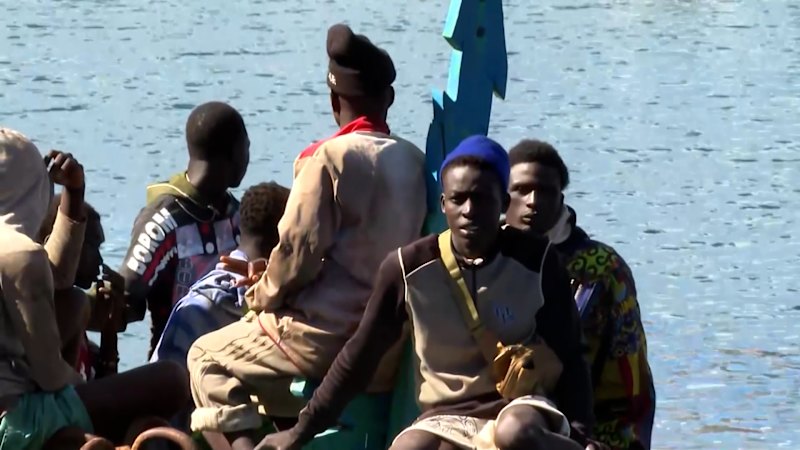
Fifteen hundred people landed on a volcanic archipelago in twenty-four hours, and every major news outlet immediately reached for the exact same playbook.
They dusted off the apocalyptic vocabulary. Surge. Deluge. Overwhelmed. They framed the arrival of 1,500 exhausted human beings on wooden cayucos in the Canary Islands as an unpredictable natural disaster—a sudden, unmanageable tidal wave crashing onto European shores.
That narrative is lazy, factually bankrupt, and intellectually dishonest.
The real story isn't that 1,500 migrants arrived in a single day. The real story is why a wealthy, modern European Union member state—backed by billions in border surveillance funding and decades of maritime data—still pretends to be surprised when the Atlantic Ocean turns flat in the autumn.
If you treat a predictable seasonal wind pattern like a black swan event, you don't have a migration crisis. You have a self-inflicted logistics failure.
The Myth of the Sudden Surge
Mainstream coverage loves a big, scary single-day number because single-day numbers strip away context. When a headline screams about 1,500 arrivals in 24 hours, the average reader pictures an unstoppable swarm materializing out of nowhere.
Here is what those articles conveniently leave out: the meteorology of the West African coast.
The Atlantic route from Mauritania, Senegal, and The Gambia to El Hierro and Tenerife is one of the deadliest stretches of open water on earth. For most of the year, fierce trade winds and rough swells make the 1,000-kilometer crossing nearly impossible for open wooden fishing boats.
Then comes the autumn calm. Every single year, between September and November, the winds drop. The ocean flattens into glass. Smuggling networks don't suddenly invent new boats or recruit thousands of new passengers overnight; they simply wait for the barometric pressure to shift, and they launch every vessel they have been staging on the beaches for months.
I have spent years tracking maritime logistics and border policy across the Mediterranean and the Eastern Atlantic, and I have watched governments burn hundreds of millions of euros on reactive emergency contracts every single autumn. They act shocked in October, declare a state of emergency in November, let the temporary tent camps rot by February, and repeat the exact same cycle twelve months later.
Calling a seasonal maritime window an "unprecedented surge" is like a ski resort claiming to be blindsided by snow in January.
The Balloon Effect Nobody Wants to Admit
To understand why boats are hitting El Hierro—an island of barely 11,000 residents—instead of crossing the narrow Strait of Gibraltar, you have to understand basic fluid dynamics. Squeeze one end of a balloon, and the air rushes to the other.
Over the past decade, Spain and the European Union poured staggering sums of money into fortifying the short, relatively safe routes into Europe. They built triple-layered razor-wire fences around Ceuta and Melilla. They funded Moroccan security forces to patrol the northern coastline. They deployed high-tech radar systems across the Alboran Sea.
Policymakers celebrated when arrival numbers in Andalusia dropped. They called it deterrence.
They didn't deter a single person. They simply forced desperate people onto a vastly longer, infinitely more lethal route.
By sealing the 14-kilometer Strait of Gibraltar, European border policy pushed human smugglers south toward Nouadhibou and Saint-Louis. Instead of a two-hour crossing in a rubber dinghy, migrants were forced onto week-long voyages across the open Atlantic in unseaworthy wooden skiffs with failing outboard motors and no navigation equipment.
When 1,500 people arrive in a single day, that isn't evidence of lax border enforcement. It is the direct mathematical consequence of aggressive border enforcement elsewhere. Every time Brussels celebrates closing a short route, it signs a death warrant for people forced onto a long one. According to the International Organization for Migration (IOM) and monitoring groups like Caminando Fronteras, thousands of people vanish into the Atlantic every year without ever reaching a Spanish radar screen. The 1,500 who landed safely are the statistical survivors of a policy designed to make the journey as deadly as possible.
What Everyone Gets Wrong About Pull Factors
Whenever arrival numbers spike, pundits immediately blame "pull factors." They argue that rescue boats, humane reception centers, or European welfare states act as magnets drawing people north.
This argument collapses the second you look at who is actually getting on those boats and why.
The people landing in El Hierro aren't reading Spanish parliamentary debates over breakfast in Dakar. They are reacting to immediate, violent shocks in their own backyards—shocks that European economic and foreign policies helped create.
Look at the real drivers behind the West African departures:
- The collapse of local fisheries: Industrial trawlers from Europe and Asia have systematically vacuumed up the fish stocks off the coasts of Senegal and Mauritania. Local artisanal fishermen, whose families have lived off those waters for generations, suddenly cannot make a living. When your boat can no longer catch fish, the only profitable cargo left is human beings.
- Political instability across the Sahel: Coups in Mali, Burkina Faso, and Niger, combined with entrenched jihadist insurgencies, have displaced millions. When France and its European allies pulled their military presence out of the Sahel, the security vacuum pushed displaced populations straight toward the Atlantic coast.
- Climate desertification: Agricultural yields across the semi-arid Sahel belt are failing as temperatures rise faster than the global average. Subsistence farming is becoming physically impossible.
None of these drivers are solved by deploying another Frontex patrol plane over the Canary Islands. You cannot deter someone who has nothing left to lose with the threat of a detention center in Tenerife.
The Industrial Complex of Manufactured Chaos
If the meteorological patterns are predictable and the geopolitical drivers are obvious, why do the Canary Islands remain perpetually "overwhelmed"?
Because chaos is profitable, and political theater wins votes.
When a regional government declares an emergency, procurement rules go out the window. Emergency budgets get unlocked overnight. Millions of euros flow rapidly to private security contractors, catering conglomerates, hotel chains, and charter airlines without the scrutiny of standard public bidding processes.
At the same time, keeping migrants bottled up on remote volcanic islands serves a deliberate political purpose for Madrid and Brussels.
Think about the geography. The Canary Islands are closer to Morocco than they are to mainland Spain. By treating the archipelago as a giant, open-air waiting room—slow-walking asylum processing and restricting transfers to the mainland—the Spanish government creates an invisible buffer zone. Voters in Madrid, Barcelona, and Valencia don't see the overcrowding. They only see headlines about distant islands "under pressure," which allows politicians to posture as tough defenders of the border while starving local island administrations of the permanent infrastructure they actually need.
I've watched municipal mayors in El Hierro and Gran Canaria beg for streamlined mainland transfer protocols while national ministries argue over jurisdiction. The bottleneck isn't the ocean. The bottleneck is a bureaucratic refusal to move people off a tiny rock in the middle of the Atlantic to a mainland economy of 48 million people that desperately needs labor.
Answering the Questions Nobody Asks Honestly
When people search for news about the Canary Islands arrivals, they usually ask the same three questions. Here is the brutal truth behind each one.
Why don't they just send the boats back?
Because maritime law isn't a suggestion, and the physics of the Atlantic make "pushbacks" impossible. You cannot legally or physically tow a rotting wooden boat carrying 150 dehydrated, hypothermic people back across 1,000 kilometers of open ocean. Under the UN Convention on the Law of the Sea, any vessel within reach of people in distress is legally obligated to rescue them and take them to the nearest safe port. Once they are on Spanish soil, international and European law guarantees their right to apply for asylum—a process that requires individual legal review, not mass summary expulsion.
Are the Canary Islands actually running out of space?
No. The Canary Islands host over 14 million tourists every single year. The archipelago has hundreds of thousands of hotel beds, massive airport capacity, and sophisticated supply chains built specifically to absorb massive surges of visitors. The islands aren't running out of physical space; they are running out of allocated administrative capacity because Madrid refuses to integrate migrant reception into mainland infrastructure quickly enough.
Will tougher border deals with Mauritania and Senegal stop the boats?
They will pause them for six months, enrich a few authoritarian security apparatuses, and then fail completely. The EU recently pledged hundreds of millions of euros to Mauritania to stop departures. All that does is force smugglers to launch from further south—like Guinea or Sierra Leone—making the sea voyage even longer and deadlier. You cannot bribe a transit country into reversing demographic and economic gravity.
The Counter-Intuitive Fix That Actually Works
If European leaders genuinely wanted to end the spectacle of 1,500 people washing up on tourist beaches in a single afternoon, they would stop treating migration like a military invasion and start treating it like a supply-chain problem.
Here is what an actual, functional strategy looks like:
- Pre-position permanent transfer capacity every August. Stop pretending the autumn calm is a surprise. Station high-capacity naval ferries and charter flights in the Canary Islands from September through December with automatic triggers: the moment island reception centers hit 80% capacity, people are moved immediately to processing hubs across mainland Spain.
- Create legal, circular labor visas in West Africa. Spain has one of the fastest-aging populations in Europe. Its agricultural, construction, and hospitality sectors are screaming for workers. Right now, the only way a young man in Senegal can apply for a job in Spain is by paying a smuggler €2,000 for a seat on a death trap. Open consular processing centers in Dakar and Nouakchott, tie legal work permits to bilateral return agreements, and watch the smuggling networks lose their customer base overnight.
- Audit the emergency contractors. Force full transparency on every euro spent on temporary camps and border surveillance. When private companies lose their financial incentive to prolong emergency conditions, administrative bottlenecks magically disappear.
Now, let's be honest about the downside of this approach. Legal pathways and rapid mainland transfers are politically toxic. Any Spanish prime minister who implements them will be crucified by opposition parties and tabloid media for "opening the floodgates." It requires burning massive political capital to explain long-term economic math to an electorate conditioned to fear short-term headlines.
Politicians prefer the current system precisely because it lets them look busy while accomplishing nothing. They get to deploy patrol boats, sign flashy memoranda of understanding with West African presidents, and express deep concern whenever 1,500 people arrive on a Tuesday.
Until voters stop falling for the theater, the boats will keep coming every time the wind dies down. The Atlantic doesn't care about press conferences, and desperation doesn't read border treaties.


