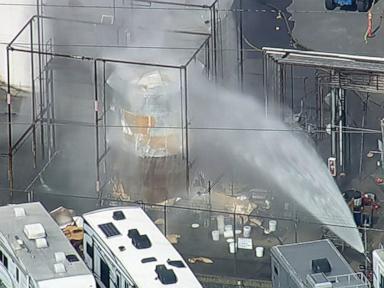
The recent industrial scare in California involving a styrene monomer tank under threat of a runaway polymerization reaction followed a predictable script. Emergency sirens wailed. Authorities ordered mass evacuations. Media outlets tracked temperature readings like a Hollywood countdown clock. Then, the moment the temperature stabilized, officials declared victory, the public sighed in relief, and everyone went back to sleep.
This is a dangerous delusion.
The lazy consensus surrounding incidents like the Perris, California chemical crisis frames the outcome as a triumph of modern emergency response. It was not. It was a coin flip that landed on heads. When a chemical tank holding thousands of gallons of volatile material begins to overheat, the window for meaningful human intervention is incredibly narrow. Treating a near-miss as a success story masks the systemic fragility of our current industrial infrastructure and ensures that the next incident will be handled with the same reactive panic.
We do not have an emergency response problem. We have a fundamental design philosophy problem.
The Chemistry of a Blind Spot
To understand why the standard narrative is flawed, you have to look at the exact mechanics of what happens inside a failing chemical storage asset. In the California incident, the culprit was styrene monomer—a precursor material used universally in plastics, rubber, and resins.
Styrene is inherently unstable. Left to its own devices, it wants to link up into chains to become polystyrene. This process, known as polymerization, generates heat. It is an exothermic reaction. Under normal operating conditions, inhibitors like 4-tert-butylcatechol (TBC) are added to the liquid to act as chemical brakes, scavenging the free radicals that initiate polymerization. Furthermore, these tanks require active temperature monitoring and, frequently, mechanical circulation or cooling to keep the bulk liquid well below its critical threshold.
When an incident occurs, the mainstream analysis usually focuses on the immediate trigger: an inhibitor depleted too quickly, a cooling pump failed, or a tank sat stagnant for too long during a maintenance shutdown.
This focuses on the spark while ignoring the fuel layout. The real vulnerability lies in the physics of scale and the geometry of standard storage design.
Consider the surface-area-to-volume ratio of a massive industrial storage vessel. As the volume of a cylinder scales up, its capacity increases exponentially faster than the surface area of its outer shell. If a runaway reaction begins in the core of a large fluid mass, the heat generated cannot dissipate through the walls fast enough. The core temperature rises. Because heat accelerates chemical reactions, the polymerization speeds up, generating even more heat.
This is the classic thermal runaway loop.
Once this loop crosses a specific thermodynamic threshold, no amount of external water spraying from a fire hose will stop it. The thermal conductivity of steel and the convective heat transfer of a stagnant, highly viscous fluid mean that cooling the outside of a tank does almost nothing to stop the chemical engine revving at 300 degrees in the center.
When officials tell the public they are "cooling the tank," they are often just trying to prevent the structural steel from weakening and collapsing under pressure. They are treating the symptom, not the disease.
The Mirage of Real-Time Monitoring
A common question generated by these events is: Why can't operators just detect the temperature spike early and inject more inhibitors to kill the reaction?
It sounds logical on paper. In practice, it misunderstands fluid dynamics.
I have spent years looking at asset integrity data and industrial control systems. The hard truth is that standard industrial storage tanks are remarkably blind on the inside. A typical bulk storage tank might have one or two thermowells—metal tubes inserted into the vessel containing temperature sensors. These sensors measure the temperature at specific, fixed points near the bottom or sides of the tank.
If a runaway reaction begins in a localized pocket of the fluid—perhaps due to poor mixing or a concentrated zone of contaminant—the bulk temperature registered by the control room may remain completely normal for hours. By the time the heat plume finally migrates to the sensor location, the reaction has already reached exponential velocity.
[Localized Hot Spot] ---> Heat fails to reach sensor ---> Control room sees 20°C
[Reaction Accelerates] ---> Bulk fluid begins to boil ---> Control room sees 80°C (Too Late)
Attempting to pump inhibitors into a tank that is already undergoing rapid polymerization is incredibly dangerous. To stop a runaway, the inhibitor must be distributed uniformly throughout the entire volume of the liquid. If the fluid is already thickening and generating localized convective currents, the added inhibitor will simply float on top or channel through paths of least resistance, leaving the reacting core completely untouched.
You cannot stir a bomb that is already ticking.
Dismantling the Regulatory Security Blanket
Whenever these near-misses occur, industry trade groups point to strict adherence to codes like OSHA’s Process Safety Management (PSM) standards or the EPA’s Risk Management Program (RMP) as proof that the system works.
Let's look at the data objectively. The Chemical Safety and Hazard Investigation Board (CSB) has documented dozens of catastrophic reactive hazards over the decades. A recurring theme in their investigative reports is that many of the facilities experiencing these failures were fully compliant with existing regulatory frameworks right up until the moment of rupture.
Regulations are backward-looking documents. They are written in the ink of past disasters. They excel at mandating paperwork, checklists, and standardized maintenance intervals. What they fail to do is account for the real-world operational degradation that happens between those checkpoints.
- Inhibitor levels degrade faster in high ambient summer heat.
- Sediment buildup at the bottom of old tanks creates unmixed zones.
- Mechanical seals on circulation pumps weep over time, introducing oxygen or moisture that destroys chemical stability.
Compliance does not equal safety. Relying on compliance as your primary shield is a failure of imagination.
The Real Cost of the Reactive Mindset
The economic and social toll of managing industrial risk through panic evacuation is unsustainable. When authorities draw a one-mile isolation zone around a compromised asset, they are shutting down transit corridors, forcing businesses to close, halting supply chains, and displacing thousands of residents.
The immediate justification is always public safety. But this reactive deployment of civic resources is a massive subsidy for poor corporate asset management. The community bears the logistical and financial burden of the evacuation, while the facility operator treats the event as an insurable operational anomaly.
If a manufacturing facility cannot guarantee the thermodynamic stability of its inventory under catastrophic failure conditions—such as a total loss of external power for 48 hours—then that material should not be stored in bulk near populated areas. Period.
Moving Beyond the Storage Tank Era
We must stop treating bulk chemical storage as an inevitable necessity of modern manufacturing. The true counter-intuitive solution to this systemic vulnerability is the aggressive elimination of large inventory buffers through just-in-time, on-demand generation.
Historically, industrial plants stored vast quantities of hazardous precursors because supply chains were slow and processing equipment required massive scale to be economically viable. That paradigm is dead. Modern chemical engineering has advanced significantly in the field of microreaction technology and continuous-flow chemistry.
Instead of storing 10,000 gallons of a highly reactive monomer on-site, advanced manufacturing facilities can utilize continuous-feed systems that synthesize or process small, highly controlled volumes of material immediately before consumption. If a microreactor experiences a thermal runaway, the total energy potential contained within the system is so small that the reaction self-terminates without threatening structural integrity or requiring a regional evacuation.
Traditional:  [Bulk Storage Tank: 10,000 Gal] ---> [High Risk Runaway Potential]
Continuous:   [Micro-Feed System: 5 Gal]      ---> [Negligible Energy Potential]
The barrier to adopting this approach is not technological; it is financial. Bulk storage tanks are cheap, simple pieces of capital equipment. Continuous-flow systems require sophisticated automation, precise metering pumps, and advanced process control systems. Companies choose bulk storage because it shifts the financial burden of risk from their capital expenditure budget onto the public emergency infrastructure when things go sideways.
The Flawed Questions We Keep Asking
The public discussion around industrial incidents remains trapped in a loop because we are asking the wrong questions.
We ask: "How fast did the fire department respond?" We should ask: "Why did the facility design allow a critical asset to rely on external water cooling to prevent a detonation?"
We ask: "Was the tank monitored properly?"
We should ask: "Why are we still utilizing static bulk storage for materials with known exothermic runaway profiles near major transport arteries?"
Stop celebrating the fact that a tank did not explode. The California incident was a warning shot, a clear indication that our margin of safety in industrial asset management is razor-thin and overly dependent on luck. Until the manufacturing sector faces real economic penalties for relying on volatile, oversized storage architecture, we will continue to watch temperatures climb on control room monitors, hoping the chemical brakes hold for just one more day.