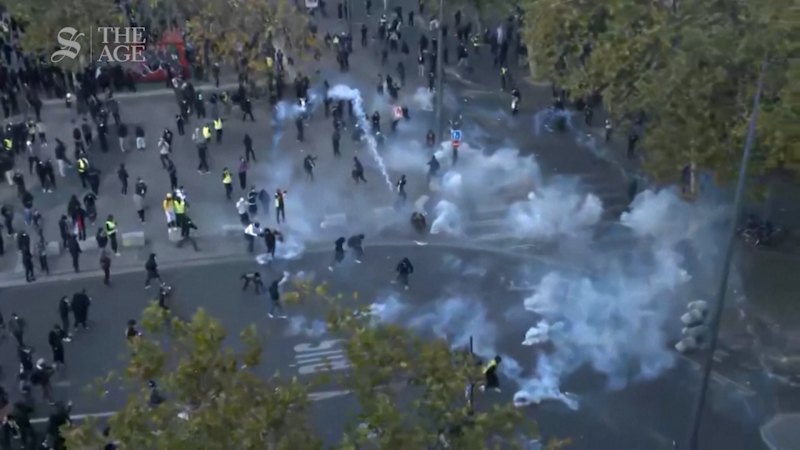
The footage loops on every screen worldwide. Smoke pouring over Haussmann facades. Pavements torn up to throw at riot police. Sirens echoing through districts that tourists pay thousands of euros to sleep in. The narrative writes itself because the lazy consensus demands it. Watch the mainstream coverage and you will hear a familiar song: civilization is collapsing in the streets of France, democracy is burning, and an angry mob is tearing down the social contract because they cannot handle reform.
It is a lazy, comforting lie for people who live behind glass towers.
Street battles and fires in Paris do not represent a descent into lawless chaos. They represent a structural negotiation of last resort in a country where the state has spent decades treating public infrastructure as a one-way street. When normal political channels are engineered to ignore structural dissent, the street becomes the legislature.
The Myth of Senseless Destruction
Every time a dumpster goes up in flames near the Place de la République, pundits clutch their pearls and wonder how a civilized nation could descend into such barbarism. They look at the broken windows and the scorched asphalt and see pure nihilism.
They are missing the machinery underneath.
France has a very specific political economy. It is built on a high-tax, high-benefit compact that worked brilliantly during the postwar boom. But that compact assumes the state acts in good faith to protect public goods. When successive administrations use constitutional workarounds—like Article 49.3 of the French Constitution, which allows the government to ram legislation through Parliament without a vote—to force through retirement age hikes or labor flexibilities, they break the social contract.
Imagine a contract where one party unilaterally changes the terms every single time the math stops favoring them. You work longer. You pay more. Your local services shrink. When you try to vote, the executive branch bypasses the legislature. When you strike, the transit systems freeze but the government simply waits you out.
What happens when legal resistance is structurally neutralized? You get direct action.
The fires are not random acts of vandalism born of a vacuum. They are a violent, highly visible audit of a political system that stopped listening. If you block every pressure valve on a steam boiler, do not look shocked when the rivets pop. The structural violence of a decree passed against the will of seventy percent of the population always precedes the physical violence of a cobblestone thrown through a bank window.
The Haussmann Fallacy and Urban Architecture
There is a geographical irony to modern French protests that few commentators care to unpack. The very layout of Paris makes these confrontations inevitable.
Baron Haussmann did not redesign nineteenth-century Paris just to give tourists pretty Instagram backdrops with zinc roofs and iron balconies. He rebuilt the city for military counter-insurgency. Wide boulevards were intentionally engineered to prevent the barricades that paralyzed the 1848 revolutions and to allow cavalry charges and artillery fire to sweep rebellious neighborhoods clean.
Yet, modern urban planning forgot the other side of that equation. When you concentrate millions of people into dense, hyper-centralized administrative hubs where every major national institution sits within a forty-minute metro ride, you create a powder keg.
When people in the banlieues or provincial working-class towns feel entirely disconnected from the political elite ruling from gilded ministries, they bring their grievances to the center. They march down the very boulevards built to keep them out. The architecture of state power becomes the theater of state vulnerability.
The mistake is analyzing these events as isolated criminal flare-ups. They are systemic rejections of central planning that ignores the periphery. When the cost of fuel spikes, when retirement feels like a distant fantasy reserved for the wealthy, and when the capital city hoards economic opportunity while telling the provinces to tighten their belts, the periphery lights a match to remind the center that it exists.
The Economic Cost That Isn't
We are always treated to breathless reports about the millions of euros in property damage. Shop windows smashed, cars torched, insurance premiums soaring. The business lobby shrieks that these riots destroy wealth and hurt small business owners.
Let us look at the actual ledger.
Property damage during protests is a visible, loud friction. But compare it to the quiet, systemic wealth extraction happening every day through regressive tax policies and pension reforms designed to prop up macroeconomic balance sheets at the expense of human labor. Billions are quietly siphoned away from generational stability to satisfy credit rating agencies in Frankfurt and Brussels. That doesn't make the evening news because it happens via spreadsheets instead of Molotov cocktails.
When French workers shut down refineries, block ports, and halt public transport, they are exercising the only leverage labor has left in a globalized economy: friction. Capital is liquid; it can flee across borders in milliseconds. Labor is anchored to bodies, homes, and communities. To disrupt capital, labor must create physical friction.
It is messy. It is disruptive. It hurts local economies in the short term. But to pretend that the violence of the protest exists in a moral vacuum separate from the structural violence of economic policy is intellectually dishonest.
The Real Danger Facing France
The real threat to France is not that protesters are burning trash cans in the Latin Quarter. The real threat is that the state is normalizing governance by decree.
When a government repeatedly bypasses representative democracy to push through deeply unpopular economic restructuring, it teaches its citizens a toxic lesson: institutions do not care about your voice unless you break something.
Every time a protest is minimized as the work of violent thugs or unhinged radicals, the political class absolves itself of responsibility. They double down on police presence, tighten security laws, and ignore the underlying rot. They treat the fever while ignoring the infection.
France will keep burning in the night until its governing class realizes that stability cannot be enforced from the top down with batons and constitutional loopholes. True stability is negotiated from the bottom up, with actual consent. Until then, keep your eyes on the streets. Not because it is the end of civilization, but because it is the only place democracy is still putting up a fight.