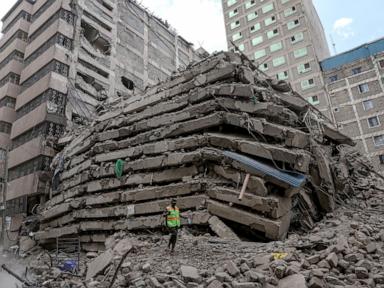
People feared trapped under tangled concrete and twisted rebar is a headline Kenya has seen far too often. When a multi-storey building goes down in or around Nairobi, the shock lasts a few days, the cameras show up, and then life moves on until the next site gives way. In late October 2026, a 12-storey building under construction collapsed in Eastleigh, sparking urgent fears that people were trapped inside. Just three weeks later, on November 13, an unfinished eight-storey building collapsed in Syokimau near the SGR terminus, killing six people.
Honestly, treating each collapse as a freak accident misses the point. Across Kenya, figures compiled by Stats Kenya put reported building collapses between January 2020 and November 2026 at 84, leaving 102 people dead and 138 injured, with 2026 recording 24 incidents by October alone. A basic wire-service report tells you who was on site and what officials promised next. It rarely explains why a fast-growing city keeps stacking concrete faster than its safety checks can hold.
Why Building Collapses in Kenya Happen So Often
If you look at Nairobi from above, you see ambition everywhere. High-rises shoot up in neighborhoods where bungalows used to sit quiet for decades. Demand for housing and commercial space is huge, and land prices push developers upward instead of outward. That pressure changes how corners get cut.
Civil and structural engineer Shammah Kiteme has pointed out that roughly 88% of building collapses tie back to poor workmanship, substandard materials, and structural design deficiencies. The Kenya Institute for Public Policy Research and Analysis has flagged the same culprits alongside weak supervision. When concrete mixes are watered down, steel reinforcement is skimped on, or curing times are rushed so another floor can be poured, the structure looks fine right up until it isn't.
There's also a habit of treating approvals as a finish line rather than a checkpoint. A developer may get initial paperwork or build beyond what the soil and foundation were designed to handle. In the October Eastleigh collapse, Nairobi Governor Johnson Sakaja noted that the project had construction approval but lacked a certificate of occupation, meaning ground-floor shops shouldn't have been operating there. Once a building starts generating rent early, pressure to keep moving spikes—and safety takes a back seat.
What Goes Wrong During Rescue Operations
Watch the early hours after a collapse and you'll notice something sobering. Emergency crews often face tight urban streets, heavy concrete slabs bound with steel, and limited specialized equipment right out of the gate. In the October incident, reports described rescuers working with basic tools and waiting for excavators and back shovels to clear tangled debris.
When search and rescue has to rely on improvised gear or heavy machinery moving big blocks at once, every minute counts. Pockets where someone might survive can close fast if debris shifts without engineering support. Good intentions from first responders and neighbors can't make up for missing heavy lifting gear, coordinated site stabilization, or clear crowd control in dense districts.
Rules Exist on Paper, So Why Are Collapses Still Rising?
Here's where people get misled. Plenty of folks assume Kenya simply lacks construction laws. It doesn't.
Look at the alphabet soup of agencies involved:
- County governments handle building plan approvals and development permits.
- The National Construction Authority (NCA) registers projects and contractors and monitors compliance.
- The Engineers Board of Kenya (EBK) regulates engineers and engineering firms.
- BORAQS oversees architects and quantity surveyors, while NEMA covers environmental licensing.
On top of that, the National Building Code 2024 was published in March 2024 and came into force a year later, setting standards for design, construction, safety, inspection, and maintenance. You can read more about how those rules fit together in this Star report on Kenya's construction oversight.
Having rules isn't the same as enforcing them. Kiteme has argued that the real weakness sits inside approval and inspection workflows—where authorities need clear milestone checks and sign-offs before a builder moves to the next stage. Meanwhile, Tom Achar, acting director of planning and compliance, has alleged political interference in City Hall's approval processes, and Governor Sakaja has called weak penalties for violations a "slap on the wrist".
When fines cost less than cutting corners or paying bribes, non-compliance becomes a business model rather than a risk.
I've seen this pattern play out across fast-urbanizing markets time and again. Agencies overlap on paper, blame each other after a tragedy, and routine site inspections stay understaffed. Until stopping work or revoking a license hurts a developer's wallet immediately, warnings won't change behavior on the ground.
Common Myths About Kenyan Building Failures
Myth 1: Only illegal, unapproved shacks collapse. Not true. Multi-storey buildings with permits or partial approvals have come down too. Paper approval doesn't guarantee steel quality or proper soil testing.
Myth 2: Tall buildings are inherently unsafe. A well-engineered eight- or twelve-storey building can be completely safe when designed properly, tested thoroughly, and built to spec. Height amplifies mistakes; it doesn't invent them.
Myth 3: A single new law will fix everything overnight. Passing a code is easy compared to inspecting hundreds of active sites every week across sprawling neighborhoods. Enforcement takes staffing, digital tracking, real penalties, and insulation from political pressure.
Practical Next Steps for Buyers, Tenants, and Builders
If you're renting, buying, or building in a high-growth area, don't rely on guesswork.
- Verify official registration before signing or paying. Check project registration with the National Construction Authority and confirm that the lead engineer or architect holds active standing with EBK or BORAQS.
- Ask for occupation and compliance documents. If you're leasing shop space or buying an apartment in a newly completed block, ask to see proof of completion and occupation sign-off rather than taking a landlord's word that it's "ready."
- Watch for red flags on active sites. Cracks in columns or retaining walls, uneven settling, rushed concrete pours without proper curing, or missing safety boards around a tall structure are signs to steer clear—and report concerns to county planning and NCA channels.
- Build in milestone inspections. If you're financing or managing a build yourself, tie payments to independent structural checks at foundation, column, and slab stages—never release funds just because walls are going up fast.
Eastleigh building collapse rescue operations video
This video provides visual coverage of the multi-storey building collapse in Nairobi and highlights the emergency response and recurring safety concerns around high-rise construction in the city.