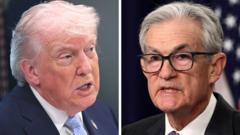
Donald Trump and Jerome Powell are locked in a power struggle that threatens to dismantle the foundational independence of the Federal Reserve. This is no longer a mere disagreement over interest rates; it has devolved into an institutional siege. Since returning to the White House in early 2025, Trump has systematically escalated his rhetoric, moving from calling Powell a "moron" and a "loser" to deploying the Department of Justice to investigate the Fed’s renovation budget. The endgame is clear: the White House wants direct control over the cost of money in America.
The friction is rooted in a fundamental clash of ideologies. Trump views the Federal Reserve as an extension of the executive branch—a tool to supercharge growth through aggressive rate cuts and a weakened dollar. Powell, conversely, operates under the mandate of price stability and maximum employment, shielded by a legal framework designed to keep monetary policy out of the hands of politicians. As Powell’s term as Chair nears its May 15, 2026 expiration, the conflict has reached a fever pitch, with the Senate recently confirming Kevin Warsh as a potential successor who may be more amenable to the President’s demands.
The Weaponization of the DOJ
In a move that stunned veteran Fed watchers, the Department of Justice launched a criminal inquiry in late 2025 into the renovation costs of the Federal Reserve’s headquarters. While the DOJ recently dropped the probe in April 2026, the damage to the institutional "moat" around the Fed was substantial. Powell took the unprecedented step of releasing a video response, stripping away typical central bank jargon to call the investigation a "pretext" for political intimidation.
This was not a standard bureaucratic dispute. It was a high-stakes game of legal chicken. Trump allies, including Senator Kevin Cramer, suggested that Powell could "exchange" his early resignation for the disappearance of the indictment threat. This brand of hardball politics is common in the halls of Congress but was previously unthinkable when dealing with the person who controls the world’s reserve currency.
Why the President Wants a Weaker Dollar
The economic logic driving Trump’s vitriol is centered on his trade agenda. Since early 2025, the administration has imposed massive tariffs—some as high as 245 percent on Chinese imports. These tariffs are designed to protect domestic industry, but they also risk triggering stagflation: a toxic mix of high inflation and stagnant growth.
To offset the inflationary pressure of tariffs, Trump demands that the Fed slash rates to zero. He has explicitly stated that the U.S. should have the "lowest interest rates in the world."
- The Goal: Lower borrowing costs to spur domestic manufacturing.
- The Risk: Devaluing the dollar so rapidly that global investors flee U.S. Treasuries, leading to a debt crisis.
- The Reality: Powell has refused to budge, keeping rates steady as recently as the April 29, 2026, board meeting, citing "elevated inflation" and global instability.
The Shadow of Kevin Warsh
The confirmation of Kevin Warsh as a new Fed governor—and likely the next Chair—marks a turning point. Warsh has historically been more critical of the Fed's "long-term" independence if it conflicts with broader national economic strategy. However, the Federal Reserve is not a dictatorship. Even if Warsh takes the gavel, he is only one of twelve voting members on the Federal Open Market Committee (FOMC).
Powell has hinted that he might not leave the building when his chairmanship ends on May 15. Legally, he can remain as a Fed governor until 2028. This creates a scenario where the outgoing Chair remains on the board, potentially leading a faction of "inflation hawks" against a Trump-appointed Chair. It would be an administrative nightmare, effectively split-heading the world's most powerful financial institution.
The Cost of a Broken Fed
When a President calls the central bank head a "numbskull" or an "enemy," the markets don't just laugh; they price in the risk. Institutional trust is a fragile construct. If global markets believe the Fed is merely an arm of the White House, the "inflation risk premium" on U.S. debt will rise. This means the government will have to pay more to borrow money, ironically leading to the exact "hundreds of billions in unnecessary interest expense" that Trump claims he wants to avoid.
The current trajectory is unsustainable. We are witnessing the slow-motion collision of a populist executive who views economic levers as personal property and a technocratic institution that believes it is the last line of defense for the dollar.
The next few weeks will determine if the Fed remains a neutral arbiter or becomes a political prize. If Powell stays on the board after May 15 to fight Warsh and Trump from the inside, the resulting internal war could be more damaging to the economy than any single rate hike. Watch the Senate’s final procedural moves on the transition; they are the only thing standing between a managed transition and a total institutional breakdown.