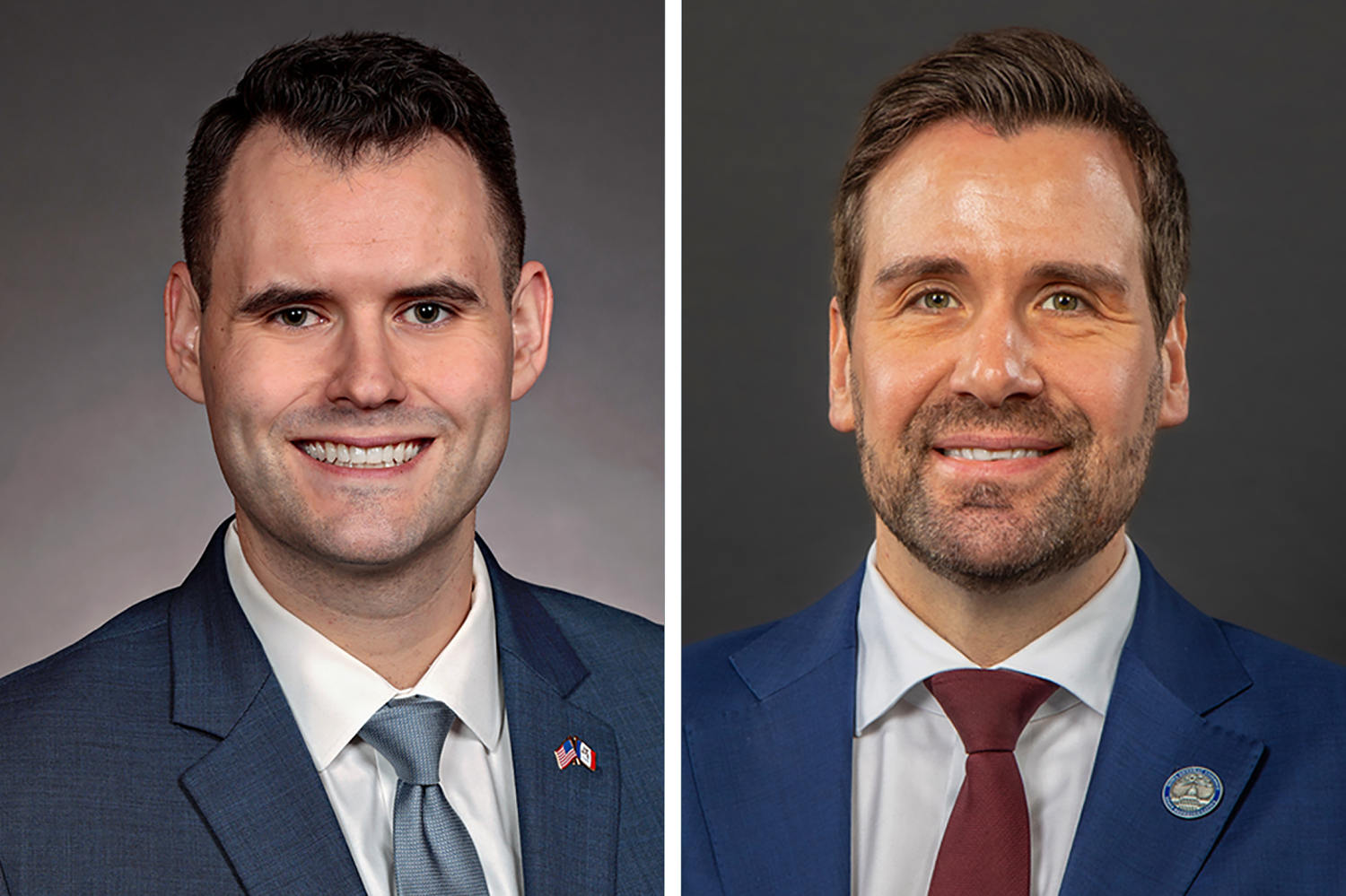
The Democratic primary for Iowa’s open Senate seat has devolved into a high-stakes proxy war that mirrors the existential crisis of the national party. While the June 2 primary fast approaches, the two leading contenders—State Representative Josh Turek and State Senator Zach Wahls—are no longer just debating policy. They are litigating the soul of Democratic campaign finance and whether the "Chuck Schumer playbook" of top-down candidate selection still functions in a state that has drifted steadily toward the right.
At the heart of the friction is the influence of national leadership and the sudden, heavy-handed entry of outside money. Turek, a Paralympic gold medalist, has emerged as the preferred choice for many establishment figures in Washington. Wahls, a high-profile advocate for LGBTQ+ rights, has positioned himself as the homegrown alternative, specifically targeting the influx of millions in "dark money" from super PACs like VoteVets that have moved to tilt the scales in Turek’s favor. This is not just a local skirmish. It is a referendum on how Democrats intend to survive in the Midwest.
The Washington Hand in Des Moines
National party leaders, led by Senate Minority Leader Chuck Schumer, have a clear priority: electability. With Republicans holding a 53-47 majority following the 2024 elections, the Democratic Senatorial Campaign Committee (DSCC) is desperate to reclaim any ground. Iowa, featuring an open seat vacated by retiring Republican Joni Ernst, should be a prime target. However, the path to victory involves threading a needle through a voting base that increasingly views national Democratic brands with skepticism.
The establishment's preference for Turek is not accidental. His profile—a world-class athlete with deep roots in Council Bluffs—is designed to appeal to the "purple" voters who have abandoned the party in recent cycles. But this preference comes with baggage. National endorsements from figures like Senators Maggie Hassan and Catherine Cortez Masto signal to the local base that the race has already been decided in a D.C. boardroom.
The Super PAC Shadow
The most volatile flashpoint in this race is the spending by VoteVets. The super PAC has poured roughly $2.5 million into the primary to support Turek. Wahls has seized on this, framing the intervention as a violation of the party’s stated values regarding campaign finance reform.
- The Wahls Argument: By allowing outside groups to flood the airwaves before the primary, the party is effectively disenfranchising local voters and making the eventual nominee a "subsidiary of D.C. interests."
- The Turek Defense: Turek’s campaign maintains that they do not coordinate with super PACs and that their focus remains on building a coalition broad enough to defeat the Republican frontrunner, Representative Ashley Hinson.
This tension highlights a recurring Democratic dilemma. The party base demands "clean" campaigns without corporate PAC money, yet the leadership knows that defeating a well-funded Republican like Hinson—who already has over $5 million on hand—without outside help is a mathematical impossibility.
A Fractured Caucus
The primary has forced sitting Democratic senators to choose sides, exposing a rift that runs deeper than just Iowa. While the centrist wing aligns with Turek, progressive stalwarts like Senator Elizabeth Warren have thrown their weight behind Wahls. This split creates a "spicy primary" environment that some, like Senator Brian Schatz, argue is healthy for the party. Others fear it is a repeat of 2020 and 2022, where bruising primaries left the eventual Democratic nominee broke and bloodied before the general election even began.
The data suggests a worrying trend for Democrats in the Hawkeye State. In 2020, Theresa Greenfield raised massive sums but still fell short against Joni Ernst. In 2022, Michael Franken outperformed expectations but could not unseat Chuck Grassley. The "Schumer Playbook" of recruiting "perfect on paper" candidates and backing them with massive national funds has yet to produce a win in Iowa for over a decade.
The Hinson Factor
While Democrats "tussle" over PAC money, the Republican side is remarkably unified. Ashley Hinson has locked up the endorsement of Donald Trump and the national GOP apparatus. She is sitting on a war chest that dwarfs the combined totals of Turek and Wahls. For the winner of the Democratic primary, the reward is a grueling climb against an incumbent-style candidate in a state that The Cook Political Report currently rates as "Likely Republican."
The Ghost of Citizens United
The debate over the Citizens United ruling is not just academic in this race; it is a weapon. Both Turek and Wahls have taken pledges to refuse corporate PAC money, yet the definition of "corporate influence" has become the primary point of contention. Wahls’ allegation that Turek is benefiting from "dark money" is a calculated move to peel away the activist base that views any scent of super PAC involvement as a betrayal.
However, the "dark money" label is often used loosely in political theater. VoteVets, while a super PAC capable of accepting unlimited donations, is a known quantity in Democratic circles. The real "dark money" usually refers to 501(c)(4) organizations that do not disclose their donors at all. By conflating the two, Wahls is betting that Iowa voters are more interested in the source of the power than the legality of the paperwork.
The Midwestern Identity Crisis
The fundamental problem for Iowa Democrats isn't just Schumer or super PACs. It is an identity crisis. The state that once launched Barack Obama to the presidency has become a graveyard for Democratic ambitions. The party is struggling to find a message that resonates with rural voters without alienating the urban centers of Des Moines and Iowa City.
Wahls represents the "energize the base" strategy—focusing on civil rights, immigration reform, and climate change to drive turnout. Turek represents the "broaden the tent" strategy—focusing on his personal story of overcoming disability and his ability to talk to voters in Republican-leaning western Iowa.
National Democrats are terrified that if they don't pick the "right" candidate, they will lose the seat before the general election even starts. But their very intervention may be the factor that ensures that loss. When voters perceive a candidate as a "product" of a national committee, the "Iowa nice" persona dissolves into a "D.C. elite" narrative that Republicans are all too happy to exploit.
The primary is no longer about who would make the best Senator. It is a trial by fire for two different theories of political survival. If Turek wins, it validates the establishment's belief that money and "electable" profiles are the only way back to power. If Wahls wins, it signals a grassroots rebellion against the party’s top-down management style.
Either way, the winner will inherit a party that is deeply divided and a bank account that is significantly lighter than their opponent’s. The "tussle" in Iowa is a symptom of a larger disease: a party that is so focused on how to win that it has forgotten how to speak to the people it needs to win over.
The ads will keep running. The PACs will keep spending. And the voters in Iowa will continue to watch as their local primary becomes a proxy for a national struggle that seems increasingly detached from the realities of life in the Midwest.
The outcome on June 2 will provide the first real data point on whether the Democratic Party can still hold its coalition together in the face of internal dissent and external pressure. It isn't just about a seat in the Senate. It's about whether the party can still compete in the heartland.