Two hours.
For decades, that was the tyranny of geography separating the west bank of the Pearl River from the east, a stretch of muddy, brackish water that might as well have been the Pacific Ocean for the factory owners, commuters, and logistics managers trying to survive in southern China. You could stand on the waterfront in Zhongshan on a clear morning, squint past the cargo barges chugging through the haze, and practically see the glass towers of Shenzhen shimmering on the opposite shore. Yet to get there by road, you had to drive north in a massive, exhausting horseshoe, crawling through congested highways around Guangzhou, burning fuel, losing daylight, and watching profit margins evaporate in brake-light traffic.
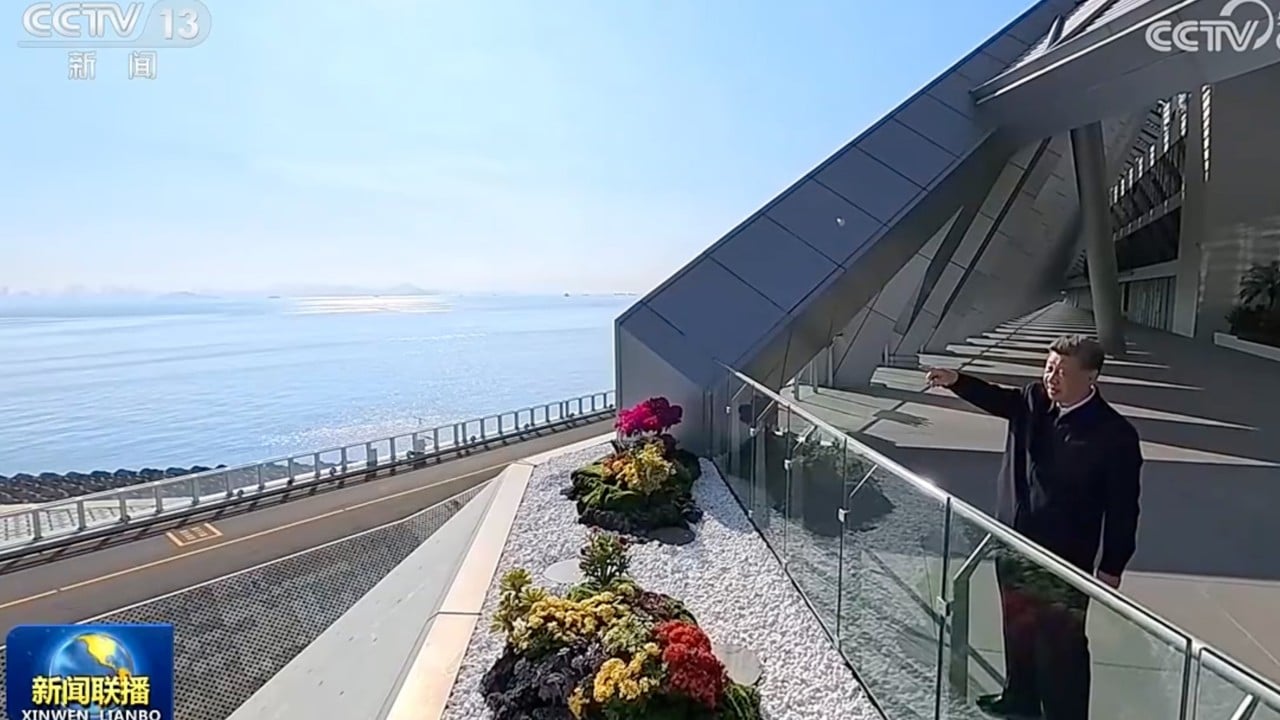
When Chinese President Xi Jinping stepped onto the soil of Zhongshan in Guangdong province to inspect the Shenzhong Link—the colossal twenty-four-kilometer system of bridges, artificial islands, and underwater tunnels stitching those two shores together—the official state dispatches treated it like another triumph of concrete and steel. They rattled off dimensions. They cited five-year plans. They quoted policy directives about the Guangdong-Hong Kong-Macao Greater Bay Area.
They missed the heartbeat.
To understand why the top leader of the world’s second-largest economy stood in Zhongshan putting the full weight of his office behind this specific strip of coastline, you have to forget the press releases and smell the diesel exhaust on the old Humen Bridge at six in the morning. You have to understand what happens when an economic miracle runs out of room to breathe.
The Tale of Two Shores
Consider a hypothetical hardware founder—let’s call him Lin—operating out of a cramped, fluorescent-lit industrial park in Shenzhen’s Nanshan district. Lin designs smart home sensors. His engineers are brilliant, caffeinated twenty-somethings who speak the language of global venture capital and rapid prototyping. Across the water in Zhongshan, another hypothetical figure, a second-generation factory owner named Mei, runs a plant that stamps precision aluminum casings and assembles circuit boards.
For years, Lin and Mei lived in parallel universes separated by thirty kilometers of water and two hours of gridlock. Shenzhen was the brain—expensive, frantic, starved for square footage, where commercial rent could bankrupt a hardware startup before its first shipping container left port. Zhongshan, sitting quietly on the western bank alongside Zhuhai and Foshan, was the muscle—rich in manufacturing heritage, land, and skilled assembly labor, yet perpetually starved of the capital and high-tech talent pooling on the eastern shore.
I remember the first time I made that drive around the estuary years ago, wedged into the back of a hired sedan during a late-summer typhoon warning. Rain hammered the windshield so hard the wipers gave up. Halfway across the northern bottleneck, traffic stopped dead for ninety minutes because a single flatbed truck had jackknifed. Nobody honked. People simply turned off their engines, rolled down their windows into the humid, stagnant air, and stared at the taillights ahead. In that silence, you could feel the friction costing the region billions of yuan every single year.
Economists call this an infrastructure bottleneck. People who live it call it a slow suffocation.
By spotlighting the Greater Bay Area from Zhongshan, Xi Jinping was acknowledging a blunt economic reality: the eastern bank of the Pearl River Delta—Shenzhen, Dongguan, Hong Kong—has reached saturation. You cannot stack infinite factories on top of Shenzhen’s hills, nor can you ask young engineers to spend half their salaries on shoebox apartments while commuting four hours a day. For the Greater Bay Area to function as a single, cohesive economic engine capable of rivaling Tokyo Bay or the San Francisco Bay Area, the water in the middle had to disappear.
Concrete, Steel, and High-Stakes Arithmetic
Let us look at the cold facts that brought the Chinese leadership to Zhongshan, because the numbers carry their own quiet drama.
The Greater Bay Area encompasses nine cities in Guangdong province plus the two Special Administrative Regions of Hong Kong and Macao. Together, this cluster holds roughly eighty-six million people—more than the entire population of Germany—packed into an area smaller than Croatia. It accounts for over ten percent of China’s entire gross domestic product despite occupying less than one percent of its land mass.
Yet for forty years after Deng Xiaoping launched China’s reform and opening-up policies in 1978, development was wildly lopsided. Wealth surged up the eastern corridor from Hong Kong through Shenzhen to Guangzhou. Meanwhile, the western bank—home to Zhongshan, the birthplace of Sun Yat-sen, and a historic powerhouse of lighting fixtures, home appliances, and textiles—lagged behind in per-capita output and high-tech investment.
The Shenzhong Link, which Xi inspected alongside Guangdong’s top leadership, changes the geometry of that map overnight. By slashing the travel time between Shenzhen and Zhongshan from two hours to roughly twenty to thirty minutes, the corridor turns two separate labor and supply markets into one.
Think of the Greater Bay Area not as a collection of cities, but as a single sprawling motherboard. For decades, the processors on the east side could barely communicate with the memory banks and power supplies on the west side because the copper traces between them were too thin and too long. Building an eight-lane superhighway across and beneath the Pearl River estuary is the equivalent of soldering a thick gold bus directly between the two halves of the chip. Suddenly, latency drops to near zero.
During his inspection in Zhongshan, Xi emphasized a phrase that recurs constantly in Beijing’s economic playbook: "high-quality development" and the need for the Greater Bay Area to serve as a strategic fulcrum for China's broader modernization. Stripped of political jargon, this means China can no longer rely on cheap labor or endless debt-fueled real estate construction to grow. Trade tensions with the West, export controls on advanced semiconductors, and an aging domestic workforce have forced Beijing into a corner. The only way out is technological self-reliance and brutal industrial efficiency.
And efficiency hates a two-hour commute.
The Invisible Stakes Beneath the Water
It is easy to look at megaprojects—the Hong Kong-Zhuhai-Macao Bridge to the south, the Nansha Bridge to the north, and now the Shenzhong Link right through the belly of the estuary—and dismiss them as state-sponsored vanity monuments. Critics abroad often point to China’s mounting local government debt and ask whether another multibillion-dollar bridge is really necessary when consumer confidence at home feels fragile and property developers are still digging out from a historic collapse.
That skepticism is healthy. Watching a nation pour millions of tons of concrete into the sea while small business owners worry about domestic demand creates a jarring cognitive dissonance. Is this genuine economic transformation, or is it just building bridges to keep steel mills running?
The answer lies in what happens the morning after the ribbon is cut.
When a twenty-four-kilometer corridor opens directly between Shenzhen’s Bao’an International Airport and Zhongshan’s Cuiheng New District, the real estate and industrial calculus shifts immediately. Shenzhen technology firms no longer have to choose between keeping their factories close or moving them inland to Vietnam or central China. They can keep their research labs in Shenzhen and move their automated production lines thirty minutes west to Zhongshan, where industrial land costs a fraction of eastern prices.
For Mei, our hypothetical factory owner in Zhongshan, the arrival of that bridge is both a lifeline and a terrifying ultimatum.
For years, geographical isolation acted as a double-edged sword for Zhongshan’s manufacturers. It kept them cut off from top-tier talent, yes, but it also shielded them from direct competition with Shenzhen’s cutthroat corporate culture. Now, the shield is gone. Shenzhen’s speed, capital, and relentless expectations are pouring across the water at eighty kilometers an hour. Traditional factories in Zhongshan that rely on low-margin assembly will either upgrade their machinery, adopt robotics, and integrate into Shenzhen’s high-tech supply chains, or they will be priced out of their own hometowns as land values climb.
Integration is never painless. When two economies of wildly different temperatures collide, storms form along the front. Local workers in Zhongshan face rising housing costs as Shenzhen commuters buy up apartments on the western shore seeking cheaper mortgages and slower weekends. Small family workshops find themselves competing for electricity, land, and local government attention against corporate giants relocating from across the bay.
Why Zhongshan Matters More Than the Headlines Admit
There is a historical resonance to Xi’s visit to Zhongshan that outsiders often overlook. Named after Sun Yat-sen—the revolutionary leader revered across the political spectrum for overthrowing imperial rule and envisioning a modern, industrialized China—Zhongshan has always occupied a symbolic place in the national imagination. Over a century ago, Sun Yat-sen wrote The International Development of China, a remarkably ambitious blueprint filled with hand-drawn maps proposing deep-water ports, rail networks, and bridges across the Pearl River Delta at a time when the country barely had paved roads.
When Xi stood in Zhongshan inspecting the Greater Bay Area’s progress, he was standing on the exact ground where China’s earliest dreams of modern infrastructure were sketched out in ink.
More practically, Zhongshan represents the middle tier of Chinese cities—the places that will actually decide whether China escapes the middle-income trap. Everyone knows Beijing, Shanghai, and Shenzhen. Those megacities already look like science-fiction movie sets. The real test of China’s economic resilience happens in second- and third-tier manufacturing hubs like Zhongshan, Jiangmen, and Zhaoqing. If Beijing can successfully plug these quieter industrial cities into the innovation engines of Shenzhen and Hong Kong without drowning them in debt, the Greater Bay Area becomes an almost unstoppable manufacturing and R&D ecosystem.
Consider the sheer density of what sits within a one-hour radius once the estuary’s bridges are fully woven together:
- Hong Kong’s global financial markets, international legal frameworks, and world-class research universities.
- Shenzhen’s hardware ecosystem, telecommunications giants, drone makers, and electric vehicle supply chains.
- Guangzhou’s heavy industry, automotive plants, and historic trading ports.
- Zhongshan, Foshan, and Dongguan’s vast networks of component suppliers capable of turning a digital CAD file into a mass-produced physical product faster than anywhere else on earth.
Nowhere else in the world do finance, software, hardware prototyping, and heavy mass manufacturing sit this close together under a single coordinated infrastructure grid.
The Human Speed of Change
Still, concrete does not automatically create trust, and an eight-lane tunnel cannot erase institutional friction on its own.
Even within the Greater Bay Area, invisible borders persist. Moving goods, data, and people between mainland cities like Zhongshan and the Special Administrative Regions of Hong Kong and Macao still involves customs checks, different currencies, distinct legal systems, and separate regulatory standards for everything from medical devices to data privacy. Beijing has spent years rolling out incremental reforms—cross-border wealth management schemes, mutual recognition of professional qualifications, streamlined customs clearances—to soften those boundaries, yet red tape remains a daily reality for business owners operating across jurisdictions.
And then there is the human element that no five-year plan can fully script.
I think back to a dim sum restaurant in Zhongshan’s Shiqi district where I once sat beside three generations of a local family sharing steamed buns and pu-erh tea. The grandfather had spent his life repairing fishing boats along the river. The father owned a mid-sized lighting factory exporting chandeliers to Europe. The daughter had just graduated from a university in Guangzhou and was debating whether to take a tech job in Shenzhen or come home to help modernize her father’s business. At the time, taking the Shenzhen job meant disappearing from family life except on major holidays; the commute was simply too brutal.
With the Shenzhong Link open and Beijing pouring political capital into Zhongshan’s integration, that daughter no longer has to choose between her career and her hometown. She can work in a Shenzhen AI lab by day and eat dinner with her parents in Zhongshan by night.
Multiply that single family’s quiet calculation by ten million households across the Pearl River Delta, and you begin to grasp why Xi Jinping’s visit to Zhongshan carried such weight. Geopolitics is usually told through summits, tariffs, and naval deployments. Yet the most durable shifts in global power often look far more mundane: a truck driver shaving ninety minutes off a freight run, a young engineer crossing an underwater tunnel before sunrise, and two halves of an ancient river delta finally meeting in the middle.
At dusk, if you stand on the Zhongshan shoreline and look east across the water, the horizon is no longer an empty stretch of dark river. A ribbon of white highway lights curves out over the waves, dips abruptly beneath the shipping lanes into the seabed, and emerges miles away at the foot of Shenzhen’s glowing skyline, turning a barrier that lasted for centuries into a twenty-minute drive.


