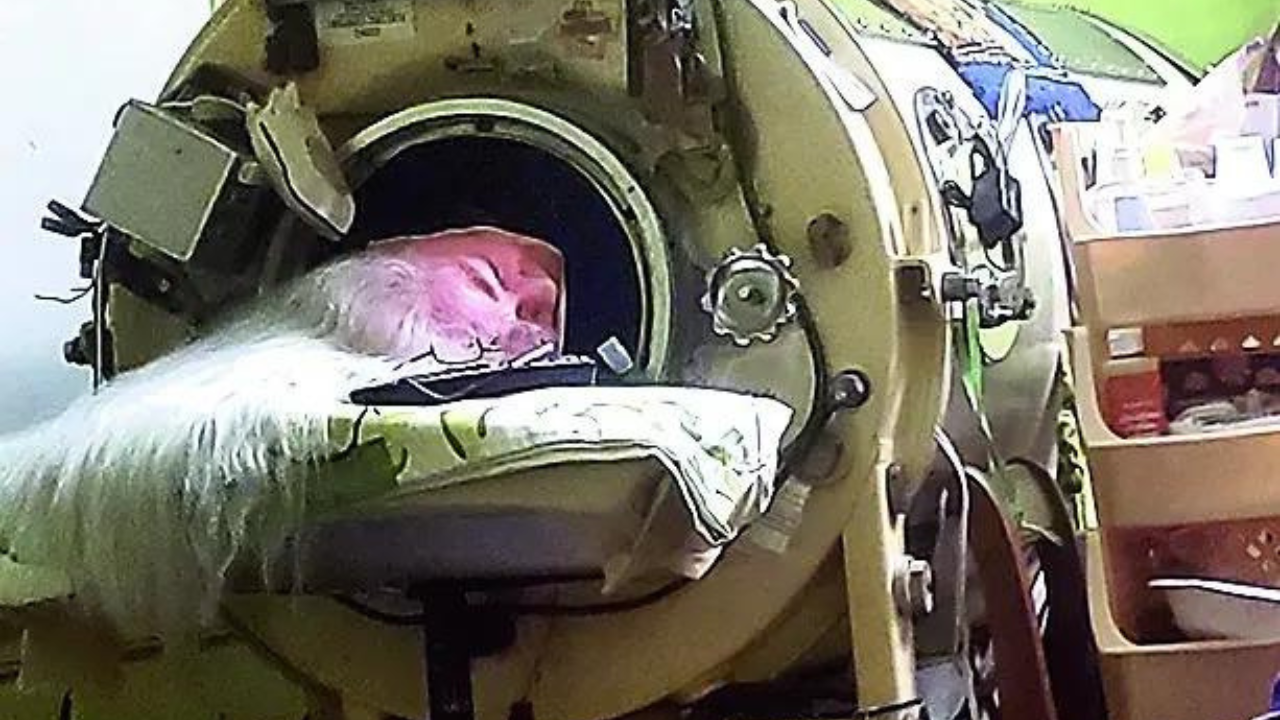
A Yellow Canister in Oklahoma
The machine measured seven feet long. It weighed somewhere near eight hundred pounds. Outside the window, modern cars zipped down paved streets, smartphones buzzed on nightstands, and the twenty-first century rushed forward without looking back. But inside a small house in Wichita Falls, Texas, time had stopped in 1953.
Her name was Martha Lillard.
When she was five years old, a microscopic terror invaded her body. It didn’t announce itself with a bang. It started with a sore throat, a mild fever, a vague sense of feeling unwell—the kind of routine childhood ailment that usually ends with a bowl of soup and an extra blanket. Within days, her neck stiffened. Her legs stopped responding. Then, the chest muscles responsible for pulling air into her lungs simply ceased to function.
Polio had arrived.
To survive, Martha was placed inside a heavy, airtight metal cylinder. A mechanical bellows at the end of the capsule pushed air out to create a negative pressure vacuum, forcing her lungs to expand. When the bellows pushed air back in, her lungs relaxed and exhaled.
Hiss. Clack. Whoosh.
That rhythmic, mechanical respiration became the soundtrack of her existence. For over seven decades, as the world moved on from vacuum tubes to microchips, Martha lived anchored to a steel relic of a bygone medical era. When she passed away, she was one of the very last human beings on Earth who still relied on an iron lung to stay alive.
Her death marks the final quiet page of a dark historical chapter—and a stark warning about how quickly we forget the monsters we once conquered.
The Terror That Silenced Summers
It is almost impossible for anyone born after 1960 to understand the sheer psychological dread that polio brought every summer.
It was an invisible thief. It targeted children above all else. In the late 1940s and early 1950s, epidemics swept through towns like clockwork as the weather warmed. Parents panicked. They banned their kids from public swimming pools. They canceled birthday parties. They kept windows tightly shut in July heat, terrified that a draft might carry the paralysis.
There were no warning signs. A healthy child could go to bed with a slight fever on Tuesday and be entirely paralyzed by Thursday morning.
The polio virus, or poliomyelitis, enters the body through the mouth, multiplies in the throat and intestines, and in a devastating minority of cases, invades the nervous system. It attacks the motor neurons—the vital nerve cells that carry signals from the brain to the muscles. Destroy those neurons, and the muscles wither. Destroy the ones connected to the diaphragm, and the body forgets how to breathe.
Before effective mechanical ventilation existed, acute bulbar polio was a swift death sentence. The iron lung, invented by Philip Drinker and Louis Agassiz Shaw at Harvard in 1928, was an engineering miracle. It offered life where there was none.
Walk into a hospital ward in 1952, and you wouldn't hear the soft hum of modern ICU monitors. You would hear a chorus of iron lungs. Dozens of children, lying side by side in metal tubes, only their heads visible through rubber seals, staring at mirrors angled above their faces so they could see the room behind them.
Imagine spending seventy years in that mirror's reflection.
Mechanics of a Forgotten Machine
Why stay in a giant metal cylinder when modern medicine offers sleek, lightweight ventilators?
The answer lies in the subtle art of human respiration. Modern ventilators use positive pressure. They force air down a tube inserted into the trachea or through a tight mask over the face. It works, but over decades, positive pressure can cause lung damage, scarring, and severe infections.
The iron lung used negative pressure. It simulated natural human breathing by gently altering the atmospheric pressure around the body, allowing the chest cavity to expand naturally without shoving air down the windpipe.
For Martha Lillard, positive pressure ventilation was physically intolerable. Her lungs were too fragile. The antique cylinder was not a choice; it was her sanctuary.
When the machinery broke—and over seventy years, mechanical parts inevitably wear out—there were no customer service lines to call. The companies that built iron lungs stopped making parts half a century ago. The technicians who understood their gears had retired or passed away. Finding a replacement canvas collar or a functional vacuum motor became an urgent quest for surviving patients. They relied on passionate local mechanics, retired engineers, and eBay collectors to fabricate custom gaskets and tinker with rusted belts.
A power outage was not an inconvenience. It was an immediate crisis. If the electricity failed, someone had to operate the manual emergency crank on the back of the cylinder, pumping air by hand, stroke after stroke, until the lights flickered back on.
Living in an iron lung required a staggering, unimaginable level of psychological resilience. Yet, Martha painted. She hosted visitors. She cared for injured animals. She cultivated a rich, vibrant inner life inside a space no larger than a standard casket.
She adapted because the alternative was giving up.
The Miracle of Conquest—And the Danger of Amnesia
In 1955, Jonas Salk developed the inactivated polio vaccine. Shortly after, Albert Sabin introduced the oral polio vaccine.
The impact was immediate and miraculous. In 1952, the United States reported nearly 58,000 cases of polio. By 1965, that number had plummeted to under 100. Today, endemic wild polio exists in only two countries on Earth: Afghanistan and Pakistan.
The vaccine did not just save lives; it transformed society. It erased a daily, existential fear that had haunted families for generations. It allowed children to run through sprinklers in July without their mothers holding their breath.
Consider what happens next when a threat vanishes completely from public memory: the fear disappears, but so does the gratitude.
We live in a world crafted by the victories of medical history, yet we often mistake those victories for nature's default state. We forget that the absence of iron lungs in our hospital corridors is not an accident of nature. It is the result of painstaking scientific labor, massive public health initiatives, and millions of parents lining up at school gymnasiums to get their children vaccinated.
When we look back at Martha Lillard's life, it is easy to view her story as a tragic anomaly—a rare artifact from a black-and-white era. But her iron lung was not just a relic. It was a mirror.
It reflected the true cost of infectious disease before science caught up. It served as a silent witness to what happens when human bodies are left entirely defenseless against microscopic invaders.
Martha's long life inside that metal cylinder was a triumph of the human spirit over physical confinement. But her death is a quiet marker of an era slipping away entirely from living memory.
As the last iron lungs finally go silent in back bedrooms across America, their echo remains loud and clear. They remind us of the terrifying fragility of the human body, the priceless value of modern medicine, and the profound danger of forgetting why those giant yellow machines were built in the first place.