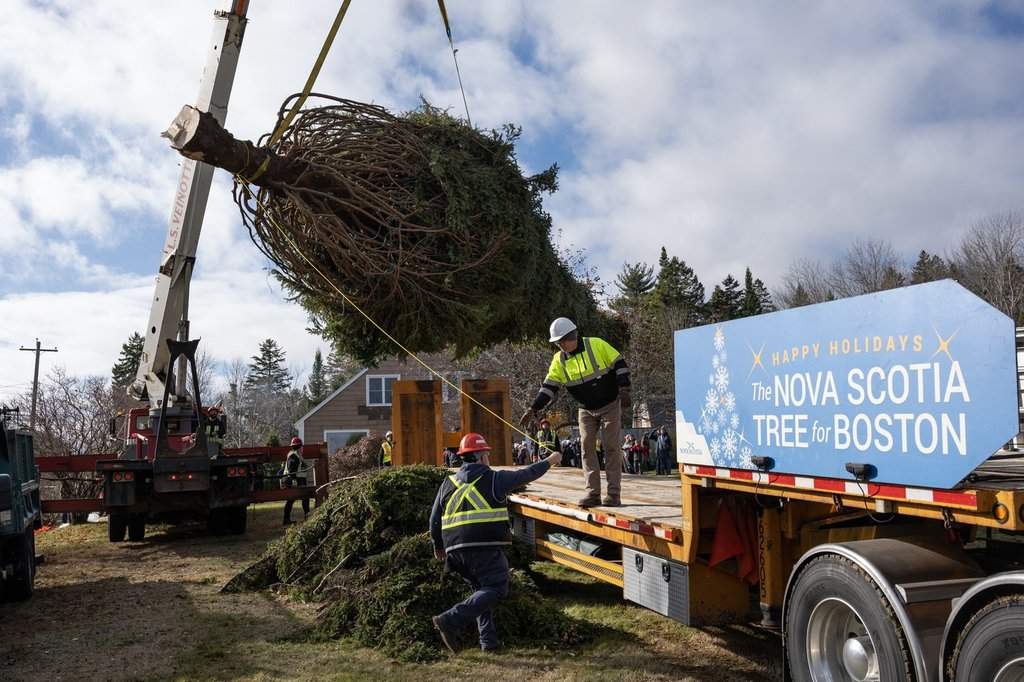
Every November, local news desks from Halifax to Beacon Hill copy-paste the exact same heartwarming press release. Nova Scotia cuts down a massive spruce. They put it on a flatbed truck. They haul it across the border to Boston Common. And every single reporter calls it a simple, touching "thank you" for the 1917 Halifax Explosion.
That narrative is lazy journalism. It reduces one of the most calculated, high-ROI public relations and tourism campaigns in North American history to a Hallmark greeting card.
If you believe the provincial government of Nova Scotia spends tens of thousands of taxpayer dollars every autumn purely out of historical sentimentality, you do not understand how destination marketing works. The Tree for Boston is not an act of charity. It is a brilliantly disguised, century-old customer acquisition funnel—and honestly, it puts modern corporate marketing agencies to shame.
The 1917 Origin Story Is Real, The Modern Motive Is Pure Commerce
Let’s get the history straight first, because precision matters. On December 6, 1917, two ships—the French munitions carrier SS Mont-Blanc and the Norwegian vessel SS Imo—collided in the Narrows of Halifax Harbour. The resulting blast was the largest human-made explosion prior to the atomic bomb. It flattened the Richmond district, killed nearly 2,000 people, and injured 9,000 more.
Within hours, before the smoke had even cleared, Boston mobilized. The Massachusetts-Halifax Relief Commission was formed. Trains loaded with doctors, nurses, medical supplies, and building materials raced north through a blinding blizzard. Bostonians raised hundreds of thousands of dollars—millions in today's currency—to rebuild a shattered Canadian port city.
In 1918, Halifax sent a Christmas tree to Boston as a genuine token of gratitude. Then, the tradition went dormant for over half a century.
It did not resume continuously until 1971. Notice the date. Not 1919. Not 1945. 1971. That year, the Lunenburg County Christmas Tree Producers Association revived the gift to promote their commercial tree-farming industry to American buyers. Soon after, the Nova Scotia government took over the operation. Why? Because they realized that a 45-foot white spruce parked in the middle of New England’s wealthiest media market generates earned media impressions that no tourism board could ever afford to buy outright.
Dismantling the "Free Gift" Illusion
I have watched regional tourism boards burn millions of dollars on forgettable billboard campaigns in Times Square and programmatic display ads that get blocked by 40 percent of browsers. They beg for attention. They pay exorbitant rates for a fraction of a second of consumer eyeballs.
Nova Scotia bypasses the entire paid media auction with one chainsaw and a flatbed trailer.
Consider the mechanics of what happens every year when the Department of Natural Resources and Renewables announces the selection of the tree:
- The Search and Selection: Scouts spend months looking for a specimen meeting strict aesthetic criteria—typically a white spruce between 40 and 50 feet tall, uniform in shape, and accessible by heavy crane. The announcement alone triggers a wave of provincial pride and local press in Atlantic Canada.
- The Send-Off: Halifax hosts a public ceremony before the tree departs. Politicians speak. Schoolchildren sing. Local television cameras roll.
- The Cross-Border Tour: As the flatbed travels through Maine and New Hampshire toward Massachusetts, it acts as a rolling billboard. Stops along the route generate regional newspaper human-interest stories.
- The Boston Common Lighting: The tree arrives in Boston with a police escort. In early December, tens of thousands of people pack Boston Common for the official lighting ceremony, which is broadcast live on WCVB-TV—Boston’s ABC affiliate—to hundreds of thousands of households across New England.
You cannot buy that kind of uninterrupted, prime-time broadcast integration during the fourth quarter. If a private corporation tried to purchase a two-hour live special on a major Boston network affiliate and secure exclusive physical branding rights in the middle of Boston Common for six weeks, the bill would easily clear seven figures. Nova Scotia gets it for the cost of felling a tree, paying a trucking company, and flying a small delegation of officials down to Logan Airport.
Answering the Questions Nobody Bothered to Ask
When people search for information about the Boston Christmas tree, they usually ask surface-level trivia. Let’s look at the real answers behind the common queries.
Why does Nova Scotia really send a tree to Boston every year?
To honor the 1917 Halifax Explosion relief effort and to keep Nova Scotia top-of-mind for New England travelers and trade partners. Acknowledging the commercial and diplomatic utility does not erase the historical gratitude. Both things are true at the exact same time. Denying the strategic value makes the arrangement look like accidental folklore rather than intentional statecraft.
Who actually pays for the Boston Christmas tree?
Taxpayers in Nova Scotia foot the bill. The provincial government—specifically the Department of Natural Resources and Renewables alongside Tourism Nova Scotia and the Department of Communities, Culture, Tourism and Heritage—absorbs the logistical, transportation, and promotional expenses. Meanwhile, the City of Boston handles local security, crane operations on the Common, and the lighting event production.
Is the tree always donated by a private family?
Often, yes. Nova Scotia residents regularly nominate trees growing on their own properties, viewing selection as a badge of honor. Occasionally, the province harvests the tree from Crown land (publicly owned provincial forest) when no private property offers a specimen that meets the exact height, symmetry, and crane-access requirements.
Why don't other cities get a tree if they helped Halifax too?
Boston was the first and most massive responder, largely due to geographic proximity and deep maritime ties. Other cities sent aid, and Halifax has expressed gratitude over the decades, but concentrating all symbolic and promotional capital into one flagship annual event in Boston maximizes media impact. Diluting the tradition across five cities would destroy its exclusivity and cut its press coverage by eighty percent.
The Strategic Brilliance of Earned Media Over Paid Advertising
To understand why this works, you have to understand the concept of earned media value (EMV) versus paid media. In destination marketing, paid advertising suffers from acute skepticism. When a state or province runs a television commercial telling you to visit their beaches or eat their lobster, your brain immediately files it under sales pitch. Your defenses go up.
When a news anchor on your local evening broadcast tears up while telling a story about international friendship and a century-old tragedy, your defenses drop completely. The message bypasses the consumer filter because it arrives wrapped in civic emotion and historical legitimacy.
Think about the demographic profile of the Greater Boston metropolitan area. It has one of the highest median household incomes in the United States, a massive concentration of higher education institutions, and direct, short-haul flight and ferry connections to Nova Scotia. For Tourism Nova Scotia, Massachusetts is not just a friendly neighbor; it is a primary target market.
Imagine a scenario where Tourism Nova Scotia canceled the tree program tomorrow and redirected the exact same budget into targeted social media ads and Boston transit posters. Within two years, brand recall for Nova Scotia among New Englanders under 40 would plummet. You cannot replicate a physical, 45-foot monument standing in the geographic heart of a major American city with digital banner ads.
The Flaws and Risks Nobody in Halifax Wants to Admit
Taking a contrarian view requires intellectual honesty. As brilliant as the Tree for Boston campaign is, it is not bulletproof, and pretending it has zero downsides would be just as dishonest as calling it pure charity.
First, environmental optics are shifting. Cutting down a healthy, 40-to-60-year-old mature evergreen every single year, hauling it 700 miles on a diesel-burning flatbed truck, putting it on display for five weeks, and then chipping it into mulch is becoming a harder sell to younger, climate-conscious audiences. Every year, a quiet chorus of critics in Nova Scotia questions why a province pushing green energy initiatives is felling old-growth-adjacent specimens for a photo op.
Second, domestic economic resentment flares up during tight budgets. Whenever inflation spikes or healthcare wait times dominate headlines in Halifax, spending public money to send a delegation of politicians and musicians to Boston draws predictable backlash from local taxpayers. If the province fails to clearly communicate the economic return on investment—namely, how many American tourist dollars and trade deals flow north because of the Boston relationship—the optics turn sour fast.
Third, the narrative risks becoming stale. When local journalists repeat the exact same script every November without adding fresh context, audiences tune out. A tradition that relies entirely on autopilot loses its cultural punch.
How Organizations Can Steal Nova Scotia’s Playbook
You do not need a 100-year-old maritime tragedy or a forest of white spruces to apply the underlying mechanics of the Tree for Boston. Whether you run a regional business, a tourism board, or a B2B brand, the lessons here are immediately actionable:
- Anchor your brand to a real, verifiable historical truth. Consumers can smell fabricated corporate purpose from a mile away. Nova Scotia’s campaign works because the 1917 relief effort actually happened, and the gratitude is genuine. Find the authentic origin point in your own history and build around it.
- Create a physical spectacle that forces media coverage. Digital noise is infinite. Physical, tangible events—especially ones placed in high-foot-traffic public spaces—still command attention from legacy television and print outlets.
- Commit to a multi-decade timeline. The Tree for Boston did not become a cultural institution in year one or year three. It became untouchable because Nova Scotia showed up every single November without fail for over fifty consecutive years. Consistency builds compounding brand equity that competitors cannot disrupt overnight.
- Own the distribution channel. Nova Scotia doesn't just drop a tree off at the border and hope someone notices. They stage the felling, manage the road trip, coordinate the arrival, and co-produce the lighting ceremony. Control every stage of the story.
Stop Reading the Press Release and Start Looking at the Ledger
Next month, when that white spruce lights up on Boston Common and the local news anchors smile into the camera to tell you about the touching bond between two cities, appreciate it for what it actually is.
Respect the history of 1917. Honor the doctors and nurses who rode through a blizzard to save lives in Halifax. And then recognize that the politicians standing beneath those LED lights are executing one of the sharpest, most cost-effective cross-border marketing plays on the planet.
Sentimentality didn't keep that tree coming to Boston for fifty years—return on investment did.