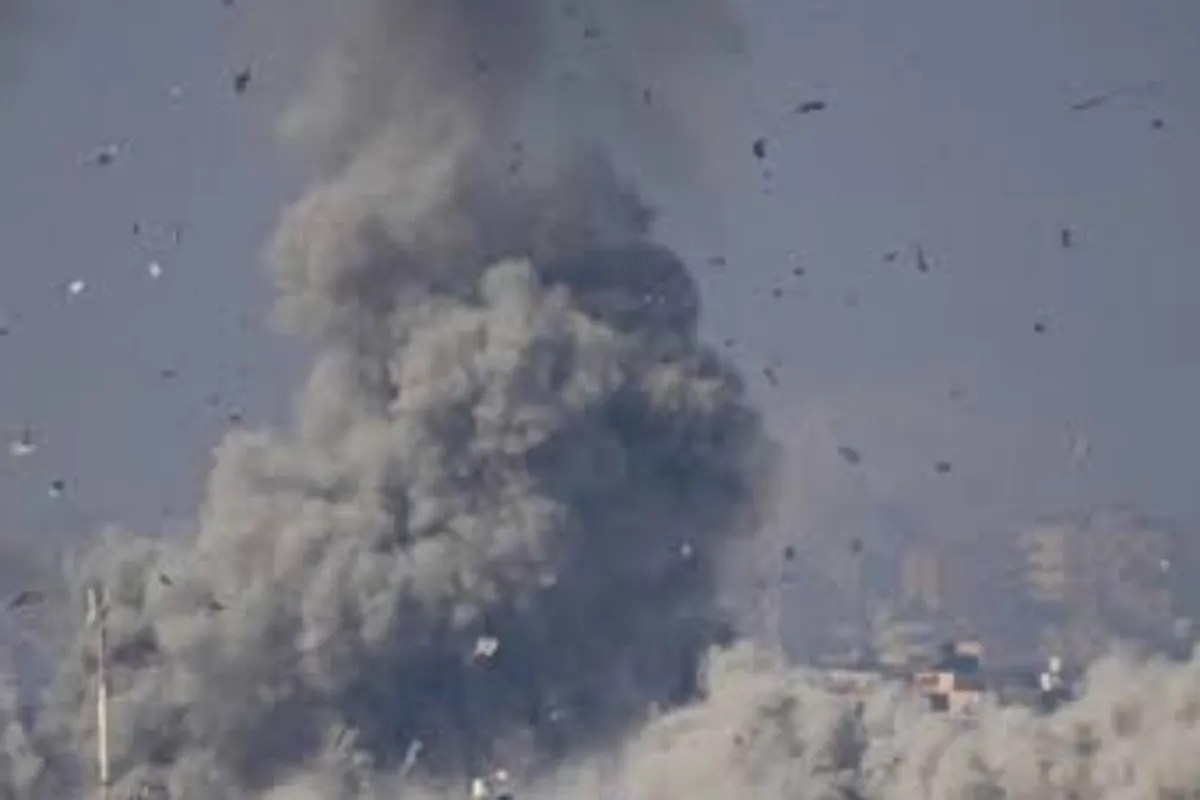
Two militants neutralized. A precision strike. A tactical victory announced with solemn gravity across news tickers and official bulletins.
Breathe out. It means nothing.
In the theater of modern asymmetric warfare, the obsession with tactical body counts is a comfort blanket for institutions that have lost the plot. When media outlets and military commands hyperventilate over every isolated skirmish, every eliminated squad leader, and every targeted cell, they are participating in a comforting ritual of managed illusion. They want you to believe that arithmetic equals strategy. They want you to measure progress by counting bodies dropped into the dirt.
It is a lie. Not because the military actions aren't happening, but because the metric itself is bankrupt.
Let us dismantle the lazy consensus governing modern counter-insurgency reporting. For decades, state militaries have relied on attrition metrics to justify campaigns against decentralized, ideological insurgencies. The premise is seductive in its simplicity: kill enough of them, and the organization collapses.
History laughs at this premise.
Look at the empirical record. In Vietnam, body counts were published weekly like sporting scores. The United States military killed hundreds of thousands of Viet Cong and North Vietnamese soldiers. By pure tactical attrition, the American armed forces won virtually every major engagement. And yet, the war was a catastrophic strategic defeat. Why? Because an asymmetric insurgency is not a conventional nation-state army whose center of gravity resides in standing divisions. It is an adaptive political-military movement rooted in grievances, narratives, and social structures.
When you kill two fighters in a basement or a ruined street, you have not decapitated an ideology. You have cleared a seating assignment. Within forty-eight hours, another recruit fills the slot, often driven by a freshly minted grievance born from the kinetic operation that killed his predecessor.
To understand why tactical success so frequently masks strategic failure, we must examine the fundamental mechanics of attrition in cellular warfare.
Traditional military doctrine, derived from Clausewitz and refined through centuries of state-on-state conflict, assumes that destroying the enemy's armed forces breaks their political will. But when the enemy is an underground network embedded within civilian populations, the physics invert. Every kinetic strike carries an invisible administrative cost. Buildings collapse. Non-combatants are caught in the crossfire. Families are displaced. Each of these collateral events acts as a recruitment catalyst for the insurgency.
Think of it as a closed-loop economic system. The state injects kinetic energy into the system, aiming to destroy capital assets, namely, personnel. But the very act of injection generates emotional capital for the opposition. Friends, relatives, and neighbors of collateral casualties become radicalized. The recruitment pipeline replenishes itself faster than the military can deplete it.
Military analysts call this friction. I call it professional self-delusion.
Commanders love body counts because they are quantifiable. They provide a neat line on a PowerPoint slide going up or down. A politician can point to a weekly tally of eliminated fighters and tell a weary public that progress is being made. It creates an illusion of momentum. But momentum in the wrong direction simply accelerates your arrival at a dead end.
Consider the mathematics of replacement. An organization operating as a decentralized cellular network does not require a complex logistics chain to train basic foot soldiers. Basic operational training for urban guerrilla warfare takes weeks, sometimes days. Meanwhile, the state invests millions of dollars, years of intelligence gathering, and immense geopolitical capital to execute a single high-profile kinetic strike. The asymmetry is staggering. You are spending a Lamborghini to capture a bicycle, and then patting yourself on the back when the bicycle is smashed to pieces.
The mainstream press report these tactical vignettes with breathless reverence. They treat each skirmish as a turning point. They analyze the weaponry used, the tactical entry angles, the intelligence sources, and the precise coordinates. This granular focus is a trap. It zooms the lens in so tight that you miss the entire terrain burning around the frame.
By focusing relentlessly on the tactical minutiae of two dead militants, the coverage actively obscures the strategic vacuum. It begs a question that nobody in the official command structure wants to answer: What is the political endgame?
If the elimination of two fighters does not alter the structural grievances, does not dismantle the ideological apparatus, and does not provide a viable alternative governance model for the territory, then what was achieved? The answer is: tactical motion without strategic displacement. You are running on a treadmill at maximum speed, sweating profusely, convincing yourself you are traveling across continents, while remaining bolted to the exact same floor tile.
To break this cycle, we must discard the vocabulary of body counts and confront the brutal realities of political anthropology. Insurgencies survive not because they possess superior firepower, but because they occupy a socio-political niche that the state has failed to govern effectively or legitimately. When a state relies solely on kinetic force to solve a political crisis, it is applying a surgical tool to a systemic infection. You do not cure sepsis with scalpels, no matter how sharp or precisely wielded those scalpels might be.
Let us run a mental experiment to illustrate the point. Imagine a territory completely sealed off, where every single active militant identified by intelligence is systematically hunted down and eliminated over a fixed timeframe. Every sniper neutralized, every tunnel commander cornered, every rocket cell dismantled. Total tactical saturation.
Does peace automatically bloom from the rubble?
History answers with a resounding negative. Total tactical victory without political reconciliation simply creates a vacuum. That vacuum is invariably filled by an even more radical, hardened successor organization that learns from the tactical failures of its predecessor. We saw this exact dynamic play out across multiple theaters in the Middle East and Central Asia over the past three decades. Every generation of kinetic crackdown produces a more resilient, more ideologically hardened adversary. The insurgency mutates. It evolves.
And yet, institutional inertia keeps the military-media complex locked into the same repetitive loop. Announce the strike. Count the dead. Reassure the public. Repeat.
Why does this persist? Because admitting that tactical victories do not equal strategic success requires institutional courage that modern bureaucracies simply do not possess. It requires generals and politicians to admit that military force has a hard ceiling. It requires acknowledging that dropping ordnance on a problem cannot fix a broken political reality.
Admitting limits is bad for career progression. So the fiction continues. The press acts as a willing stenographer for military public relations offices, regurgitating tactical body counts as proof of winning, while the strategic foundation crumbles beneath their feet.
The political economy of defense reporting thrives on this superficiality. Quick headlines about eliminated targets require zero cognitive effort from the audience. They offer a neat moral binary: good guys strike, bad guys fall. Complex questions regarding civilian infrastructure, long-term occupation costs, diplomatic stagnation, and generational radicalization are messy. They do not fit neatly into a thirty-second news segment or a breathless social media post. Consequently, both media organizations and state mouthpieces have a mutual interest in sustaining the body count illusion.
Furthermore, we must examine the limits of intelligence-led targeting. Modern surveillance technology creates an intoxicating sense of omniscience. Drone feeds, signal intercepts, and facial recognition allow commanders to track individual targets with terrifying precision. This technological capability creates a dangerous psychological trap: because we can strike a target anywhere, anytime, we assume we must strike it, and that doing so moves the needle. But tactical omniscience is not strategic insight. Knowing the exact GPS coordinates of two militants tells you nothing about the structural health of the network they belong to, nor does it measure the swelling hostility of the surrounding civilian populace.
Look at historical counter-insurgency campaigns that actually achieved sustainable outcomes, such as the British campaign in Malaya or the stabilization of Northern Ireland through the Good Friday Agreement. In neither case did security forces simply kill their way to victory. In Malaya, success hinged on population control, resettlement, and severing the insurgency from its logistical and civilian support base, coupled with a clear political promise of self-governance. In Northern Ireland, the grinding military stalemate was broken only when leaders accepted that a political settlement required engaging with the underlying political grievances rather than relying on endless security sweeps.
In contrast, wherever militaries rely purely on tactical attrition, the conflict stretches into infinity.
If you want to evaluate whether a campaign is actually succeeding, stop looking at the casualty statistics of the enemy. Stop counting dead militants. Those numbers are vanity metrics designed to soothe anxieties at home. Instead, look at three harsh indicators.
First, examine the replacement rate. Is the adversary finding it harder to recruit, or are their ranks swelling with vengeful youth? If recruitment remains constant or accelerates despite high casualties, your kinetic strategy is failing.
Second, examine governance and legitimacy. Who controls the narrative, the local services, and the daily administration of life in the contested zones? If the civilian population views the state purely as an occupying kinetic force rather than a provider of security and order, you are losing, regardless of how many tactical targets you check off your list.
Third, examine the political horizon. Is there a credible, negotiated diplomatic framework capable of absorbing the conflict's root causes, or is the strategy reduced to an endless cycle of security sweeps? If there is no political track, military operations are not a solution; they are a permanent condition.
The report of two militants killed is not news. It is noise. It is a microscopic tactical event inflated by a media ecosystem addicted to kinetic drama and incapable of structural analysis.
Until we stop treating body counts as proof of victory, we are doomed to repeat the same bloody, expensive mistakes, mistaking the sound of gunfire for the dawn of peace.
Stop counting the dead. Start examining the war you are actually losing.


