The Setup
Steel bars tell a specific kind of lie. They whisper of permanence. They encourage guards to lean heavily on wooden desks, to let their eyelids droop during the humid afternoon glare, to trust in the sheer, unyielding weight of concrete and iron.
Inside a maximum-security facility in the Philippines, a prisoner understood the nature of that lie better than anyone else. He was a man who had already traded his life in South Korea for a cage abroad, yet his mind remained entirely free. It plotted. It calculated. Most importantly, it looked up.
While everyone else watched the heavy wooden doors and the razor-wire perimeter fences, he looked at the open sky.
Walls only stop horizontal movement. They are entirely blind to the vertical dimension. For a man facing a lifetime of institutional gray, the open air above the exercise yard represented a quiet, frictionless corridor. No guards stand on the clouds. No patrol cars drive across the wind.
Yet, planning a modern escape requires a modern key. You cannot tunnel through granite when your cell sits on the second tier. You cannot bribe an entire nation's radar network with smuggled cigarettes. Instead, you need something small, quiet, and capable of lifting a human being’s desperate ambitions into the air.
You need a machine with rotors.
The Engineering of Hope
Imagine sitting in a cramped, poorly lit cell, illuminated only by the harsh glare of a single overhead bulb. Around you, the symphony of prison life drones on—shouting down the concrete corridors, the metallic clatter of meal trays, the endless shuffling of rubber sandals.
On your makeshift desk sits a controller.
This was not a toy bought from a department store shelf. It was assembled piece by piece, a Frankenstein monster of carbon fiber, brushless motors, and high-capacity lithium polymer batteries. To an outside observer, it looked like a complex hobbyist project. To the man building it, it was an ark.
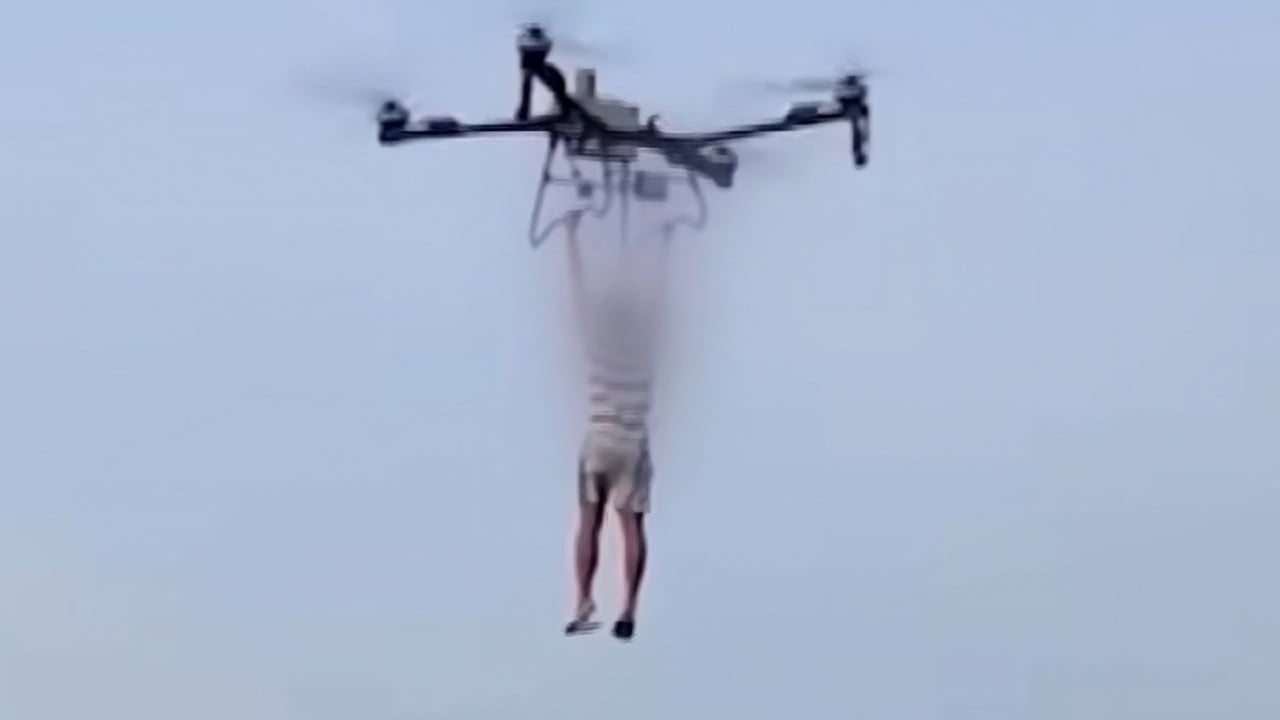
The strategy relied on a terrifying gamble. Commercial drones are loud. They buzz like angry hornets, drawing every pair of eyes within a half-mile radius. A heavy-lift drone capable of bearing the weight of a grown man—or at least carrying a payload that could compromise a fence—demands immense power.
He tested it in miniature first. He flew small quadcopters within the confines permitted to him, learning the subtle shifts of air currents inside a walled courtyard. He watched how the tropical wind bounced off concrete barriers, creating invisible eddies and downdrafts that could smash a fragile craft against a wall in a fraction of a second.
Every propeller spin was a rehearsal for a moment that had to go off without a single flaw. One second too early, and the guards would hear the whine of the motors. One second too late, and the battery would die mid-flight, plunging his exit strategy into the dirt.
He was counting on technology to do what human muscle never could.
The Pivot Point
There is a moment in every elaborate conspiracy where the architecture of the plan meets reality. Reality is notoriously uncooperative.
Outside the prison walls, accomplices waited. They had secured the hardware. They had mapped the blind spots in the facility’s perimeter defense. They understood that guards look outward, toward the streets, or inward, toward the cell blocks. They rarely look straight up at an angle of forty-five degrees.
The plan was audacious in its simplicity. A heavy-lift aerial vehicle would traverse the perimeter wall under the cover of night or dusk, drop a line or a cutting tool, or perhaps serve as an aerial scout to guide a physical breach.
The details were meticulously recorded. And that was the fatal flaw.
Modern conspiracies leave digital exhaust. In this case, the proof of the ambition was captured not just in whispered phone calls, but in test footage. Somewhere on a memory card, the drone had recorded its maiden voyage. It hovered over a secluded field, its four rotors kicking up dust, testing its payload capacity, balancing its center of gravity.
Law enforcement agencies, monitoring digital trails across borders, intercepted the evidence. They did not need to wait for the escape to happen. They watched the blueprint execute itself on a digital screen weeks before the real attempt could ever clear the prison yard.
When investigators raided the holding areas, they didn't find a dramatic tunnel or a smuggled guard uniform. They found circuit boards, lithium cells, and the silent, damning video file.
The Aftermath
The quiet hum of a quadcopter ceased before it ever reached the prison walls.
In the cold light of the interrogation room, the grand escape looked small. The brilliant engineering reduced to scattered plastic and twisted wiring on a metal table.
We build walls to keep people in, but we forget that innovation does not care about masonry. A prisoner staring at the sky realizes long before anyone else that the future belongs to things that fly. The guards rely on the weight of history; the escapee relies on the lightness of engineering.
For now, the sky above the prison remains empty. The guards still watch the doors. But somewhere, someone else is looking up, wondering how much weight a rotor can lift when you have nothing left to lose.


