The water looks perfect from the kitchen window.
From fifteen feet away, it is a flawless rectangle of turquoise, shimmering under the June sun like a postcard from a resort you cannot quite afford. It promises everything summer is supposed to be: rest, laughter, the cool shock of relief on a hundred-degree afternoon.
Then you walk out the back door. You step onto the concrete. You look down.
The illusion dissolves. There, resting on the bottom steps, is a dark, sprawling constellation of dead oak leaves. Across the deep end lies a fine, velvet coat of yellow pine pollen, shifting slightly in the current of the return jets. In the corner, a plastic green army man left behind by a seven-year-old sits trapped in a miniature tumbleweed of hair, dirt, and unidentifiable organic silt.
Suddenly, the oasis feels like an obligation. The water is no longer a luxury; it is a second job that does not pay.
For decades, suburban folklore insisted that the only way to cure this specific anxiety was through manual labor. We were told to stand under the blistering sun with a sixteen-foot aluminum pole, dragging a plastic vacuum head across the plaster, moving at the agonizing pace of a glacier to avoid stirring the debris back into the water column. It is a meditative act for about four minutes. After that, it is just a theft of time.
The standard industry guides will tell you to buy a pool cleaner because it maintains your chemical balance and protects your plaster. They are not wrong, but they are missing the point. You do not buy a pool vacuum to save your pump. You buy it to save your Saturday mornings.
The Anatomy of a Backyard Dictator
To understand why pool maintenance breaks so many spirits, consider the hypothetical case of a homeowner we will call Sarah. Sarah bought a house with a gorgeous 20,000-gallon inground pool in the spring. She envisioned pool parties, quiet evening swims, and reading paperbacks on a lounge chair.
Instead, Sarah became an unwitting technician. She learned about total alkalinity, cyanuric acid, and the infuriating mechanics of suction-side cleaners.
For the uninitiated, the pool world splits its automated labor into three distinct camps. The oldest, most stubborn of these is the suction cleaner. These devices plug directly into your pool’s skimmer or a dedicated suction line. They rely entirely on your main pool pump to pull water through them, moving erratically across the floor like a blind, hungry beetle.
Sarah’s house came with one of these. Every Saturday, she had to drag out a fifty-foot corrugated hose, fill it completely with water to purge the air, and cram it into the skimmer wall. If the hose sucked in a pocket of air, the pump lost prime, the motor screamed, and Sarah ran across the yard in a panic, fearing a thousand-dollar repair bill. When the cleaner actually worked, it frequently choked on the heavy oak leaves dropping from her neighbor’s yard, clogging the pump basket within twenty minutes.
This is the hidden cost of the budget option. Suction cleaners are inexpensive upfront, but they demand your presence. They do not run while you sleep; they run while you watch them, waiting for the inevitable clog. They turn your main filtration system into a garbage disposal, forcing your primary pump to work twice as hard, which shortens its lifespan and inflates your electric bill.
Then there are pressure-side cleaners. These are the historical workhorses of the American backyard, recognizable by the sweeping white tails that whip behind them to stir up fine debris. Unlike suction units, they attach to a return jet and use water pressure to push themselves around, shoving leaves into an attached mesh bag.
They are remarkably durable, but they have a fatal flaw: most require a dedicated booster pump. That means when you build or retro-fit your pool, you are plumbing a second, noisy motor into your equipment pad. It is a mechanical ecosystem that works, but it feels distinctly twentieth-century—loud, power-hungry, and dependent on a complex web of valves and timers.
Sarah endured this choreography for exactly four weeks before she realized she was spending more time servicing the pool than swimming in it. The water was clear, but the human cost was too high.
The Shift to Digital Domesticity
The turning point happens when you realize that your pool does not need to be tethered to your house's main plumbing.
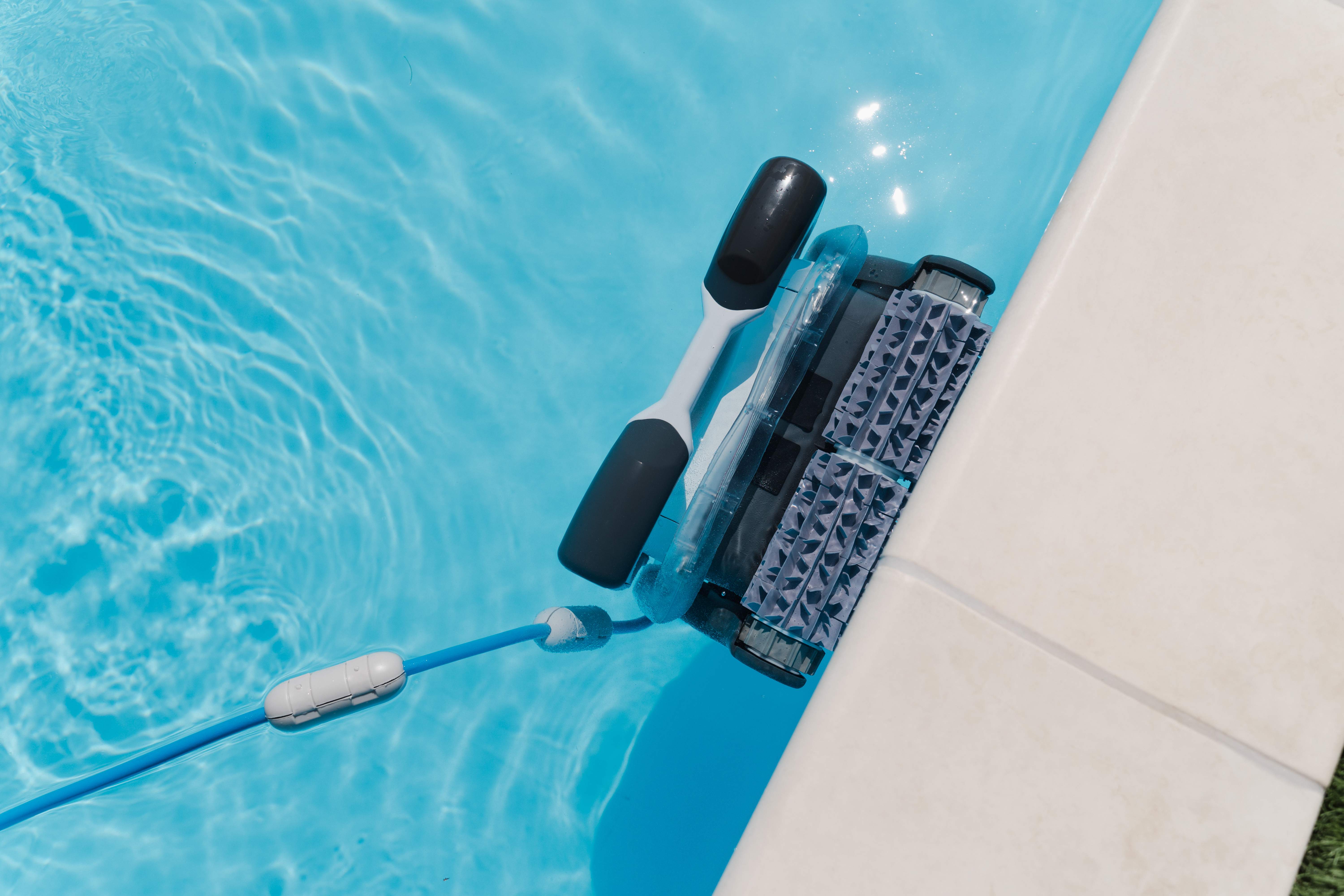
Enter the robotic pool vacuum. This is not a slight upgrade; it is a complete philosophical shift. Robotic cleaners operate completely independently of your pool’s pump and filter. They plug into a standard ground-fault outlet, drop into the water, and use their own internal motors to create localized suction while driving themselves across the floor.
Imagine a machine that does not care if your skimmer basket is full. Imagine a device that filters water down to two microns—fine enough to capture microscopic algae spores—before that dirty water ever reaches your main sand or cartridge filter.
When you drop a modern robotic cleaner like a Dolphin Nautilus or a Polaris VRX into the water, the experience is strangely jarring. There is no priming. There is no wrestling with a stiff, floating hose. The machine sinks quietly to the bottom, hums to life, and begins an calculated, algorithmic scan of the pool floor.
The engineering inside these plastic boxes is brilliant because it addresses the fluid dynamics of a wet box. A pool is a terrible environment for a robot. It contains sharp ninety-degree angles, slippery vinyl or tile steps, and a constant shifting weight of water. Early robots got stuck on main drains constantly, spinning their wheels helplessly until a human rescued them.
Today’s high-end units use internal gyroscopes and software to map the topography of your pool. If they hit a bottom drain, they sense the change in resistance, reverse their tracks, and angle around it. When they encounter a vertical wall, they do not turn back; they climb. They drive right up the plaster, using specialized rubber brushes to scrub the waterline where oils and dirt form an ugly ring, then hold themselves there against gravity through sheer water displacement.
For Sarah, investing in a robotic cleaner felt like an admission of defeat at first. It was an expensive piece of technology for a problem she felt she should be able to solve with elbow grease. But the first night she dropped it in, poured a glass of wine, and watched the machine swallow a massive pile of leaves from the deep end while she sat on the patio, the calculus changed.
The machine was doing the work. She was just a bystander.
The Reality of the Grid
It is easy to romanticize this technology, but a master storyteller must also be an honest reporter. Robots are not perfect. They are heavy.
Lifting a unit that has just filled itself with twenty pounds of water out of the deep end requires a surprising amount of core strength. If you have lower back issues, pulling a premium robot onto the deck can feel less like a luxury and more like a deadlift. This is why transport caddies exist, and it is why manufacturers have started engineering quick-release water valves that drain the machine's internal weight within seconds of breaking the surface.
There is also the question of cord management. Even the most advanced corded robots are prone to the "cable tangle"—a slow, twisting knot that forms as the machine loops around the pool over a three-hour cycle. Manufacturers have solved this with mechanical swivels that rotate infinitely without twisting the copper wires inside, but these swivels are wear-and-tear items. Eventually, they leak. Eventually, they need replacement.
This reality has driven the industry toward its newest frontier: cordless, battery-powered robots.
On paper, a cordless pool robot is the ultimate dream. You charge it on a docking station in the garage, drop it in, and let it run without a single wire trailing behind it. Machines like the Aiper Scuba series or the cordless variants from Madimack represent this new wave. They look sleek, futuristic, and unburdened.
But here is the truth you won't find in a glossy brochure: battery life in water is a brutal math problem. Water creates immense drag. Pushing a heavy machine through a liquid medium while running a high-RPM suction impeller drains lithium-ion batteries at an astonishing rate. Most cordless units give you ninety to one hundred and twenty minutes of run time before they park themselves by the pool wall, dead, waiting for you to hook them out with a pole.
If you have a small, geometric pool with light debris, a cordless robot is a revelation. If you live under a canopy of old-growth trees that drop twigs, acorns, and heavy foliage, that battery will often die halfway through the battle, leaving a half-cleaned pool and a robot stranded in the deep end. For heavy-duty maintenance, the umbilical cord of a traditional robotic cleaner remains a necessary compromise.
The Worth of a Wet Saturday
We measure the value of tools by the wrong metrics. We talk about horsepower, microns, gallons per minute, and warranty years. We calculate the return on investment based on chemical savings and fewer trips to the local pool supply store.
But the true metrics are emotional.
Think about the tension that builds when you know your backyard looks neglected. Think about the slight hesitation you feel before inviting friends over because you haven’t had the energy to skim the surface. Think about the quiet resentment of spending your only free morning of the week sweating in flip-flops, fighting a tangled hose while your family eats breakfast inside.
The right pool vacuum is not an indulgence. It is a boundary line drawn between your labor and your leisure.
When you find the machine that fits the specific architecture of your pool—whether it is a rugged pressure cleaner that handles your heavy leaf fall or an advanced robot that scrubs your tiles to a bright gleam—something shifts. The pool stops being a demanding master and goes back to being what it was always meant to be: an escape.
Tonight, the sun will set, casting a deep orange glow across the water. The surface will be completely still, free of leaves, free of dust, reflecting the sky like a giant mirror. The robot will sit quietly in its caddy on the deck, dripping dry, waiting for next week. You will look out the kitchen window, and you won't feel the urge to walk out and fix anything. You will just smile, turn off the light, and take your Saturday back.