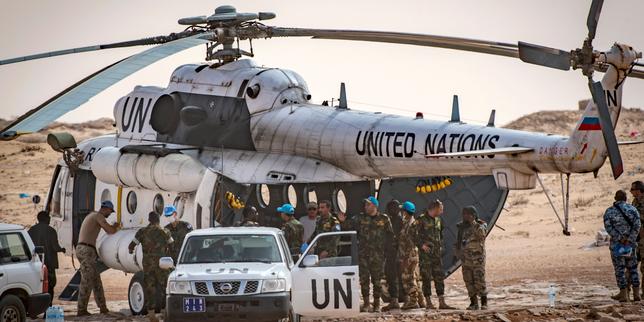
The wind in Laayoune tastes like salt and pulverized limestone. It gets into the gears of your watch, behind your eyelids, and deep into the crevices of white Toyota Land Cruisers parked outside compound walls topped with concertina wire.
For thirty-five years, those white trucks—stenciled with two black letters, UN—were the only punctuation mark in a sentence that refused to end. In other news, take a look at: Behind King Charles Walking Through Antigua’s Slavery Exhibition Before the Commonwealth Summit.
Then, suddenly, the engine stopped.
When news broke of the abrupt termination of MINURSO, the United Nations Mission for the Referendum in Western Sahara, diplomats in New York called it a procedural realignment. Pundits in Paris and Rabat called it overdue pragmatism. In the refugee camps outside Tindouf, where corrugated tin roofs rattle like dry bones in the Saharan night, nobody called it anything at all. They just stared at the static on their phones. USA Today has analyzed this critical subject in great detail.
Stop. Think about what thirty-five years actually means.
It is long enough for a child born under a canvas tent in 1991 to grow up, become a grandmother, and watch her own grandchildren trace maps in the dust of a homeland they have never touched. For over three decades, the international community maintained a fragile, expensive fiction: that a temporary peacekeeping force was simply holding the door open while two sides prepared for a vote. When that door finally slammed shut—not with a peace treaty, not with a ballot box, but with an unexpected administrative closure—it exposed a brutal truth about modern geopolitics.
We didn't solve the conflict. We just grew tired of watching it.
The Architecture of a Frozen Limbo
To understand why the sudden end of the UN mission in Western Sahara sends tremors far beyond the Maghreb, you have to strip away the acronyms and look at the dirt.
Picture a strip of desert roughly the size of Colorado, wedged between the Atlantic Ocean, Morocco, Algeria, and Mauritania. Beneath its sun-bleached gravel lie some of the richest phosphate reserves on earth—the raw mineral ingredient required to fertilize the world's crops—alongside teeming coastal fisheries and massive potential for solar and wind energy. Above ground lies a population split in two by a 2,700-kilometer wall of sand, landmines, and radar stations known as the Berm.
In 1991, after sixteen years of grinding desert warfare between Morocco and the pro-independence Polisario Front, the United Nations brokered a ceasefire. The promise was simple, clean, and democratic: the guns would fall silent, MINURSO would deploy to monitor the truce, and the indigenous Sahrawi people would vote in a referendum to choose between integration with Morocco or full independence.
That vote never happened.
Instead, the mission became a permanent fixture of the desert horizon, like a rusted derrick pumping air. Imagine hiring a referee for a championship boxing match, paying him for thirty-five years while the two fighters stand in opposite corners arguing over who is allowed in the ring, and then—without warning—turning off the stadium lights and sending the referee home. That is the exact anatomy of this diplomatic rupture.
Two Lives on Opposite Sides of the Sand
To feel the weight of what happens when neutral eyes leave a contested zone, consider a hypothetical pair of neighbors separated by that wall of sand—let us call them Youssef and Mariam.
Youssef is thirty-two, an electrical engineer living in Dakhla, on the Atlantic coast administered by Morocco. He grew up on paved boulevards built with billions of dirhams in state investment. To Youssef, the territory is the southern provinces of his country, a booming hub of kite-surfing resorts, desalination plants, and deep-water ports. When he hears that the UN mission is packing up, he feels a surge of vindication. For him, the blue helmets were an anachronism, an insult to Moroccan sovereignty that kept his city trapped in an asterisk on world maps.
Four hundred miles east, across the Berm and over the Algerian border near Tindouf, sits Mariam. She is also thirty-two. She has a degree in literature earned abroad, yet she lives in a mud-brick house reliant on World Food Programme rations. Her parents fled the war in 1975; she has never seen the Atlantic Ocean. For Mariam, the white UN trucks patrolling the buffer strip were not a bureaucratic annoyance. They were the last surviving proof that the world still acknowledged her existence, and that her exile had an expiration date.
When the mission ends unexpectedly, Youssef gets certainty. Mariam gets erasure.
And between them, the buffer zone—a bleak expanse of scrub and basalt where armed patrols once kept a respectful distance under the gaze of UN observers—suddenly goes dark.
Why the Plug Was Pulled Now
Diplomacy rarely dies from a single gunshot; it dies from starvation, shifting alliances, and quiet exhaustion.
Over the past decade, the geopolitical ground beneath Western Sahara shifted dramatically. A succession of major global powers—beginning with the United States in 2020, followed by Spain, France, and a growing coalition of African and Arab states—abandoned decades of cautious neutrality to endorse Morocco's autonomy plan as the only realistic basis for a solution. In their capitals, the word referendum quietly vanished from official communiqués, replaced by words like pragmatism, stability, and investment.
Inside the Security Council, the annual renewal of MINURSO's mandate had become an exercise in diplomatic theater. Every October, diplomats haggled over adjectives while the mission itself remained uniquely crippled: unlike almost every other modern UN peacekeeping operation, MINURSO never even had a mandate to monitor human rights. After the 1991 ceasefire collapsed into low-intensity skirmishes in November 2020, UN military observers were reduced to counting shell craters from a distance, barred from approaching active zones, their supply convoys routinely delayed.
I remember standing near a logistics staging area in the region years ago, watching a young UN logistics officer stare at a pallet of expired medical supplies stuck in customs limbo. He wasn't angry. He looked hollow. "We are paid to count the stones," he told me, wiping sweat from his forehead with the back of a dusty sleeve. "And nobody in New York wants to hear how many stones there are."
That exhaustion finally met a cold political calculus. With major powers eager to secure trade corridors, green hydrogen partnerships, and migration controls with Rabat—and with UN peacekeeping budgets bleeding cash amid crises from Sudan to Ukraine—the consensus snapped. Why fund a mission to organize a referendum that the world's most powerful nations had already decided would never take place?
The Danger of an Unwatched Border
It is tempting, from a comfortable distance, to view the end of a stalled mission as clean closure. If a bandage isn't healing the wound, rip it off.
Except in conflict zones, observers do not merely watch history; their presence alters the physics of violence.
Since 2020, the conflict in Western Sahara has smoldered as a forgotten war of attrition—drones humming over empty wadis, artillery shells lobbed across the Berm at dusk, communiqués claiming casualties that neither side allows journalists to verify. The only reason that low-grade fire did not erupt into a full-scale regional conflagration between Morocco and Algeria—two heavily armed neighbors whose diplomatic relations severed completely in 2021—was the tripwire of international presence.
Remove the observers, and you remove the witnesses.
Without UN patrols verifying troop movements in the buffer strip, miscalculation becomes inevitable. A reconnaissance drone straying too close to a border post, an ambush near a supply road, an unverified rumor of an incursion—any spark can ignite a wider confrontation when there is no neutral arbiter left to pick up the phone and separate the commanders. Worse still, a vacuum in the Sahara never stays empty for long. Just south of the border, across Mauritania and Mali, armed insurgent networks and smuggling syndicates thrive precisely where state authority and international oversight dissolve into the dunes.
A Precedent Written in Chalk
Step back from the map of North Africa, and the sudden exit of the blue helmets reveals an even colder reality.
For eighty years, the post-World War II international order rested on a flawed but vital promise: that borders could not be settled purely by patience and concrete, and that small, displaced populations would not simply be outwaited until they faded from memory. The United Nations was designed to be the world's institutional memory—the stubborn clerk who refuses to close the file until the ledger balances.
By winding down MINURSO without a mutually accepted political settlement, the international community has essentially admitted that time is now a legitimate weapon of conquest. If a state can hold territory long enough, build enough highways, attract enough foreign capital, and outlast the attention span of the Security Council, the file eventually gets shredded.
That message will not stay confined to the Sahara. It will be read carefully in every disputed valley, contested island, and frozen front line from the Caucasus to the South China Sea.
Back in Laayoune, the mechanics are already stripping the black UN decals off the doors of the white Land Cruisers. Under the harsh afternoon sun, the paint beneath the peeled vinyl looks slightly brighter, untouched by thirty-five years of blowing grit. Soon, those trucks will be repainted, reassigned, and shipped out to some newer, louder emergency.
The desert wind will blow across the tarmac by dusk, erasing the tire tracks until the sand looks as smooth and empty as a blank sheet of paper.


