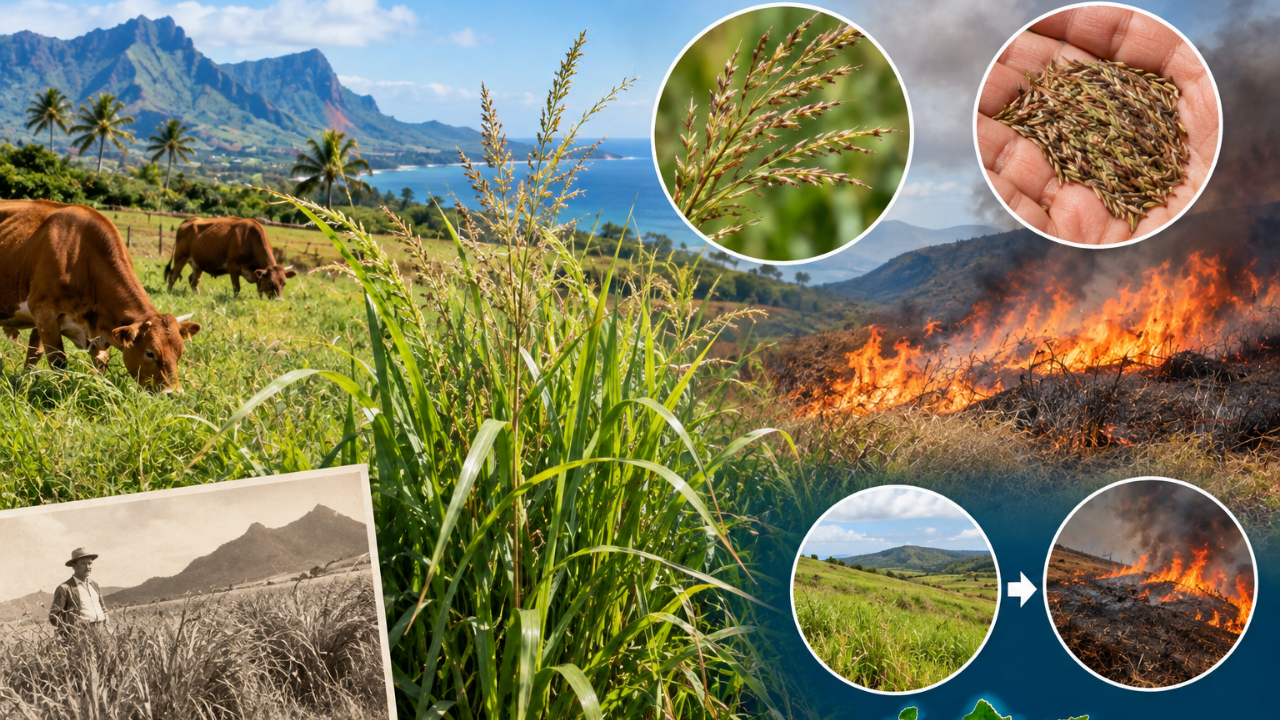
Every time a hillside smokes in the Pacific, the usual suspects crawl out of the woodwork to point a trembling finger at a single plant. They drag out the standard narrative: Guinea grass was imported back in the late nineteenth century as cattle feed, grew to towering heights, and now acts as an ecological time bomb waiting to spark. It is a neat, tidy story. It gives reporters a villain, conservation groups a steady stream of grant funding, and lazy pundits a convenient scapegoat for complex structural failures.
It is also completely backwards.
I have spent decades watching environmental management agencies miss the forest for the weeds—literally. Blaming an aggressive pasture grass for catastrophic modern fires is like blaming the match while ignoring the five-gallon drum of gasoline spilled all over the floor. The lazy consensus relies on a comfortable fiction: that nature was pristine and balanced before humans brought in foreign species, and if we just eradicate the aliens, the paradise returns.
Real land management does not work on nostalgia. It works on thermodynamics, fuel loads, and human choices.
The Myth of the Untouched Eden
The standard line on Guinea grass reads like a Victorian morality play. Introduced in 1883 from Africa to feed cattle in the islands, Megathyrsus maximus did what any resilient C4 grass does when placed in a tropical climate with disturbed soil. It grew. It produced thousands of seeds. It established dense stands.
Conservationists look at this massive biomass and panic. They see nine-foot walls of vegetation and assume the plant itself is malicious. They quote the seed counts and the growth rates as if high productivity is a moral failing.
Nature does not care about your native plant registry. Evolution is ruthlessly pragmatic. When you abandon hundreds of thousands of acres of agricultural land, stop grazing cattle, pull out the irrigation, and let the soil sit under a blazing sun, something is going to grow there. If it is not Guinea grass, it will be buffelgrass, fountain grass, or koa haole.
The obsession with nativism in ecology has crossed the line from science into xenophobia. We spend millions trying to restore ecosystems that haven't existed for five hundred years while ignoring the operational reality on the ground today. Guinea grass didn't invade the islands on a pirate ship; it was invited here by farmers who needed to feed livestock. When the plantation economy collapsed, nobody picked up the tab for managing the landscape left behind.
That is the real origin story of the fire hazard. Not a grass, but an economic vacuum.
Why High Biomass is a Symptom, Not the Disease
Let us look at the mechanics of the plant itself. Guinea grass thrives because it is exceptionally good at capturing sunlight and converting it into organic matter. In a functioning pasture, cattle eat that matter down to the dirt. Cows are biological lawnmowers. They convert invasive biomass into protein and milk while keeping fuel loads dangerously low.
Then the activists and land managers chased the cattle away.
Imagine a scenario where you ban all grazing from a dry, abandoned ranch, walk away for twenty years, and express shock when the fuel load reaches critical mass. That is not an ecological crisis; that is basic physics. If you remove the herbivores, you must replace them with mechanical clearing, prescribed burns, or intensive land management.
Instead, agencies let the land go wild, choked off the water rights, cut the budgets for brush clearing, and then acted surprised when a lightning strike or a downed power line turned a tinderbox into an inferno.
Blaming the grass for growing is like blaming a sponge for being wet. The plant is simply doing what biology programmed it to do: fill an empty niche. If you want the grass to stop acting like fuel, you have to change the conditions that turn it into fuel.
The Data They Ignore
Look past the hysterical press releases and examine what actually happens when Guinea grass is left unmanaged versus when it is actively utilized. In dry tropical zones, fine fuels are inevitable. Whether it is an introduced grass or an aggressive native shrub, abandoned land dries out during the summer drought.
The difference is that Guinea grass actually has economic utility. It is one of the most productive forage crops in the tropics. When managed correctly through rotational grazing, it provides dense ground cover that prevents erosion, outcompetes even worse fire hazards, and feeds livestock.
The disaster happens when land is locked up, abandoned, and forgotten. Environmental groups lobby to convert former ranches into nature reserves, but they fail to fund the massive ongoing labor required to maintain a reserve in a dry climate. You cannot just draw a boundary on a map, call it a sanctuary, and walk away. A sanctuary without maintenance is just a fuel depot.
The statistics cited about seed production—millions of seeds per acre over a season—are weaponized to induce panic. But seed count only matters if the seeds have open, disturbed soil to colonize. Healthy, diverse canopies resist invasion far better than sterile, chemically sprayed wastelands.
What Actually Works
If we want to stop watching hillsides burn, we have to stop looking for magical eradication programs. Spraying glyphosate by the tanker load or pulling grass by hand on steep cliffs is an expensive exercise in futility. Nature bats last, and she has a much bigger budget than your local department of land and natural resources.
Real mitigation requires structural changes that make conservationists uncomfortable.
First, bring back the cows. Rotational high-intensity grazing is the single most effective tool for managing tropical fine fuels ever invented. Four-legged mowers do not require fossil-fuel-guzzling weed whackers, they do not cause chemical runoff into the reefs, and they pay for themselves by producing food.
Second, stop treating abandoned agricultural land as a blank canvas for pristine wilderness. It is an industrial ruin. Treat it like one. If a piece of land is prone to fire, establish green breaks, maintain fuel-free perimeters around communities, and stop prioritizing ideological purity over human safety.
Third, accept that the historical baseline is gone. The climate has shifted, the species mix is permanent, and trying to turn the clock back to 1778 is a fool's errand. You manage the ecosystem you have, not the one you wish was there.
The next time you read a headline blaming a foreign plant for a local disaster, ask yourself who benefits from that narrative. It is always easier to fight a weed than it is to fix systemic zoning failures, neglected infrastructure, and decades of absentee land stewardship.
Tear down the fences, put the animals back on the hills, and stop blaming the grass for doing its job while you refuse to do yours.


