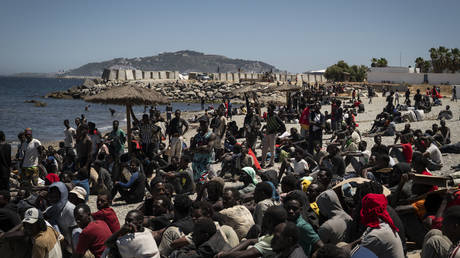
The footage loops endlessly across cable news networks. A surge of humanity at the border fence, batons swinging, tear gas hanging heavy in the Mediterranean air, and pundits wringing their hands over the collapse of humanitarian order at Europe's southern gates. The lazy consensus is immediate, predictable, and entirely useless. Watchers point fingers at border guards, accuse governments of moral failure, or decry the brutal efficiency of perimeter defense. Everyone is arguing about the symptoms while ignoring the structural engine driving the entire machine.
Blaming the violence in Ceuta on security tactics is like screaming at a thermometer for registering a fever.
I have spent years watching policymakers construct administrative band-aids over systemic arterial bleeding. Every time a crossing turns violent, the predictable theatre replays itself. Human rights organizations issue sharp rebukes, politicians demand more funding for containment, and the public gets caught in a cycle of outrage. Meanwhile, the fundamental economic gravity pulling people toward these enclaves remains completely unaddressed.
The Economics of Desperation Nobody Wants to Calculate
Let us look past the emotional veneer of the media coverage and examine the mechanics. Ceuta and Melilla are unique geographical anomalies. They are European Union soil planted firmly on the North African coast. For anyone trapped in a regional economy choked by youth unemployment and institutional stagnation, those fences represent the literal dividing line between destitution and survival.
Conventional analysis treats migration pressure as a humanitarian crisis to be managed with better crowd control or softer diplomatic agreements. That is an expensive delusion. It is an economic calculation. When the expected utility of risking a border breach outweighs the risk of injury or deportation, rational actors move. No amount of razor wire or crowd-dispersion gear alters that mathematical equation.
Security forces do not create the pressure; they absorb it. When borders are designed as hard binary walls separating stark economic realities, violence is not an aberration of the system. It is a mathematical certainty. Every reinforcement of the perimeter simply raises the stakes, driving desperate people toward more coordinated, high-risk mass rushes.
The Policy Theatre of Containment
Governments love visible barriers because walls are political performance art. They project strength to domestic electorates who want to see sovereign control stamped onto a map. But physical barriers without functional economic integration or legal pathways act as pressure cookers.
Consider how the dialogue frames the situation. The debate always centers on how much force is acceptable or how many processing centers can be expanded on the European side. Notice what is missing from every mainstream panel discussion: an honest appraisal of bilateral labor agreements and regional economic development that actually scales.
We throw millions at border fortification while underfunding the structural reforms needed in source countries. We act surprised when a massive economic gradient produces friction. If you build a dam across a rising river without spillways, the water does not politely wait for permission to overflow. It destroys the dam.
Dismantling the Humanitarian Binary
The public discourse is trapped in a false binary. You are either told to view border enforcement as fascist oppression or as necessary civilizational defense. Both positions are intellectually lazy.
Border guards deployed to Ceuta are placed in an untenable position, tasked with managing a macroeconomic failure with a riot shield. Criticizing individual tactical responses without acknowledging that the entire containment strategy is structurally bankrupt is intellectual cowardice. It allows politicians to pretend they have a policy when they merely have a containment protocol.
The uncomfortable truth is that Europe relies on undocumented labor to prop up sectors like agriculture, construction, and caregiving, even as it criminalizes the entry vectors required to supply that labor. This hypocrisy is the bedrock of the entire crisis. We want the cheap labor without the legal infrastructure, and the border violence is the inevitable invoice for that cognitive dissonance.
What Real Reform Looks Like
If we want to stop the recurring spectacle of violence at the fences of Ceuta, we have to abandon the fantasy of total containment. Borders cannot function as economic vacuum seals.
Real solutions require dismantling the black-market smuggling networks by replacing them with transparent, demand-driven labor mobility frameworks. That means tying seasonal work visas directly to economic sectors that desperately need workers, paired with strict enforcement of domestic labor laws to eliminate exploitative undercutting. It means treating migration as a supply-and-demand reality rather than an existential military threat.
Until policymakers stop treating border control as a substitute for actual foreign policy and economic strategy, the footage will not change. The batons will swing, the tear gas will clear, and the next wave will gather at the fence.
Stop asking how to make the walls higher. Start asking why the people on the other side have nothing left to lose.


